Get Full Government Meeting Transcripts, Videos, & Alerts Forever!
Get email alerts on the Cannabis Regulation topic
No spam. Unsubscribe anytime.
Council amends cannabis retail ordinance to narrow local role to zoning confirmation; broader retail rules left to state
Summary
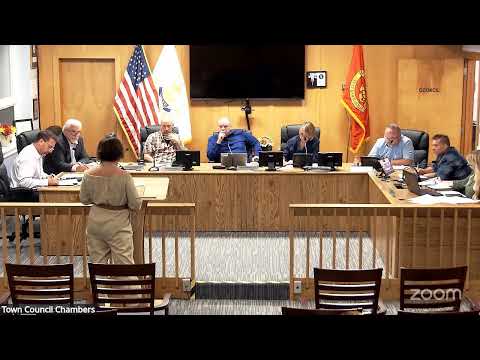
The Town Council amended its cannabis retail ordinance on Oct. 7 to limit the town’s role to confirming whether a proposed retail site is in a zoning district the town allows for cannabis retail (B or CI), while leaving licensing decisions to the state Cannabis Control Commission.
The Town Council considered amendments to its cannabis retail ordinance on Oct. 7, narrowing local review to whether a proposed retail site is located in a zone the town has designated as allowable rather than conducting a full local licensing review.
Town solicitor/attorney Al (transcript) — who presented the amendment — summarized the change as removing local special-use hearings and instead providing a simple zoning confirmation: when the state notifies the town that an applicant has sought a cannabis retail sales license, the building official checks whether the property is in a B or CI commercial zone; if so, the town notifies the state that the location is within a permissible zoning district. That approach, Al said, reduces town processing costs and recognizes that the Cannabis Control Commission (CCC) will exercise licensing authority and regulatory oversight.
Councilors and members of the public asked about potential secondary impacts, including onsite odor, queuing outside stores, music or other noise, and proximity to day-care centers. Several councilors said the town already regulates public smoking and vaping and can adopt reasonable, nonconflicting safeguards. One councilor asked whether the town could impose a 500-foot buffer from private homes; staff and the presenter said such broad buffers can be impracticable in compact Rhode Island villages and may conflict with state law. Council members noted cultivators already operate under state permits and that the fire department reviews cultivation sites for safety rather than local licensing scrutiny.
The council approved an amendment (entered in the record as 25-6.1) that retains the town’s right to designate which zoning districts permit retail sales but limits the town’s process so that, once the building official confirms a proposed location is in a permitted zone, the remaining licensing and operational approvals are handled by the state CCC and by state regulatory processes.
Councilors emphasized that this amendment does not preclude the town from enforcing municipal nuisance, noise, public smoking restrictions or other applicable ordinances if retail activity creates local problems. The council also discussed but did not adopt local distance buffers from private homes; members said those strict buffers would likely be impracticable in parts of town with mixed residential and commercial development.
Ending: The council’s amendment simplifies the town’s review role to zoning confirmation for retail cannabis locations in B and CI zones and preserves municipal enforcement authority on issues such as public smoking, noise and nuisance. The amended ordinance moves the bulk of licensing and operational oversight to the state Cannabis Control Commission.