Get Full Government Meeting Transcripts, Videos, & Alerts Forever!
Minnesota hearing: HR 1 changes and federal cuts threaten SNAP, food banks and local food systems
Summary
A Minnesota Senate subcommittee heard testimony Oct. 1 that federal changes in HR 1, USDA program cuts and declines in TFAP shipments will reduce SNAP benefits, shift administrative costs to counties and leave food banks and farmers markets stretched beyond capacity.
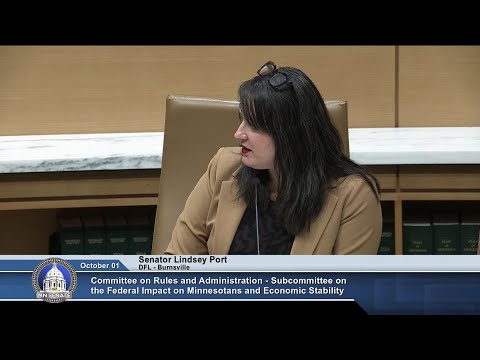
A Minnesota Senate subcommittee convened Oct. 1 to review how federal policy and budget changes are already shaping food access in the state, and multiple witnesses told lawmakers that the combination of HR 1 provisions and reduced USDA support will increase hunger, shift costs to local governments and strain food shelves, food banks and farmers.
Second Harvest Heartland researchers told the committee that a new, statewide food-security scale shows a broader role for the emergency food network than is captured by typical measures. Sophie Wallerstedt, public affairs manager for Second Harvest Heartland, said the group surveyed roughly 3,000 households (15% response rate) and classified households into four “stops” on a food-security continuum. She said the survey found about 2% of households had not had enough food and did not access help; 5% lacked enough food but did access assistance; 13% had enough food only because they relied regularly on SNAP, food shelves or other supports; and about 81% were fully food secure without assistance. “One in five Minnesota households are food insecure — do not have enough food without the help of the network,” Wallerstedt said.
Wallerstedt and other testifiers warned that several HR 1 provisions will make that insecurity worse. Wallerstedt summarized the major program changes the committee discussed: the federal administrative reimbursement for counties will shift from a roughly 50/50 split to 25% federal / 75% state-and-county; states will begin paying a portion of SNAP benefit costs tied to a payment-error rate beginning Oct. 1, 2027; expanded work requirements and other eligibility changes will require thousands of adults to report work hours; and updates to how the Thrifty Food Plan is calculated will slow benefit growth as grocery prices rise. “Starting 10/01/2027 states will be required to pay a portion of benefits,” Wallerstedt said. Testifiers provided preliminary cost estimates: an $86 million to $127 million annual increase in state benefit costs (estimate range provided by witnesses), about $39 million in additional staff/administrative costs statewide, and 30,000–40,000 additional Minnesota adults who may be newly subject to work-reporting rules. Presenters also noted the thrifty food plan changes affect roughly 450,000 SNAP recipients in Minnesota.
Food banks, food shelves and local…
Already have an account? Log in
Subscribe to keep reading
Unlock the rest of this article — and every article on Citizen Portal.
- Unlimited articles
- AI-powered breakdowns of topics, speakers, decisions, and budgets
- Instant alerts when your location has a new meeting
- Follow topics and more locations
- 1,000 AI Insights / month, plus AI Chat