Get Full Government Meeting Transcripts, Videos, & Alerts Forever!
Get email alerts on the Food Security Snap Policy topic
No spam. Unsubscribe anytime.
Minnesota hearing: HR 1 changes and federal cuts threaten SNAP, food banks and local food systems
Summary
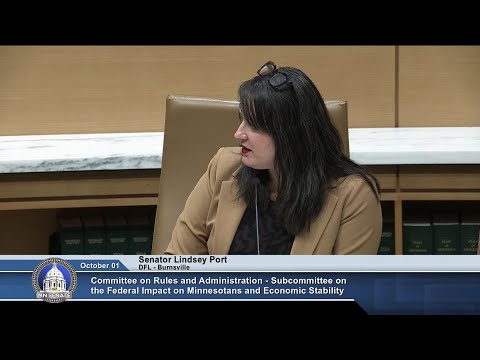
A Minnesota Senate subcommittee heard testimony Oct. 1 that federal changes in HR 1, USDA program cuts and declines in TFAP shipments will reduce SNAP benefits, shift administrative costs to counties and leave food banks and farmers markets stretched beyond capacity.
A Minnesota Senate subcommittee convened Oct. 1 to review how federal policy and budget changes are already shaping food access in the state, and multiple witnesses told lawmakers that the combination of HR 1 provisions and reduced USDA support will increase hunger, shift costs to local governments and strain food shelves, food banks and farmers.
Second Harvest Heartland researchers told the committee that a new, statewide food-security scale shows a broader role for the emergency food network than is captured by typical measures. Sophie Wallerstedt, public affairs manager for Second Harvest Heartland, said the group surveyed roughly 3,000 households (15% response rate) and classified households into four “stops” on a food-security continuum. She said the survey found about 2% of households had not had enough food and did not access help; 5% lacked enough food but did access assistance; 13% had enough food only because they relied regularly on SNAP, food shelves or other supports; and about 81% were fully food secure without assistance. “One in five Minnesota households are food insecure — do not have enough food without the help of the network,” Wallerstedt said.
Wallerstedt and other testifiers warned that several HR 1 provisions will make that insecurity worse. Wallerstedt summarized the major program changes the committee discussed: the federal administrative reimbursement for counties will shift from a roughly 50/50 split to 25% federal / 75% state-and-county; states will begin paying a portion of SNAP benefit costs tied to a payment-error rate beginning Oct. 1, 2027; expanded work requirements and other eligibility changes will require thousands of adults to report work hours; and updates to how the Thrifty Food Plan is calculated will slow benefit growth as grocery prices rise. “Starting 10/01/2027 states will be required to pay a portion of benefits,” Wallerstedt said. Testifiers provided preliminary cost estimates: an $86 million to $127 million annual increase in state benefit costs (estimate range provided by witnesses), about $39 million in additional staff/administrative costs statewide, and 30,000–40,000 additional Minnesota adults who may be newly subject to work-reporting rules. Presenters also noted the thrifty food plan changes affect roughly 450,000 SNAP recipients in Minnesota.
Food banks, food shelves and local nonprofits described operational impacts already visible this year. The Food Group, which tracks statewide food-shelf data, reported about 9 million food-shelf visits last year — roughly 2.5 times the visits seen in 2020. Michelle Ness, executive director of PRISM in Golden Valley, said PRISM now serves about 500 families a week and that 1 in 5 visiting families was there for the first time. Dom Corbel of Community Pathways described a local food-shelf increase in his area from 23,000 visits in 2022 to a projected 62,500 in 2025, and he said average pounds of food distributed per person dropped from about 18.9 pounds to 16 pounds so far this year — roughly three fewer pounds per person per visit.
Channel 1 Regional Food Bank in Rochester told the panel it received half as much TFAP (The Emergency Food Assistance Program) commodity food in the first half of 2025 as it did in the same period in 2024. “Less food in the food bank means less pounds of food that food shelves give out per household,” said Virginia Witherspoon, executive director of Channel 1. Witherspoon summarized the linked role of SNAP and the charitable food system: “For every one meal we provide at food banks, SNAP provides nine.” Testimony from multiple food shelves said TFAP shortfalls, reduced donations, and increased grocery prices (testifiers cited double‑digit price increases on common items) have left shelves emptier and forced providers to reduce the quantity and quality of food they can give per visit.
County officials described the administrative burdens and costs that would follow HR 1 and the practical limits of local capacity. Julie Wrang, executive director of the Association of Minnesota Counties, told the committee counties administer SNAP eligibility in Minnesota and that the state’s legacy eligibility systems — several decades old — are a major driver of workload and of measurement problems often reported as “error rates.” “The system for SNAP was built in the nineties and has languished since then,” Wrang said, noting that new staff often take one to two years to master the main eligibility interface. County officials said the federal change cutting administrative reimbursement to 25% of costs will come at the same time workload and complexity rise. Meeker County Commissioner Steve Schmidt told the panel he expects a $1 million cost impact to Meeker County’s 2027 budget from the federal changes unless state and federal relief is provided; Dakota County estimated an $8.2 million staffing cost and other counties estimated multi‑million dollar pressures on levies.
County officials also raised how SNAP quality‑control reviews are sampled and calculated. Barb Dahl, human services director for Scott County, described a 2024 example where only 10 out of roughly 4,000 county SNAP cases were reviewed; a small dollar error in that sample produced an apparent 8% error rate that could trigger a sizable projected benefit cost under the federal formula. Dahl said many errors reflected incomplete client reporting rather than worker mistakes and argued that counties should not bear full financial liability for calculation conventions they cannot control.
Witnesses outlined cascading effects in the broader local food system. Representatives of the Minnesota Farmers Market Association and Minnesota Farmers Union said SNAP and related incentive programs (market bucks, Produce Market Bucks, LFPA/farm‑to‑food‑bank purchasing) directed millions of dollars into local markets and farmers; cuts or program cancellations reduce both farmers’ revenues and consumers’ access to fresh local food. Kathy Zieman, executive director of the Minnesota Farmers Market Association, said recent federal pauses or cancellations (including the Local Food Purchase Assistance pauses) disrupted farmers’ 2025 business plans and left producers with committed production and fewer contracted buyers.
The University of Minnesota Extension described programmatic impacts to nutrition education. Patricia Olsen, associate dean at University of Minnesota Extension, said SNAP‑Ed funding reductions forced the program to lay off about 60 full‑time staff who delivered nutrition education and community food‑system work statewide. “I’ve had to lay off 60 full‑time staff who worked from Canada to Iowa to help people be healthy,” Olsen said, underscoring that SNAP‑Ed had both direct education and community engagement roles that helped food shelves, schools and farmers‑market outreach.
Several residents with lived experience testified about immediate effects on families. Tamara, a single parent who said two‑thirds of her household has diabetes and that gluten‑free foods cost three to four times as much, told the committee she relies on SNAP to afford medically necessary foods and worries she would not meet new work reporting deadlines. Rhonda Elstead, a Duluth resident on disability, said she depends on SNAP and that a work requirement would be impossible for many seniors and people with mobility limitations. Dottie Quam, a 65‑year‑old SNAP recipient, described a six‑month paperwork gap in benefits earlier this year and said the process “feels like survival of the fittest.”
What the committee did (and did not) decide: the Oct. 1 meeting was informational. Members asked county and state partners to provide more detail on county error‑rate drivers, the timeline for USDA guidance on HR 1 implementation, and options for state investments to offset federal cost shifts. The panel announced follow‑up hearing dates and site visits; it made no votes or formal policy changes at the session.
Why it matters: committee members and local providers agreed that SNAP is the largest single nutrition safety net in Minnesota, and that reducing benefit value or coverage will shift volume to food banks and shelves that are already at or beyond capacity. County officials told lawmakers that without state or federal corrective action, administrative and benefit cost shifts will translate directly into higher local property levies, reduced services or both. Food‑system leaders added that reductions in SNAP and accompanying incentives will ripple through farmers’ markets, local grocers and farm‑to‑school programs.
Next steps and outstanding questions: witnesses asked for near‑term USDA guidance on implementation dates and administrative requirements, for state action to modernize eligibility technology and reduce error rates, and for additional state funding to blunt the immediate impacts of federal cuts. County leaders asked the legislature to consider state appropriations for the two major cost shifts (administrative reimbursement and the benefit cost share) and to prioritize modernization of legacy eligibility systems. Several members asked the subcommittee to invite the state Department of Children, Youth, and Families and the Minnesota Management and Budget office to explain any state plans to reduce error rates and to provide a timetable for system upgrades.
The hearing record includes detailed local data and personal testimony that lawmakers said they would use in crafting any state responses during the coming legislative session.