Get Full Government Meeting Transcripts, Videos, & Alerts Forever!
Get email alerts on the Constitutional Law topic
No spam. Unsubscribe anytime.
County attorney says Constitution bars keeping a Bible on display in county chambers; offers alternatives
Summary
A pastor offered to donate a Bible for display in the commissioners' chambers. The county attorney advised that the Establishment Clause would prohibit displaying a religious text in the county chambers because it would amount to government preference for a religion; commissioners and members of the public reacted with mixed viewpoints.
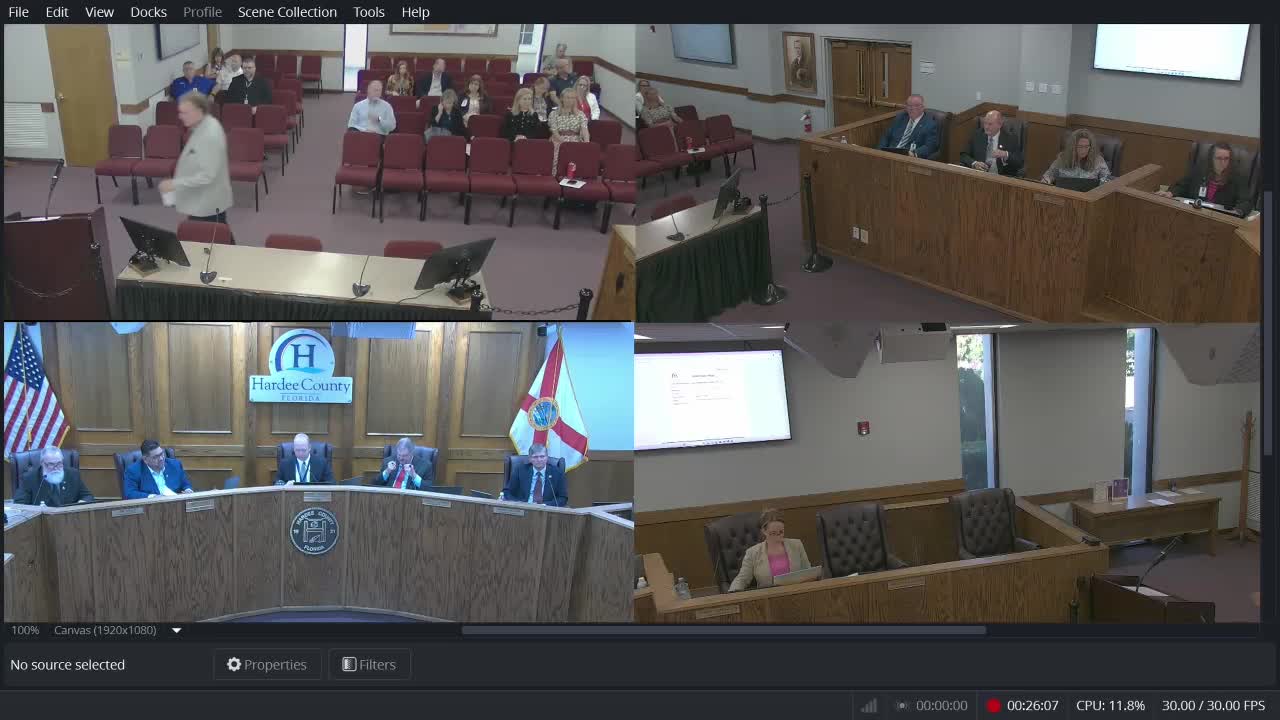
A pastor asked the Hardee County Board of County Commissioners on Oct. 2 to accept a Bible to keep in the county chambers. The county attorney advised that displaying a Bible in the chambers would likely violate the Establishment Clause of the U.S. Constitution and risk legal challenge.
Pastor Wendell Smith of Faith Temple Church of God told the board he and many families in the community would appreciate a Bible in the chambers as a symbol and for personal use. The county attorney responded that the Establishment Clause prohibits government actions that show a preference for a particular religion, and that placing a Bible on display in county chambers would create such a preference. The attorney noted the constitutional and caselaw background that distinguishes display types and locations; in the attorney’s review, a Bible kept in the chambers, as a religious artifact or display, would not withstand a legal challenge.
Commissioners and members of the public offered differing views. Some commissioners expressed personal support for a Bible being available; others deferred to the attorney’s legal opinion and suggested alternatives. The attorney suggested possible alternatives that would reduce constitutional risk, such as placing religious texts in the county library (where educational materials are maintained for public access) or adopting a neutral policy for invocations and religious expression that complies with Supreme Court guidance on invocations at public meetings.
The board did not adopt any change in policy at the meeting. The county attorney offered to work with staff on alternatives — for example, a process to permit invocations with a neutral policy or to identify non‑display locations where members of the public can access religious materials — and to review options that would reduce legal exposure while respecting residents’ views.