Get Full Government Meeting Transcripts, Videos, & Alerts Forever!
Get email alerts on the Early Learners Head Start topic
No spam. Unsubscribe anytime.
Portland Public Schools reports enrollment gains, braided funding and upcoming federal Head Start review
Summary
Portland Public Schools (Portland SD 1J) staff briefed the Board of Education on Dec. 30, 2025 during the annual Head Start/early learners board training, saying the district is 93 percent enrolled across Pre-K slots (842 of 910) and outlining how braided funding of federal Head Start, Oregon Pre-K, Preschool Promise and Multnomah County’s Preschool for All supports services.
Portland Public Schools (Portland SD 1J) staff briefed the Board of Education on Dec. 30, 2025 during the annual Head Start/early learners board training, describing program scope, recent enrollment gains and how the district combines multiple funding streams to operate its Pre-K system. Presenters said the early learners program has the capacity for 910 three- to five-year-olds across 51 classrooms at 14 sites and reported that, as of the latest reconciliation, 842 slots (93 percent) were filled districtwide.
The presentation, led by Emily Glasgow, senior director for Pre-K–5 academics, and Dana Stiles, director of early learners, framed Head Start as one component of a larger early learners system. Glasgow said the session was intended to “strengthen our understanding of the program, review our roles and responsibilities, and ensure that we’re fulfilling both federal requirements and our commitment to the children and families we serve.” The presenters emphasized that federal Head Start standards require board oversight and that the district is responsible for both programmatic and fiscal compliance.
Why it matters: Board oversight affects how federal Head Start funds are drawn down and reported, how families access services, and whether the district meets performance and eligibility requirements during an upcoming federal review. District staff told the board that enrollment levels and the mix of funding sources — federal Head Start grants, Oregon Pre-K (OPK), the state Preschool Promise program and Multnomah County’s Preschool for All — shape both the services families receive and the program’s financial stability.
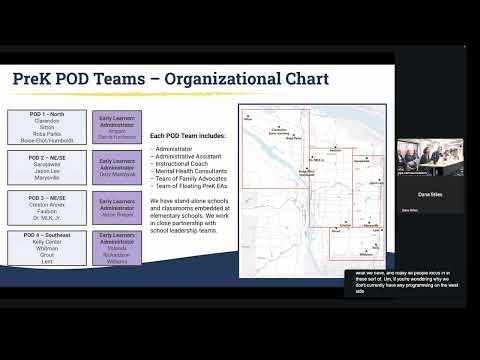
Scope and enrollment - Capacity and sites: Presenters said Portland Public Schools’ early learners program runs 51 Pre-K classrooms at 14 sites, including stand-alone early childhood sites and classrooms embedded in elementary schools. Of those classrooms, seven are designated dual-language and three are culturally specific. The system employs roughly 250 staff who support early learners programming. - Current enrollment: Staff reported the district is 93 percent enrolled across its Pre-K slots (842 of 910). Breakdowns provided during the presentation showed 91 percent enrollment for Head Start-funded slots, 96 percent for Preschool for All slots and 99 percent for Preschool Promise slots. Presenters said enrollment is up about 21 percent from the same point last year.
Student demographics and wraparound services - Composition: Using last year’s data, presenters said approximately 210 students (about 25 percent) were identified as students with special needs, 37 percent were multilingual learners, 13 students were in foster care and roughly 13 percent were experiencing homelessness. Presenters cautioned that these categories overlap and do not sum to the total enrollment. - Health and family supports: Staff described family advocates at every site and reported screening and service counts from the prior year: 870 vision screenings, 637 hearing screenings and 844 dental screenings; dental treatment for students rose by 15 percent year over year. Family advocates also facilitated approximately $86,000 in utility assistance and hosted multiple mobile play-lab events (OMSI mobile play labs), providing free memberships to some families.
Instruction and program design - Curriculum and language work: District staff said they piloted a systemwide phonological-awareness curriculum adoption (presented as Heggerty phonemic-awareness curriculum) and reported an initial implementation rate near 89 percent with plans to continue literacy and phonological-awareness work. Seven dual-language classrooms follow a 90/10 model (six Spanish, one Vietnamese). - Service alignment: Staff described a deliberate approach of “braiding” funding and aligning services so that families receive comparable wraparound supports regardless of which funding source covers a child’s seat. The district uses a single enrollment pathway (one application) and then places students into the appropriate funding slot based on eligibility and community need.
Governance, oversight and federal review - Roles: Presenters explained the governance structure that includes the early learners management team (district staff), a Parent Policy Council with parent co-chairs and the Board of Education as the governing body responsible for fiduciary oversight, legal accountability and safeguarding compliance. - Continuous improvement and review: Staff said the Head Start grant operates on five-year cycles and that the program is in year three of its current cycle. A federal Office of Head Start program review (virtual and in-person components) is expected this year; board member participation in interviews and review components is required. Presenters noted that the district will provide more specific dates and that materials and interview requests will flow through the board office and the board liaison (Director Sullivan).
Funding and sustainability - Braided funding: Presenters described the program’s funding as a combination of federal Head Start grant funds, state and county grants (Oregon Pre-K/OPK, Preschool Promise, and Multnomah County’s Preschool for All). They said braiding has provided flexibility that helped increase enrollment but also that some costs (notably staff salaries under district pay scales) create financial pressure within grant caps. - Risk management: Staff acknowledged potential instability in federal funding and said district and program leaders are working with legal, fiscal and partner agencies to draft mitigation plans. Staff also reported a forthcoming memorandum of understanding (MOU) with the county Department of Human Services to support categorical eligibility referrals and cross-training.
Board communications and next steps - Reporting cadence: Staff said routine program updates will appear in quarterly board packets (director’s updates, policy council minutes, enrollment and fiscal reports) and that additional notifications (audits, health or safety incidents, review findings) will be sent as supplemental communication through the board office. - Invitations and follow-up: Presenters invited board members to visit sites and to be prepared to participate in the federal review process when dates are scheduled.
The training closed with presenters reiterating that program sustainability will continue to depend on maintaining enrollment, braiding funds and responding to any changes in federal grant conditions. No formal board votes or motions were taken during the training portion of the meeting.