Get Full Government Meeting Transcripts, Videos, & Alerts Forever!
Get email alerts on the Housing Finance topic
No spam. Unsubscribe anytime.
Self Help outlines Western North Carolina Affordable Housing Loan Fund; Buncombe has four projects in pipeline
Summary
Self Help Ventures Fund described two loan products—bridge and mezzanine—aimed at closing financing gaps for affordable housing in Western North Carolina; Buncombe County currently has four projects in the fund's pipeline, three nonprofit and one for-profit.
Self Help Ventures Fund housing associate Tracy Thompson told the Buncombe County Affordable Housing Subcommittee on Aug. 5 that the Western North Carolina Affordable Housing Loan Fund is offering bridge and mezzanine loans to help developers acquire, hold and complete affordable housing projects across 18 western North Carolina counties.
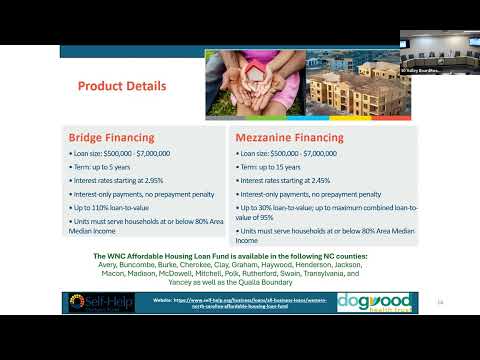
The fund, created in partnership with Dogwood Health Trust and managed under Self Help Ventures Fund, seeks to “leverage subsidies, so stretching those existing funds, multiplying capital, and then maximizing community benefit,” Thompson said. The fund targets nonprofits and for-profit developers working on new construction, rehabilitation and preservation of rental housing serving households at or below 80% of area median income.
Thompson said the fund's bridge loans range from $500,000 to $7,000,000 with up to five-year terms, interest-only payments and a stated interest rate of 2.95%. “Up to a 110% loan to value for the bridge,” she said. Mezzanine (subordinate) loans have the same $500,000 to $7,000,000 sizing, up to 15-year terms, interest-only payments, a stated rate of 2.45% and are described as the second lien in the capital stack; mezzanine loans can be up to 30% loan-to-value with a maximum combined loan-to-value of 95%.
Thompson said the fund has no prepayment penalty and offers in-house legal and real estate development expertise to borrowers. She described the fund as filling persistent financing gaps that affordable housing projects face because low rents reduce the amount of eligible senior debt, making “soft debt” or subordinate financing necessary to close deals.
On the fund's pipeline, Thompson said there are 739 units in the initial leads phase and 293 units in origination; she said the fund closed its first deal about a month prior to the meeting, a 42-unit project in Transylvania County. For Buncombe County specifically, Thompson said the fund currently shows four projects in the pipeline: three nonprofit-led projects and one for-profit project, with an average requested loan size of about $2,500,000 and average project size of about 51 units. She said most requests to date have been for the mezzanine (gap) product and for new construction paired with low-income housing tax credit (LIHTC) financing.
When asked what role local governments play and how public funds would be accounted for if a county participated, Thompson said Self Help would “adhere to whatever the county or city is requiring for the use of the funds” and that the level of reporting and parameters are set in conversation with the funder and the local government. She also noted that Dogwood Health Trust provided seed capital for the Western North Carolina fund.
Thompson described existing collaborators and prior funds in other North Carolina jurisdictions and said the fund's geographic coverage mirrors Dogwood Health Trust's footprint in 18 counties in Western North Carolina. She invited interested local staff to speak with Self Help's development team for more details on loan parameters and partnership arrangements.
The subcommittee did not take formal action on the loan fund; members asked for follow-up conversations between Self Help and county staff.
Ending: Subcommittee members said they will follow up with county staff to explore whether Buncombe County should consider participation or provide local funding that would be subject to county reporting and accountability requirements.