Hudsonville district presents student-performance gains, outlines work on standards and assessments
Loading...
Summary
District staff presented enrollment trends, state assessment results and local interventions, highlighting post‑pandemic recovery on M‑STEP and growth in AP participation while noting persistent statewide declines on some PSAT/SAT measures.
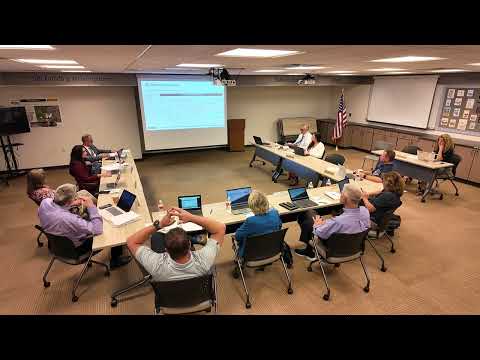
At a Hudsonville Public School District board meeting, district staff presented an overview of enrollment trends and student performance data, saying the district has seen post‑pandemic dips followed by steady recovery and targeted work to raise rigor and alignment.
The presentation, given by Jamie (staff presenter), reviewed enrollment comparisons with peer districts, M‑STEP proficiency trends dating back to 2017, PSAT and SAT patterns, and local instructional work aimed at improving outcomes. "We are always striving for continuous improvement," Jamie said, describing professional learning communities and subject committees that are drilling into standards and common assessments.
District staff told the board that M‑STEP proficiency for the district and its comparables dipped between 2019 and 2021 and has shown a steady rise since. Social studies scores were singled out as a notable improvement: the presenter said Hudsonville students performed 20 to 25 percentage points better in some social studies grades after new standards and the associated test administration. The presentation identified the M‑STEP (state assessment) and PSAT/SAT as primary data sources discussed.
Staff described work in preK–12 ELA and math committees that review benchmark assessments (STAR), local common assessments and classroom data to align instruction across buildings. Jamie said the district uses committees and principal leadership to compare which standards are being taught and how students perform on those standards: "The teachers are now ingrained or deep in that work of saying, how do we realign so that all sixth grade students have same content, knowledge, and skill no matter who their sixth grade teacher is." The district plans job‑embedded professional learning, learning walks and additional collaborative time for teachers.
On college‑readiness metrics, Hudsonville reported strong AP participation and scores: the presenter said an increased number of students are taking AP exams and that a high share—cited in the presentation as 93.6%—of those students scored 3 or above on AP exams. The board discussed reasons some students skip AP exams (cost, perceived need) and noted that colleges sometimes accept course grades in lieu of exam scores.
The board also reviewed postsecondary intent data the district tracks: Jamie said that, for the most recent year discussed, 56% of respondents planned to attend a four‑year institution, 15% a two‑year institution, 6% a technical or trade program and 2% the military; the transcript presented the remainder as employment but the final percentage figure in the record was unclear. The presenter noted the counseling staff maintains exit survey data and that more detailed, year‑over‑year comparisons are available on request.
Staff discussed enrollment drivers (local job and housing markets) and explained that bond planning and building projections must show viability: the presentation said bond projections are typically five‑year and the district must show projected enrollment at about 80% building capacity to justify opening a new facility. The district also discussed removing a $2.2 line item for irrigation plantings from a bond proposal; the transcript records the amount as "$2.2" but does not specify units or whether that is thousands or millions.
The presentation closed with next steps: the district will continue PLC work, present additional proposals in October for the 2025–26 school year and hold a district improvement meeting in October to set priorities and review deeper building‑level data. Jamie said multiple checks throughout the year will monitor student progress so the district does not rely only on end‑of‑year assessments.
Board members asked questions during the presentation about how benchmark and state data are combined, how PSAT/SAT percentages were calculated, and whether outside consultants and projection firms still are used for bond forecasting. Staff replied that prior projections used a firm called Stanford and Associates, that the district will revisit projection methodology before approaching the treasury, and that the Michigan Department of Education (MDE) memos had highlighted statewide third‑ and fourth‑grade ELA concerns that the district did not see to the same degree locally.
The district framed the data as a basis for targeted instruction rather than for immediate policy action, and said more detailed building‑level reports will follow.