Get Full Government Meeting Transcripts, Videos, & Alerts Forever!
Get email alerts on the Traffic Calming topic
No spam. Unsubscribe anytime.
Riverton council reopens debate on speed humps; staff asked to inventory removed bumps and propose process for future installations
Summary
At a Riverton City Council work session, members discussed a 2018 ordinance limiting new speed humps, unresolved questions about whether pre‑2018 humps should have been restored after overlays, and possible next steps including an inventory, cost estimates and a formal traffic‑committee review before any new installations.
Riverton City Council members on the council's work session agenda discussed whether the city should restore or again allow the installation of speed humps, instructing staff to inventory locations where humps were removed and to prepare an ordinance amendment and process for future requests.
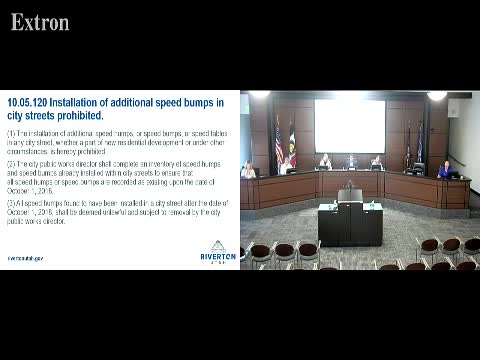
The topic arose during an item introduced by city staff reviewing a 2018 ordinance that, as written, prevents new speed humps after Oct. 1, 2018. Staff said the ordinance is open to interpretation on whether speed humps that existed before that date should remain after roadway overlays. City staff asked the council for guidance about whether to (1) require a traffic‑committee review and engineering sign‑off before any new or replacement hump is installed, and (2) study the costs to restore previously removed humps.
The discussion underscored competing priorities: residents in some neighborhoods continue to ask for traffic calming, while emergency responders and other officials warned of operational impacts. "It does exactly what it's designed to do. It slows us down," said Chief Paul Larsen of the Unified Fire Authority, describing how large apparatus negotiate humps and the effect on response speeds. City staff added the fire code contains no explicit reference to speed humps.
Council members reported mixed local experience and research. Council member McKay said many of her constituents want humps and asked for more data; she recommended the transportation committee gather speed counts and other evidence. Council member McDougall said he has been surprised that some residents report humps can encourage drivers to accelerate between humps or create noise and vehicle wear. Council member Broker asked staff to consider designs with emergency‑vehicle cutouts, a feature used in some jurisdictions that preserves a clear path for large apparatus.
Council member Perucci urged restoring the option as a tool the city may use selectively. City staff said the practical next steps would include: an inventory of humps removed after overlays, cost estimates to reinstall, and a clear policy that would involve the traffic committee, the city engineer, public works, police and UFA before any installations.
No formal motion to change the ordinance was taken at the meeting. Instead councilmembers directed staff to prepare analysis and come back with clear options. The mayor summarized the council preference as wanting a process that could reinstate the tool when appropriate: "let's work on that and queuing up a change to the ordinance. Budget. To review inventorying those speed bumps that were removed and what it would cost to put them back in play."
What remains unresolved is whether specific humps that were present before 2018 — examples cited in discussion included Lambton View and Shaggy Peak Drive — should be treated as grandfathered and reinstalled when resurfacing occurs. Staff said they will inventory removed locations and return to the council with cost estimates and a proposed procedural change for council consideration.
The council asked that any proposed policy require technical review by the traffic committee and city engineer and that the analysis include public‑notification and permitting steps. Council members also asked staff to bring comparative research and implementation options, including the "cutout" design for emergency vehicles, and to include budget estimates in the next report.
The council did not take a final vote or amend the ordinance at the meeting; the item will return to committee and ultimately back to the council when staff completes the requested inventory and options analysis.