Get Full Government Meeting Transcripts, Videos, & Alerts Forever!
Get email alerts on the Pretrial Monitoring topic
No spam. Unsubscribe anytime.
Board work session: county reviews pretrial monitoring as Close Street caseloads spike and sheriff proposes off-ramp
Summary
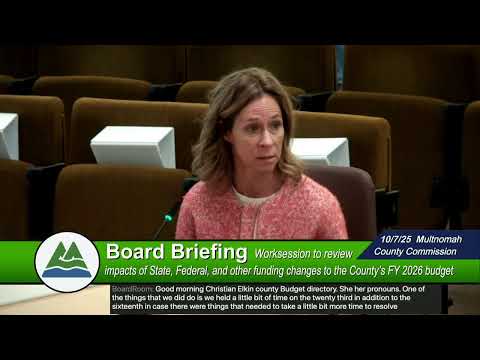
County leaders and justice-system partners held a work session to review how state, federal and other funding changes affect the county’s FY 2026 budget and to discuss the structure and performance of Multnomah County’s pretrial monitoring programs.
County leaders and justice-system partners held a work session to review how state, federal and other funding changes affect the county’s FY 2026 budget and to discuss the structure and performance of Multnomah County’s pretrial monitoring programs.
Sarah Mullen, executive director of the Local Public Safety Coordinating Council (LIPSC), and Multnomah County Chief Criminal Judge Michael Greenlick presented background and system findings. Mullen said the county now uses the Public Safety Assessment (PSA) for universal risk assessment, which increased the number of people identified for pretrial monitoring and changed how cases are routed between the Department of Community Justice’s Pretrial Services Program (PSP) and the sheriff’s Close Street program.
Mullen said the sheriff’s office caseload at Close Street has more than doubled since fall 2022, creating unmanageable workloads; she reported inconsistent data sharing between agencies and a lack of warm handoffs to services. The LIPSC pretrial subcommittee — composed of judges, public defenders, the district attorney’s office, court administration, the sheriff’s office, DCJ and others — has been meeting since 2023 to develop options for a redesigned pretrial system and had prioritized peer services, case management, access to county services, regular data reporting and a unified supervisory structure.
Judge Greenlick described the types of cases that most often require heightened pretrial oversight — defendants with histories of failing to appear, repeat bookings, or the potential for new criminal activity — and warned that a rapid closure of Close Street with no transition could lead judges to keep more defendants in custody. He said some protective functions Close Street formerly provided (in‑person investigations, home visits and pre‑release contacts) have largely stopped because deputies’ caseloads have grown.
Denise Pena, director of the Department of Community Justice, explained certain staffing and jurisdictional differences observed in other counties; she and Mullen said Clackamas County’s model uses a transition center that interviews and performs case planning before release and provides warm handoffs to services.
Mullen and Justice System Partners (JSP) reports recommended shifting from compliance‑focused monitoring to supportive pretrial services, establishing support services separate from the legal system, implementing warm handoffs at release and targeting services to assessed needs. The county contracted JSP to produce three reports: (1) an analysis of pretrial programs and best practices, (2) an assessment of local administrative data and policies (released late the prior week) and (3) a cost analysis that had not yet been started; Mullen said the county has about $3.37 million currently budgeted for pretrial monitoring services.
Commissioners and staff discussed short‑term fixes (adjusting reporting formats, focusing supervision on higher‑risk cases, and creating interdisciplinary case staffing to identify services already being received) and longer‑term options (a one‑year transition to a new model, contracting with a nonprofit, housing services in a county department, or a hybrid). Several commissioners said a four‑to‑six‑month closure timeline proposed by the sheriff would be too fast for a safe transition and asked staff to evaluate a longer off‑ramp and alternative budget modifications to avoid abrupt service loss.
County budget staff said budget modification items from the sheriff would be submitted for board consideration on Oct. 16 and noted availability to hold an item for additional review on Oct. 23 if commissioners request more time to evaluate alternatives. The board requested additional data about overlap between the pretrial population and other county services, outcomes data for Close Street and comparative outcome measures from Clackamas County’s transition center.
Ending: Board members asked staff to pursue a combination of near‑term operational fixes and a deliberate transition plan (estimated at a minimum of 12 months) to preserve public safety functions while redesigning pretrial monitoring; no formal decision to close Close Street was recorded at the work session.