Get Full Government Meeting Transcripts, Videos, & Alerts Forever!
Get email alerts on the Bull Run Filtration topic
No spam. Unsubscribe anytime.
Council committee accepts Bull Run Treatment Projects 2025 annual report; staff warn schedule, appeals and land-use constraints threaten costs
Summary
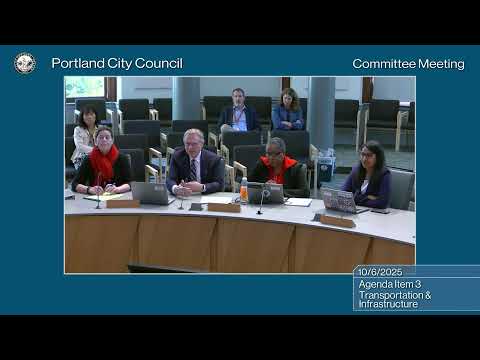
The Transportation and Infrastructure Committee voted to forward the Bull Run Treatment Projects 2025 Annual Report to full council with a recommendation to accept, as bureau leaders outlined construction progress and emerging schedule and cost risks.
The Transportation and Infrastructure Committee voted to forward the Bull Run Treatment Projects 2025 Annual Report to full council with a recommendation to accept, as bureau leaders outlined construction progress, project scope and emerging schedule and cost risks on Oct. 6.
David Peters, engineering manager for the Water Bureau, summarized the program as three linked projects: a drinking-water filtration facility with the capability to treat approximately 135,000,000 gallons (facility sizing cited by staff), about seven miles of new pipelines to connect the facility to the existing system, and a completed corrosion-control facility that began operation in 2022.
Peters said the corrosion control work has already reduced lead exposure, noting the treatment "has significantly reduced lead at the tap for customers who have lead solder in their private plumbing" and that lead levels are now "well below the EPA's proposed lower regulatory level for lead in drinking water." He described the filtration facility as a resilience investment that will remove cryptosporidium and other organic material and help the system respond to fires, storms and seismic events.
Staff reported construction milestones completed since June 2024: mass excavation and grading of the 95-acre site (nearly 800,000 cubic yards excavated), placement of roughly 2,000 cubic yards of concrete foundations, installation of more than 3,000 feet of 66-inch diameter pipeline and over 4,000 feet of smaller-diameter pipeline. Staff said site work has mobilized and that roughly 200 craft workers were on-site at the time of the presentation with a peak forecast of about 460 workers next summer; the program also anticipates over 20% of labor hours to be apprentice hours.
Peters and Interim Director Quisha Light told the committee the project budget has changed since initial planning: an early 2019 treatment estimate was described to council as about $500 million (treatment-only), the earlier combined estimate for projects was $1.48 billion, and the current budget established in 2024 is $2.1 billion. Peters and Light emphasized that the project is funded through a combination of WIFIA loans, water revenue bonds and water revenues (rates, fees and charges). The bureau also said it has secured WIFIA financing totaling just over $1 billion in low-interest loans.
Committee members concentrated questions on schedule and cost control. Peters outlined why schedule risks could raise costs: land-use appeals and remands have caused suspensions and led to operational constraints tied to permit conditions, including limited construction hours, vehicle caps on site roads, and intersection timing restrictions. Peters described a pause in construction from Feb. 14 (suspension after a LUBA remand) until June 30, when Multnomah County reapproved permits; opponents subsequently filed a new LUBA appeal.
Light described how those constraints limit the bureau's ability to accelerate work to make up time without increasing cost and said the bureau is working with prime contractors on time-impact analyses. On cost mitigation, staff said they are reprioritizing other water capital projects to give the Bull Run work priority, pursuing external funding, and using two WIFIA loans to smooth near-term rate impacts. Staff emphasized council approval would be required if the guaranteed maximum price (GMP) or overall budget requires change.
A formal motion to move the report to full council with a recommendation to accept passed on a roll call vote: Green, aye; Smith, aye; Koyama Lane, aye; Moriyo?, aye; Clark, aye (5-0). The motion was seconded by Councilor Koyama Lane; the transcript does not name a mover. Committee members asked staff to return with negotiated contractor time-impact analyses and potential rate impacts as soon as they are available to inform upcoming budget decisions.