Get Full Government Meeting Transcripts, Videos, & Alerts Forever!
Get email alerts on the Water Supply And Conservation topic
No spam. Unsubscribe anytime.
Portland Water Bureau outlines conservation programs, wholesale shifts and fixed-cost pressures
Summary
Water bureau staff told the committee the city has two high-quality sources (Bull Run watershed and Columbia South Shore well field), is seeing falling wholesale demand as four wholesale partners plan to leave, and said conservation reduces demand but does not eliminate fixed-cost pressures that will push rates up.
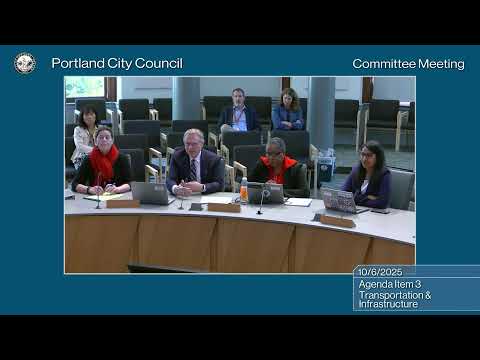
Portland Water Bureau staff told the Transportation and Infrastructure Committee on Oct. 6 that the bureau manages two high-quality drinking water sources and relies on conservation and active planning to meet customers' needs, but that declining wholesale demand and a changing customer mix create upward pressure on rates.
"The Bull Run Watershed has been our water supply since 1895," Sarah Murphy Santner, director of resource protection and planning at the Water Bureau, said, and the city also maintains the Columbia South Shore Well Field as a secondary source. Santner noted the bureau serves about a million people across a service area that extends beyond the City of Portland.
Santner said in 2023-24 roughly 38% of the water produced was sold to wholesale partners (19 providers); 52% was sold to retail customers within the city; about 9% is attributed to water loss or leaks; and approximately 10% is "other uses" (authorized nonmetered uses). She said four wholesale partners are expected to leave the system in 2026, reducing wholesale sales to an anticipated ~14% of production in future years.
"Reduced total demand decreases pressure on supplies," Santner said, adding that conservation and targeted programs remain part of the bureau's adaptive planning strategy. The Water Management and Conservation Plan, required by the state of Oregon, guides the bureau's conservation benchmarks: annual water audits, full metering, meter testing and maintenance, public education and some rebate and retrofit programs.
Interim Water Bureau Director Quisha Light summarized the financial concern: "Less water sold does not mean that there's less cost that the system needs to provide for." Light outlined the primary fixed costs: operating and maintaining treatment plants and pump stations, paying down debt, upgrading aging infrastructure to meet state and federal rules, and funding affordability programs. Many of those costs do not vary with volumetric sales, she said, and the changing customer mix (more multifamily accounts with master meters) means there are fewer billing accounts to spread those fixed costs across.
Santner described the bureau's conservation and water-loss work, including a satellite leak-detection pilot that detected non-surfacing leaks during the prior scan: staff found 219 leaks and estimated about 36,500,000 gallons saved from repairs and an associated carbon benefit. The bureau runs technical assistance for businesses (about 100 businesses annually), a home leak repair program for low-income customers (serving more than 100 households a year), and various rebate programs. Staff said they provide materials and multilingual outreach.
Committee members asked for methodological detail on the bureau's "cone of uncertainty" demand forecasts; Councilor Green asked whether the bureau used Monte Carlo or other probabilistic methods. Santner said the bureau uses an adaptive planning approach with updated demand models and scenario planning and that the forecast assumptions (including a middle-ground demand decline) are reflected in current financial planning.
Light and Santner told the committee the bureau will continue to manage costs, pursue outside funding where feasible, seek commercial customers, and expand affordability and financial assistance efforts for residents and small businesses. Staff offered to return to the committee with additional detail on the demand-forecast methodology, the wholesale customer departures, and the bureau's emergency restoration and prioritization procedures.