Get Full Government Meeting Transcripts, Videos, & Alerts Forever!
Get email alerts on the Transportation Funding topic
No spam. Unsubscribe anytime.
Portland officials say new state transportation package will shore up FY26 operations but remains a stopgap
Summary
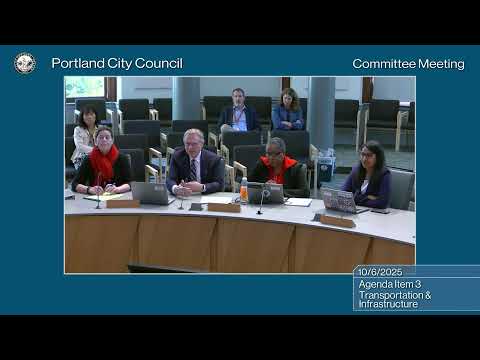
Portland transportation and city staff told the Transportation and Infrastructure Committee on Oct. 6 that a newly passed state transportation package (HB 3991) will stabilize the Bureau of Transportation's budget for the current fiscal year but that the funding is a short-term solution.
Portland transportation and city staff told the Transportation and Infrastructure Committee on Oct. 6 that a newly passed state transportation package (HB 3991) will stabilize the Bureau of Transportation's (PBOT) budget for the current fiscal year but that the funding is a short-term solution.
"We are estimating that in this fiscal year, the city of Portland will receive about $10,600,000," PBOT Director Melissa Williams told the committee, adding the city's ongoing share is estimated at about $24,000,000 in future years. Williams said the package covers approximately $11 million already assumed in the city's FY25-26 budget and "eliminates the need for any additional position reductions or service cuts this fiscal year."
The city's Deputy City Attorney (DCA) for Public Works, Priya Danapal, framed the funding as welcome but limited: "While this funding is incredibly good news, it will help stabilize things for now. It is still unfortunately just a stopgap." Danapal and Williams said the transportation system has been underinvested for years and pointed to competing priorities including streetlight replacement, pothole response, microsurfacing, and expanded street sweeping.
Sam Chase, director of Office of Government Relations, explained timing and a possible delay tied to petition efforts: petitioners have 90 days from the Legislature's adjournment (Oct. 1) to collect signatures to refer the measure to the ballot; if successful, funding would not be available until after the Nov. 2026 election. Chase summarized timing for immediate funds if there is no successful referral: "we would be able to begin to realize funding as soon as January 2026" and that the roughly $10.6 million would begin to impact the bureau then.
Committee members pressed staff on related funding and program questions. Councilor Smith asked whether a separate $10 million federal sidewalk award had been released; Williams said the award was obligated and connected to a specific project (said to be the 120 Second Avenue project) and the bureau would follow up with exact timing. Councilor Grama emphasized the interconnectedness of transportation, housing and climate policy and urged the city to use the coming year to plan longer-term revenue strategies.
Williams warned that the dollar amounts in the package will not be adjusted upward for inflation over time and that without additional revenue Portland risks losing ground again: "this funding is really just a drop in the bucket, filled with many competing priorities." She noted the city will continue to receive updated ODOT forecasts and that parking revenues and other local revenues remain dynamic.
The presenters also said the package includes funding to other regional partners (ODOT, TriMet, Multnomah County) that will indirectly affect Portland services. Williams and Chase said the city will continue work during the FY26-27 budget process to program any additional state funds and monitor whether petitioners succeed in sending the package to voters.
Looking ahead, PBOT staff identified near-term priorities for any new state funds: maintaining current service levels, supporting microsurfacing and paving programs, replacing critical signs and poles, and addressing increased costs from severe weather events. Several councilors urged the bureau and council to treat the package as an opportunity to pursue durable, long-term funding solutions rather than a recurring expectation of stopgap support.
An item on the agenda noted further details would be provided in follow-up communications; staff committed to follow up by email on specific questions about federal sidewalk funding and the ODOT forecast timeline.