Get Full Government Meeting Transcripts, Videos, & Alerts Forever!
Get email alerts on the Housing Policy topic
No spam. Unsubscribe anytime.
Summit County debates overlay zone, employer partnerships to reach 1,500‑unit housing goal
Summary
Summit County officials spent the morning and afternoon-wide workshop session reviewing new housing-market data and debating how to meet a previously adopted county goal of 1,500 housing units over the next decade.
Summit County officials spent the morning and afternoon-wide workshop session reviewing new housing-market data and debating how to meet a previously adopted county goal of 1,500 housing units over the next decade.
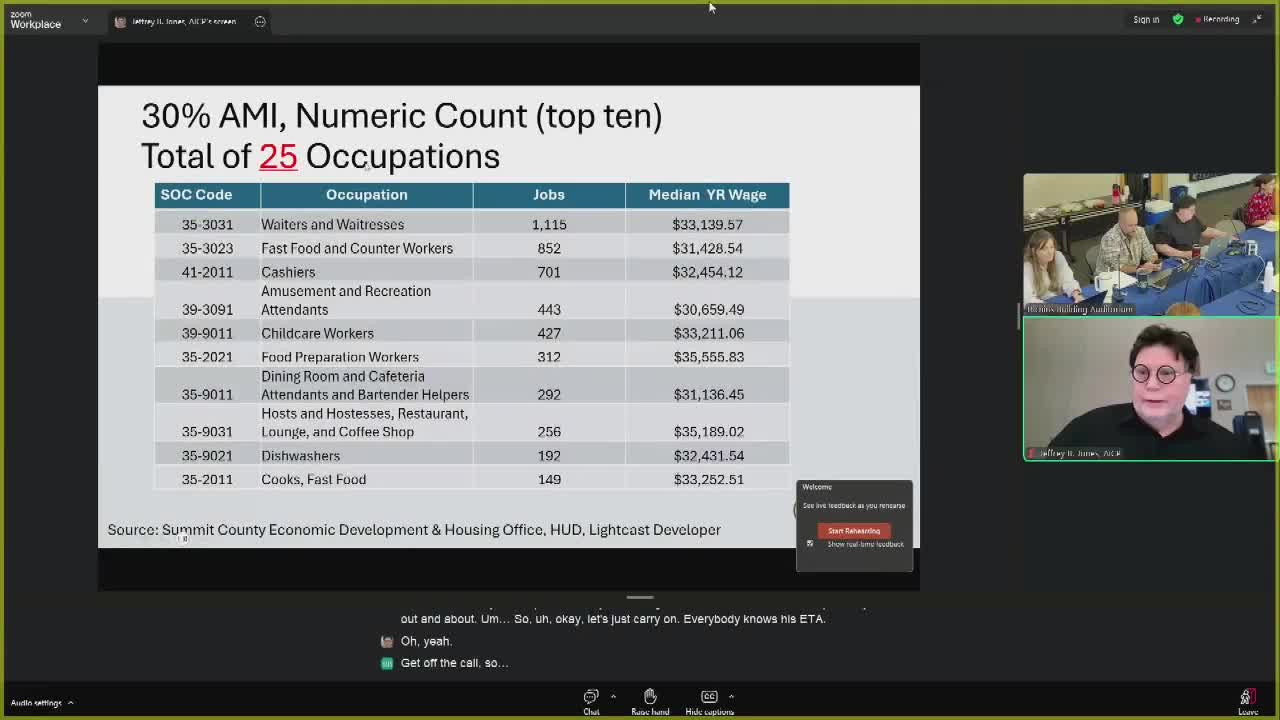
County staff outlined occupation-level data showing a large share of Summit County workers falling in the 40–70% area‑median income (AMI) band and presented model price and rent thresholds for deed‑restricted and market units. Staff said the county currently lacks the zoning tools to allow some of the smaller “missing middle” housing types that would better serve the workforce and recommended two broad approaches: (1) promote more public‑private partnerships and employer‑sponsored housing and (2) create a narrowly‑designed overlay zone or other code amendments that would allow higher‑flexibility housing types where context and public benefits justify them.
Why it matters: staff argued that the county’s market today offers almost no for‑sale or rental product at the price points needed by workers who score between 30% and 80% AMI. Without changes to the land‑use code or additional subsidy/partnerships, staff said, developers and housing programs will struggle to produce units affordable to firefighters, teachers, childcare workers and hospitality staff — groups identified in the county’s occupation analysis.
Key details from staff analysis: staff aggregated occupation data for Summit County and concluded the majority of jobs fall between 40% and 70% AMI, and that a focus nearer the 40% AMI level would better serve the workforce. Staff described an input‑output model they use to convert AMI and household size into price and rent targets; example figures included an illustrative maximum income of about $35,400 and a maximum monthly rent near $885 at 30% AMI for a single‑person household, and a roughly $94,400 maximum income and $2,360 rent at 80% AMI (these were presented as scenario outputs tied to assumptions about down payment, interest rates, HOA and insurance costs). Staff also highlighted the outsized landfill‑space and housing impacts of food‑waste and utility costs on affordability.
Zoning and policy options: presenters described several tools: - An overlay zone targeted to parcels with attributes the county identifies as suitable for workforce or affordable housing, to be implemented through a future‑land‑use map and opt‑in rezones with performance standards; or - Incremental code amendments that add administrative flexibility (for example allowing duplexes on corner lots or small lot conversions without a full development agreement); and - Continued and expanded public‑private partnerships and employer‑sponsored projects (developers or employers providing land or capital) to drive AMI targets lower than market alone will produce.
Concerns and disagreement: several council members and attendees welcomed firm action but differed on pace and process. One council member urged caution, citing a past overlay process that resulted in controversy when large developers gained control of a proposed village overlay; that member asked for strong guardrails, tighter limits on when overlays could be applied, and more analysis before adopting a new zoning tool. Other members argued an overlay narrowly crafted and limited by parcel, scale and attributes could enable employer housing and smaller “infill” projects that otherwise cannot proceed.
Implementation and next steps: council members and staff agreed to continue the discussion. The council asked staff to prepare a dedicated work session on zoning options (including pros/cons, guardrails, and test cases), plus an implementation plan that lists likely milestones, resource needs and who would be responsible for each item. Staff also said they will continue to develop financial models for public‑private partnership pilots (the Klein Dolly and Gilmore parcels were discussed as early test cases) and will bring more concrete draft code amendments for the council to review.
Context and background: staff and council repeatedly noted that market forces (investor ownership, HOA charges, and shifts in AMI driven by retiree investment income) complicate comparisons between deed‑restricted affordability and market prices. Staff recommended pairing zoning changes with programmatic tools — down‑payment assistance, targeted preference windows for county employees, or “waterfall” priority rules that favor emergency services and other county‑critical occupations — to preserve public returns on investments in public safety and other high‑onboarding‑cost positions.
What’s next: staff will return with a work‑session package that includes: (a) an overlay‑zone concept with guardrails and test‑case results; (b) administrative code changes that would permit modest missing‑middle housing types; and (c) recommended pilot public‑private partnership terms for employer‑sponsored housing. Council members asked for a staged approach and said they expect to see timeline, budget implications and how code changes would interact with existing and pending large developments.