Get Full Government Meeting Transcripts, Videos, & Alerts Forever!
Get email alerts on the Natural Disaster Sales Tax Refunds topic
No spam. Unsubscribe anytime.
Tennessee Department of Revenue outlines sales-tax refund process for natural-disaster survivors
Summary
Department staff summarized who qualifies for natural-disaster sales-tax refunds, eligible and ineligible items, documentation requirements and how to file, including a one-year filing window tied to the FEMA decision letter and a $2,500 per-resident refund cap.
NASHVILLE — Staff from the Tennessee Department of Revenue explained the state’s process for claiming sales-tax refunds tied to natural-disaster damage during a Sept. 30 webinar aimed at residents affected by storms, flooding and other emergencies.
Katie (presenter, Taxpayer Services, Tennessee Department of Revenue) said the refunds cover sales tax paid on tangible items residents buy to repair or replace household property damaged by a declared natural disaster and that the guidance in the presentation is “current as of 09/30/2025.” She noted that “there were $730,000,000 passed in natural disaster relief funding during the 2025 session,” describing a mix of special-session and regular-session appropriations.
The refund program is available to Tennessee residents who received financial assistance from the Federal Emergency Management Agency for repair, replacement or construction of a primary residence damaged by a natural disaster, department staff said. Department manager Billy Trout (manager, Taxpayer Services Education Section, Tennessee Department of Revenue) and Ben Blackwell (Audit Division, Tennessee Department of Revenue) answered technical questions about eligibility and documentation.
Who qualifies and the filing window
Department staff said qualifying claimants must have a FEMA decision letter approving assistance for repair or replacement of a primary residence. The deadline to file is one year from the date on that FEMA decision letter; for paper claims the department uses the postmark date. Ben Blackwell told attendees claimants should “wait until all purchases have been made before filing” and gather receipts and invoices before submitting a claim.
What is eligible and limits
Staff described the program’s major limits:
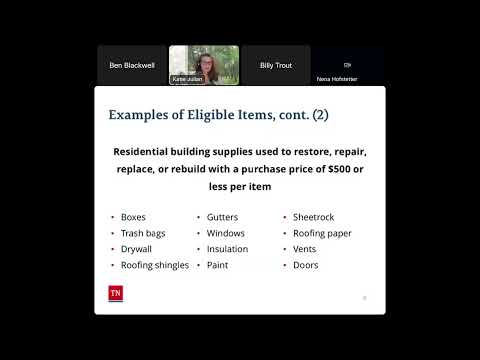
- A maximum refund of $2,500 in sales tax per resident. - Major appliances with a purchase price of $3,200 or less per item (examples given: ovens, refrigerators, water heaters, vacuum cleaners). - Residential interior furniture with a purchase price of $3,200 or less per item (patio or exterior furniture does not qualify). - Building supplies and construction materials with a per-item purchase-price limit of $500 or less (examples listed: drywall, roofing, gutters, windows, paint, doors, faucets, countertops, cleaning/disinfecting supplies). Flooring is subject to a $500 unit-price limit (staff explained “unit” typically means a box or comparable supplier unit).
Staff emphasized items specifically excluded from eligibility, citing clothing, computers and televisions, dehumidifiers, dishes, and HVAC/heating-and-air units among the noneligible items mentioned in the webinar.
Contractor invoices and tax paid by contractors
The department said Tennessee sales tax paid by a contractor on eligible items may be included in a claim if the contractor invoice lists those items and the sales tax paid. Staff advised claimants to obtain invoices that break out the sales-tax amount; if an invoice shows only a total, the refunds unit can work with the claimant to determine next steps. Blackwell said auditors assigned to claims will “reach out to the claimant” when information is missing or needs clarification.
Documentation and how to file
Claimants must attach the FEMA decision letter and receipts or invoices that show Tennessee sales tax paid on eligible purchases. Staff advised that screenshots or online order invoices that show the order number, price and sales tax are generally acceptable; by contrast, they said credit-card statements typically lack sufficient detail to show the specific item and tax and therefore may not be adequate. The department provides an electronic filing option through the web portal shown in the webinar (temtap.tn.gov/eservices) and a paper form option. Staff repeated that claims are per residence/household (one claim per residence).
Timing, follow-up and help
Blackwell said an auditor will be assigned to each claim and will contact claimants if additional information is required; staff told attendees to include a working email and phone number so auditors can follow up if a mailing address is not functional. The refunds unit phone number presented on-screen was 615-741-0443.
Why it matters
The department framed the program as a legislatively created mechanism to return sales tax paid on eligible replacement items to residents who received FEMA assistance after a covered disaster. The webinar aimed to reduce errors and late filings by clarifying the list of eligible items, unit-price caps and the requirement to file within one year of the FEMA decision letter.
Ending
Staff closed by inviting attendees to use the department’s online resources and the refunds phone line for case-specific questions. They also noted upcoming webinars on other tax topics and asked participants to complete an event survey.