Get Full Government Meeting Transcripts, Videos, & Alerts Forever!
Get email alerts on the Behavioral Health Integration topic
No spam. Unsubscribe anytime.
CBH official describes on‑site clinical integration with DHS; council members press for more capacity
Summary
Laura D'Riggi of Community Behavioral Health told council the agency and DHS co‑located staff and developed forensic evaluation capacity, but council members said the city needs more clinical consultants at the front door to reduce unnecessary investigations and connect families to services earlier.
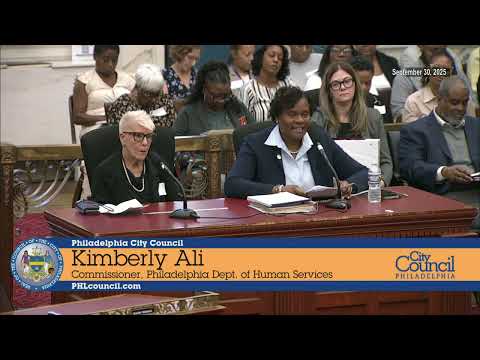
At the Committee on Public Health and Human Services hearing, Laura D'Rigi (senior director for clinical consultation at Community Behavioral Health, CBH) described long‑standing integration between CBH and the Department of Human Services — including co‑location of CBH clinical staff at DHS, courtroom placement of CBH staff, and a CBH–DHS forensic evaluation unit established in 2004.
D'Rigi said the integration began under earlier DHS leadership and was intended to ensure seamless access to behavioral health services when children and families enter the child welfare system. She described a ‘‘hybrid’’ role — clinical consultation that combines home visits, direct practice, court consultation and cross‑system coordination — and said she personally continues to do home visits and courtroom testimony in complex cases.
Capacity concerns raised: Council members asked whether behavioral health should be present earlier in hotline screening and whether CBH’s consultative role could be expanded. D'Rigi said CBH staff had previously been co‑located in the hotline but that access to behavioral health information depends on consent; CBH shares information when families sign consent forms used during investigations. She also confirmed she is currently the sole person in that hybrid, cross‑system clinical consultant role and that the department had sought funding in a prior needs‑based plan to expand the role into a team.
Why it matters: Councilmembers said adding clinical capacity at the front door could increase appropriate diversions, reduce formal investigations, and attach the right level of services earlier. D'Rigi said a stronger front‑end clinical presence could help ensure “the right level of services be attached early on,” which DHS and council members argued would reduce avoidable entries into formal child welfare cases.
Other CBH functions described: D'Rigi outlined CBH care managers colocated with CUAs to support family team conferences, court‑based behavioral health forensic evaluations that involve psychiatrists and psychologists for comprehensive court assessments, and an IDS/DBH staff member dedicated to prenatal plans for infants exposed prenatally to substances.
Council follow‑up: Committee members requested additional detail on whether CBH resources can be scaled and whether consent and privacy processes limit earlier information sharing. D'Rigi and DHS leadership said they would provide further information on how front‑end consents and staffing might be modified without violating privacy rules.