Get Full Government Meeting Transcripts, Videos, & Alerts Forever!
Get email alerts on the Child Welfare Hotline And Prevention topic
No spam. Unsubscribe anytime.
Philadelphia DHS outlines hotline volumes, prevention spending and drop in child placements
Summary
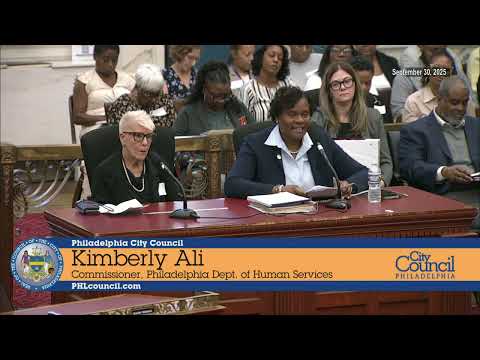
At a Sept. 30 hearing, Philadelphia Department of Human Services Commissioner Kimberly Ali described a drop in children placed outside their homes and detailed how the agency handles 38,184 hotline contacts in fiscal 2025, diversion practices, and prevention funding including a $3.135 million emergency "concrete goods" fund.
Philadelphia Department of Human Services Commissioner Kimberly Ali told the City Council Committee on Public Health and Human Services on Sept. 30 that the department has seen measurable declines in the number of children in placement while continuing to operate a 24/7 child abuse hotline that handles tens of thousands of contacts each year.
Ali told the committee that in fiscal year 2025 the department logged 38,184 calls, walk-ins or emails to its child abuse hotline. Of those, 23,080 — about 60 percent — were diverted from formal investigation after screening and provision or referral to prevention services, while 15,104 reports received a formal investigation by DHS social workers. Of the investigations, 4,033 reports were accepted for services, representing 2,598 children who then received in‑home support or entered placement, Ali said.
Why it matters: The department presented those figures while describing a sustained reduction in the number of children placed outside their homes, from a high of 6,194 on June 30, 2017, to 2,504 on June 30, 2025, and 2,406 on the date of testimony. Ali said federal-comparison data show Philadelphia’s removal rate fell from 7.6 children per 1,000 in 2017 to 3.4 per 1,000 in 2023 and that the in‑care rate fell from 16.1 to approximately 8 per 1,000 over the same period.
DHS’s screening and diversion approach: Ali described the department’s use of a structured Hotline Guided Decision Making (HGDM) process. That process is intended to collect information about maltreatment and family dynamics so supervisors can decide whether a report meets the criteria in the state Child Protective Services Law (CPSL) for formal investigation, or whether families should be diverted to preventive services provided by community umbrella agencies (CUAs) and other providers. Ali told council members that all hotline determinations are reviewed by a master’s‑level manager.
Prevention spending and supports: Ali and Nadine Parisi, DHS chief financial officer, told the committee the department now spends about $110 million annually on prevention services. Parisi said a discrete, city-managed emergency "concrete goods" fund totals about $3,135,000 and is used mainly for housing supports — rental and utility assistance — and for furniture and similar needs. Ali added that CUAs also have discretionary funds; the pooled CUA discretionary line across agencies was described as roughly $1,300,000 and that DHS had requested an additional $1,000,000 for the next fiscal year. Other prevention line items cited in testimony included RSRI ($3.3 million), Family Empowerment Services (FES, $2.4 million), and two site-based family empowerment centers (about $4.5 million).
How families receive diversion services: Ali said diversion services are voluntary, documented in DHS’s case management system, and can include in‑home supports, intensive prevention services, or behavioral health interventions arranged with Community Behavioral Health (CBH). She said FY25 had 5,083 families referred to prevention services. Ali emphasized the department moved its prevention documentation into the same case management system as investigations to provide a holistic family view.
Safety assessments and court process: Ali outlined the removal process under state law: when an allegation meets CPSL criteria, a DHS investigator may seek an order of protective custody from a judge; only the courts can order removal. She described the statutorily required review hearings — in particular, an initial hearing within 72 hours after protective custody is granted and review hearings at least every three months thereafter — and noted Act 33 governs reviews of child fatalities and near‑fatalities and requires multidisciplinary external reviews.
Gaps and next steps identified in testimony: Committee members pressed DHS on tracking of families who self‑refer versus mandated reports, the composition and sufficiency of prevention spending, and whether the department should publish clearer, stand‑alone line items for emergency assistance so the council and the public can see where concrete supports are spent. Ali said the $3.135 million emergency fund is primarily used for housing (about 70 percent) and that the department expanded a Philly Families Can support line through the Department of Public Health (about $1.5 million) to connect families with services.
Ending note: Ali argued DHS continues to refine policies and practices, and she reiterated the agency’s stated priority to reduce trauma and keep families together when it is safe to do so. Council members signaled interest in additional data on prevention expenditures, outcomes over multiple years, and whether increased early investment reduces the rate of removals.