Get Full Government Meeting Transcripts, Videos, & Alerts Forever!
Get email alerts on the Loading Zones Center City topic
No spam. Unsubscribe anytime.
Center City loading‑zone bill splits neighbors and advocates; court injunction and data transparency drive debate
Summary
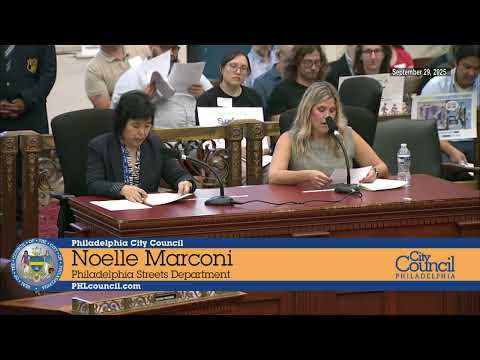
A committee hearing on bill 250,718 drew sharply divided public testimony after the Department of Streets said it supports reauthorizing curb and loading‑zone rules in Center City; neighborhood groups said the changes lacked sufficient data and a court injunction has affected recent loading‑zone installations.
The Philadelphia City Council Committee on Streets and Services considered bill 250,718, which would confirm regulations adopted by the Department of Streets and reauthorize the department to establish and revise time‑limited parking, stopping and loading zones within a specified Center City area bounded by Spring Garden Street, the Schuylkill River, Bainbridge Street and the Delaware River. Department witnesses supported the measure; public testimony at the hearing was sharply divided.
Deputy Commissioner Richard Montanez told the committee the department supports the legislation and that it would authorize reauthorization of loading zones and other curb regulations within the Center City area. He said the department can establish or reauthorize time‑restricted loading zones and reiterated the department's existing regulatory authority to manage curb space.
Opponents, including Friends of Pine and Spruce (FOPS), urged the committee to defeat the bill or to delay action. Lloyd Brotman, president of Friends of Pine and Spruce, said the city’s changes ‘‘failed to employ a scientific data‑driven approach’’ and that a recent court injunction had barred construction and required removal of certain loading zones; Brotman and others said the curb changes had disproportionate impacts on elderly and disabled residents. Richard Herskovitz, a registered architect who testified for FOPS, urged transparency, technical analysis and community consultation, saying some installed loading zones were underutilized and that operational problems had arisen.
Proponents included Russell Ritchie of Fifth Square and other residents and contractors who said the loading zones improved safety and access. Ritchie and several residents said the zones provided needed space for unloading groceries, contractors and residents and that the temporary posting of signs earlier in the year produced immediate improvements in curb management. Contractor Wesley Nunezessa testified the removal of a loading zone had increased time and cost for local construction projects. David Wolfson, a resident and attorney, said his 95‑year‑old mother benefited from a nearby loading zone and that the block felt safer while the zone was in place.
The record also included testimony from bicycle advocates supporting the bill as a tool to manage curb use and protect bike lanes. Witnesses and members referenced a recent injunction from the Philadelphia Court of Common Pleas; one speaker identified the judge by name during public comment. Committee members and witnesses discussed an amendment that would narrow the bill's scope to specific blocks on Pine and Spruce Streets; some speakers said they were not aware of the amendment until the hearing. Several council members asked the administration for underlying data and technical analyses; proponents said crash data supports prioritization of some streets.
No formal committee vote on bill 250,718 was recorded at the hearing; multiple speakers urged either a vote to proceed or tabling until additional data and public input were produced.