Get Full Government Meeting Transcripts, Videos, & Alerts Forever!
Get email alerts on the Education Title I topic
No spam. Unsubscribe anytime.
Proviso Township HSD 209 details Title I, II and IV allocations and parent engagement rules at annual meeting
Summary
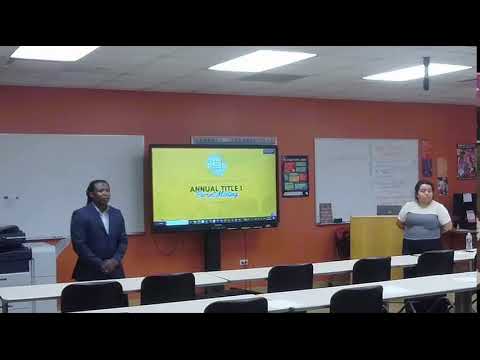
At an annual Title I parent meeting, district officials described how federal Title I, II and IV funds for fiscal 2026 will be used, explained parent-family engagement requirements under the Every Student Succeeds Act, and reviewed the school-parent compact and how parents can request teacher qualifications.
At a Title I annual parent meeting for Proviso Township High School District 209, Dr. Walker, the district’s state and federal grant coordinator, outlined how the district plans to use federal Title I, II and IV funds for fiscal 2026 and reviewed parents’ rights under the Every Student Succeeds Act.
Dr. Walker said the district uses Title I money to “identify students that are experiencing learning difficulties, assisting with student attendance, providing timely assistance to help with students who are struggling to meet state standards, and also the purchasing of additional resources, materials, curriculum, supplies that will assist with the academic outcomes for our students.”
The presentation explained why the meeting was being held: ESSA and Title I require annual parent meetings so that parents can learn about their rights, how the LEA allocates funds, and how to engage in school planning and evaluation. Dr. Walker described the LEA consolidated Title I plan, the school-level continuous improvement plan and the school-parent compact as documents in which parents have a right to participate.
On the compact, Dr. Walker said: “The compact, it is a commitment. Just a commitment for the family, the school, and the student to take a shared responsibility for his or her for their own learning.” She told parents the compact is available in hard copy and on the district website and encouraged families to read it with their students.
Dr. Walker presented line-item allocations the district expects to use to support Title programs. For Title I she said the district designates substantial funding for instructional supports and personnel; the presenter listed approximately $887,000 for instructional supports, about $289,000 for instructional materials, roughly $200,000 for parent and family engagement activities and about $3,500 for neglected and delinquent student supports. She also said the district sets aside funds for nonpublic schools (which she listed as about $89,056). For Title II she said allocations total about $191,000, citing roughly $94,078 for professional development, about $9,500 for administrative conference fees, about $42,174 for nonpublic school services and about $23,818 for recruitment. For Title IV she said the allocation is about $97,835, with roughly $40,077 for well-rounded educational activities, $19,567 for safe and healthy students, $14,675 for technology, and an administrative allocation of about $1,900; she also cited a nonpublic allocation figure of about $34,244 and an after-school set-aside of about $123,491 aimed in part at ACT prep.
Dr. Walker explained the Title I 1% parent-family engagement requirement and how that amount is distributed: by law, any school with a Title I allocation of at least $500,000 must set aside at least 1% for parent and family engagement; up to 10% of the total 1% may be reserved by the LEA for systemwide initiatives and the remaining 90% must be allocated to schools. When asked by a parent how much the 1% set-aside would be for the district, Dr. Walker said it was “about $14,014” for parent and family engagement.
She described how the district evaluates parent-family engagement plans annually using tools such as parent surveys, focus groups and parent advisory committees and said evaluation informs next year’s plans. She encouraged parents who want to be involved in plan development or the continuous improvement process to contact their school principal.
On how parents can request teacher qualifications, Dr. Walker said parents should contact building administration; she also referenced state resources for checking teacher credentials.
Parents asked practical questions about using parent-engagement funds — for example, whether the monies could support taking parents to conferences — and Dr. Walker said such uses are possible and that building-level staff (she referenced a counselor who served as a go-to person last year) typically begin the planning and approval process.
The presentation also noted the district’s partnerships for school improvement work (Dr. Walker cited a state-approved vendor, ECRA) and referenced ongoing work after a summer designation process.
The meeting closed with invitations for parents to sign compacts, ask questions and engage in upcoming planning and evaluation activities.