Get Full Government Meeting Transcripts, Videos, & Alerts Forever!
Get email alerts on the Animal Shelter topic
No spam. Unsubscribe anytime.
Animal shelter seeks 5.25 FTEs, volunteer support and regional cost‑sharing after year of intense intakes
Summary
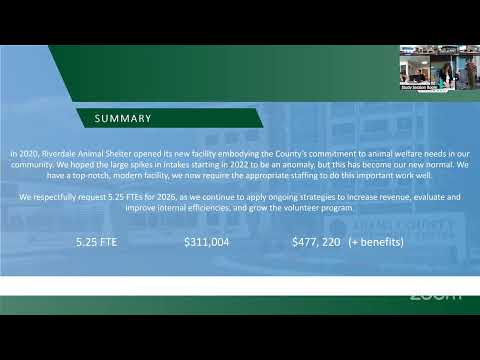
The Adams County Animal Shelter reported sustained higher intakes, several large mass impounds and stretched staffing. Director Stephanie Wild requested 5.25 FTEs focused on health care and customer‑facing roles, increased volunteer coordination and continued city cost‑sharing discussions.
Shelter Director Stephanie Wild briefed the board on staffing strains after a multi‑year rise in intakes and several large, court‑ordered mass impounds this summer. Wild said intake volume and clinical demand have pushed operations beyond existing bench strength and asked the county for 5.25 full‑time equivalents, more volunteer coordination capacity and continued engagement with municipal partners on cost‑sharing.
Wild summarized four core shelter duties for an open‑admissions county facility: (1) customer service and intake of lost or surrendered animals, (2) health care (vaccination, spay/neuter and treatment), (3) behavior evaluation and foster coordination, and (4) adoption and reunification. She said the shelter’s live‑release rate has improved past 90% since moving to a new facility in 2020 and that volunteers, foster families and regional transfer partners have been critical in managing demand.
Wild told commissioners the SIT team completed a staffing assessment that estimated the shelter needed roughly a dozen additional staff at an earlier point; the department has since added some positions but remains below an operating baseline. To mitigate workload, the shelter uses temporary veterinary staff, student internships, a county work‑crew program and expanded volunteer onboarding technology; these strategies provide relief but do not fully close gaps in clinical and customer‑facing work.
Financially, Wild said the shelter receives roughly 7% of its operating support through municipal intergovernmental agreements (IGAs) and roughly 7% from fees; donations and grants have increased after the impounds but are not a reliable, recurring source. The shelter asked staff to continue regional discussions and offered a cost‑recovery model for cities; a phased, multi‑year approach to increasing municipal support was discussed.
Ending
Wild and staff thanked the board, reiterated the shelter’s immediate need for frontline care and volunteer coordination, and said they will continue regional outreach with city partners to explore phased cost sharing and other revenue options.