Get Full Government Meeting Transcripts, Videos, & Alerts Forever!
Get email alerts on the Ethics Complaints topic
No spam. Unsubscribe anytime.
Clark County ethics panel declines to pursue two complaints after review, citing limits of its authority
Summary
The Clark County Ethics Review Commission reviewed two complaints during its public meeting, dismissed one following an executive session in which the chair recused, and voted unanimously not to hold a hearing on a second complaint after staff and commissioners cited human-resources findings and First Amendment considerations.
The Clark County Ethics Review Commission reviewed two complaints and voted not to advance either as formal ethics hearings during its public meeting, the commission announced after returning from two executive sessions.
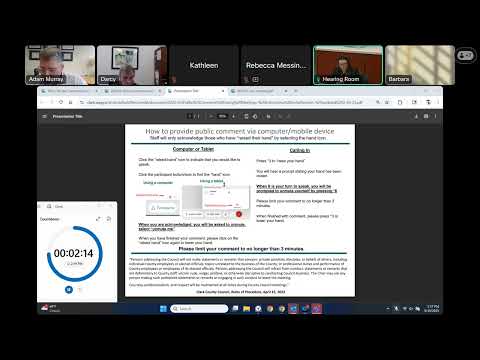
The decisions came after the county provided an investigation report on one matter and after commissioners met in executive session on a separate, previously continued complaint. Commissioners also approved meeting minutes and heard public comment at the start of the session.
The actions matter because the commission is the county body that determines whether allegations fall within the county's ethics code and whether to open formal hearings; its rulings determine whether matters move into quasi-judicial proceedings or remain personnel or civil claims handled by other processes.
Public comments: procedural limits and political accusations
During the public-comment period, callers raised political and procedural concerns. Carmen De Leon, who identified herself as disabled, complained about perceived violations involving large campaign signs and asked what enforcement authority the commission possessed. Kimberly Goheen Elvin, a caller who identified herself as a Clark County resident, delivered a broadly political statement urging the commission to hold public officials accountable for what she described as unconstitutional conduct. The commission reminded commenters that it cannot receive public comment on specific pending complaints outside a hearing because those matters are quasi-judicial and must be handled through the commission's administrative procedures.
Minutes and procedural steps
Commissioners unanimously approved the meeting minutes early in the session.
Complaint continued from Aug. 19 (Complaint 202504): chair recused; commissioners decline to move forward
The meeting record shows the first complaint considered was listed as complaint 202504, continued from the Aug. 19, 2025 meeting. The chair recused himself from that matter because it involved courts before which he sometimes appears. The remaining commissioners met in executive session and then returned to open session to report their decision, stating that they were not recommending the complaint be moved forward and that they did not find an ethics violation. The commission recorded the motion and carried it; two commissioners voted in favor and the chair was recused for that vote.
Complaint filed by Justin Forsman (Complaint 202508): county investigation found HR policy breaches; commission declines hearing
The commission next considered complaint 202508, filed by Justin Forsman, which alleged that a county employee made defamatory statements about him in public online forums while displaying that employee's government email and county identity. The complaint referenced alleged violations of the county employee code of conduct and RCW 42.52.160 (use of public resources for private benefit).
The county's investigation, summarized to the commission, concluded that the employee used a county work email address when posting comments and identified violations of Clark County Human Resources policies 13.1 (conflicts between personal interests and job requirements), 13.3 (use of county email for personal social media activity) and 14.4 (failure to exercise professional judgment and follow established policies). The county report also noted the postings created an appearance of county involvement in political activity and could undermine public trust.
When the commission reviewed the record, commissioners noted limits on the panel's authority. The commission emphasized that defamation, harassment and similar civil or criminal claims are not within its purview and that its mandate is limited to finding ethics violations under Clark County code and applicable state law. The commission discussed RCW 42.52.160 and RCW 42.52.180 (restrictions on use of public resources for political campaigns) and noted a recent Ninth Circuit Court of Appeals decision addressing use of government email addresses and First Amendment protections in a university context.
Chair Adam Murray summarized the commission's review and explained the legal concern: "For an ethics violation under our rules, I think there needs to be more, and I just don't see it here," he said, citing the absence of evidence that the employee sought a private benefit or gain under RCW 42.52.160. The commission therefore concluded that, while the county's human-resources policies may have been violated, the record did not establish an ethics violation within the panel's statutory authority.
The commission voted unanimously to determine that the allegations did not constitute an ethics violation and to decline to hold a formal hearing on complaint 202508.
What the commission did not decide
Commissioners explicitly noted they were not ruling on defamation, harassment, or other legal claims outside the ethics code. The commission's decisions were limited to whether the matters fell within the county's ethics rules; any personnel discipline or civil claims referenced in the filings remain matters for county human-resources processes or the courts.
Next steps and meeting schedule
The commission concluded its meeting and announced its next regular meeting date as Nov. 18 at 2:30 p.m.