Heppner group asks Morrow County to study mill-site move and flood mitigation to expand fairgrounds
Summary
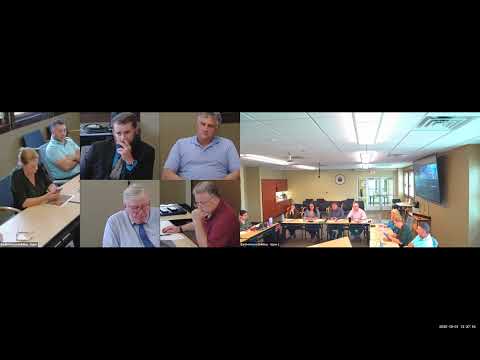
A group representing the City of Heppner’s economic development efforts urged Morrow County commissioners at a work session to study using the Port of Morrow’s former mill site — or alternatively mitigating the current fairgrounds floodplain — to expand the county fair and rodeo facilities.
A group representing the City of Heppner’s economic development efforts urged Morrow County commissioners at a work session to study using the Port of Morrow’s former mill site — or alternatively mitigating the current fairgrounds floodplain — to expand the county fair and rodeo facilities.
“We can use a space there of maybe 25 acres allowing another 45 acres or continued industrial growth,” said Corey Sweeney, mayor of Heppner, describing preliminary maps and land estimates for the mill site. He said the group is seeking county partnership to assess monetary feasibility and possible infrastructure investments.
The request grew from repeated constraints at the existing fairgrounds, which speakers said is roughly 10 acres and partly inside the floodplain, limiting upgrades and parking. Kim (last name not specified), who identified herself as chair for Wakefit and said she was attending as a certified floodplain manager for the community, said the Port and FEMA mapping complicate what land is actually developable: “That was from Business Oregon, and it was for $2,000,000,” she said, referring to a mitigation grant she has worked on for years. She said mitigation trenching being planned along Willow Creek would free some land but that FEMA map changes are difficult to obtain.
Speakers gave rough figures for potential acreage and costs. Sweeney said the mill site could yield roughly 25 acres for fair use plus additional developable acreage outside the floodplain; another presenter estimated about 45 acres would be buildable after mitigation, with roughly 35 more acres on the opposite side of the highway. An engineer’s mitigation estimate cited in the discussion put trenching at about 3,700 linear feet and a mitigation cost around $1.6 million, with fairgrounds mitigation likely lower.
County and local participants discussed available funding. Heppner representatives said they have a mix of funds: one speaker said the fair group has $1,000,000 already allocated in county funds for fairgrounds infrastructure; another referenced a separate grant amounting to roughly $200,000 with a deadline. Participants agreed the allowable uses and deadlines for those dollars must be checked before committing them to long-term planning.
Commissioners and other participants urged two paths be explored in parallel: (1) a feasibility study and master plan for the Port of Morrow mill site that clarifies ownership, water/sewer availability and required mitigation; and (2) a study of whether targeted flood mitigation or floodproofing at the current fairgrounds can yield usable acreage and cheaper short-term improvements. Several speakers cautioned that state funding that has already been allocated could be at risk if not spent in a reasonable timeframe.
No formal motion or vote was taken. County staff said the matter was requested as a community-driven topic and had been scheduled as a work session to collect ideas and determine whether further study was warranted. Participants recommended assembling an action/advisory committee (including fair and rodeo representatives, city staff and county capital-improvement advisors) and retaining an engineering firm such as Anderson-Perry to scope a feasibility study.
Supporters stressed that any move should preserve the community value of the fair and keep rodeo and fair weeks aligned for attendance. Opponents or cautious voices urged probing mitigation options for the existing site first, saying moving the fairgrounds without resolving the disposition of the current site could “trade one problem for another.”
Next steps described by staff and participants included convening a county capital-improvement advisory committee to collect public input, determine the scope of a feasibility study, confirm grant restrictions and costs, and, if warranted, request county funding or grant applications to pay for engineering and planning work. No timeline or funding commitment was approved at the session.
Why this matters: Heppner’s fair and rodeo attract region-wide events; constraints at the existing site limit capacity and utilities, while available acreage at the Port of Morrow mill site could enable larger, multiuse facilities — but ownership, infrastructure, FEMA mapping and grant rules must be resolved before any relocation or major capital work.
Ending: County staff said they will coordinate with Heppner city officials, the Port of Morrow and interested community groups to identify a next meeting and to contact engineering firms to scope potential studies. The issue remains at the study-and-consideration stage; commissioners will decide later whether to fund or formally direct follow-up work.
AI generated
The text on this page is AI generated. Summaries, highlights, analysis, and video transcripts are all produced from the original source material.
AI can make mistakes, so if you spot one, and we will fix it for everyone.
Note: the source content is unaltered by us. Any content source we link to, be it a video, an audio recording, or a document, is presented exactly as its publisher released it. That publisher is usually a government body, sometimes an individual official or another organisation.