Get Full Government Meeting Transcripts, Videos, & Alerts Forever!
Get email alerts on the Urban Open Space Fire Mitigation topic
No spam. Unsubscribe anytime.
Bend advisory group debates long-term fire and ecological management for city-owned open spaces
Summary
The City of Bend Water Advisory Group used Overturf Butte as a case study to discuss city policy on fire mitigation, ecology and infrastructure protection on city-owned urban open spaces after a $25,000 buffer project this summer. Members urged coordinated messaging, clearer permitting paths and exploring grant and workforce options to scale work.
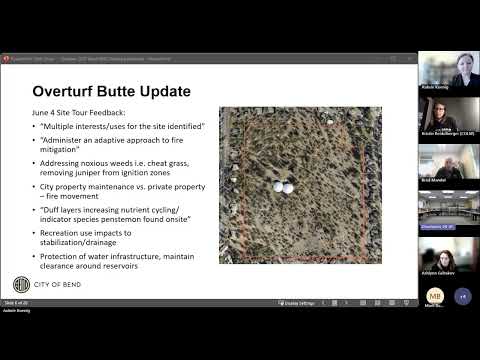
The City of Bend Water Advisory Group met in October and revisited a June site tour of Overturf Butte to discuss how the city should manage utility-owned natural open spaces long term after a summer fire-mitigation project.
Dan (staff member) summarized the city's response to neighbor complaints and the results of a contractor-led mitigation: “I think we paid $25,000 for this 20 foot buffer,” he said, and described the prescription used: crown lifting to about 6 feet, removal of trees smaller than 6 inches, creation of about 10-foot spacing from large shrubs and retention of bunchgrass where possible for soil stabilization.
Members said the work addressed immediate fire-safety concerns but raised choices about ecological value, infrastructure protection and cost. “We had a few neighbors reach out that were interested in participating in the long term planning,” Dan said, noting widespread positive feedback but one resident’s concern that brush removal reduced quail habitat.
Why it matters: these city parcels mix utility infrastructure, recreation and native habitat and adjoin residential neighborhoods. Advisory group members and guest experts emphasized that decisions affect wildfire risk, stormwater performance and neighborhood character, and that those multiple goals must be balanced in any long-term plan.
Discussion highlights
- Fire mitigation and code flexibility: Ian Gray, Urban Forester for the City of Bend, said municipal code offers limited written guidance and that allowing fire-based prescriptions can create backlogs or onerous processes for small property owners. “It was proving to be somewhat onerous for…a relatively small parcel that is bigger than an acre,” he said, describing cases where dead-tree removal required grading permits and engineering sign-offs.
- Cross-agency messaging: Ariel Cowan of Oregon State University Extension recommended closer coordination on public outreach and said the Central Oregon Wildlife Education Group — a subcommittee of the Central Oregon Fire Prevention Cooperative — could help align regional communications. “If anyone’s interested to reach out to me,” she said, she would accept liaison involvement.
- Infrastructure and operator access: Several participants, including county and engineering representatives, stressed that keeping utility infrastructure operable during an emergency must be a priority. One speaker noted sites that store chlorine or other chemical canisters require extra clearance and protection.
- Funding and workforce: Ariel and other members flagged new state grant rounds through the Oregon State Fire Marshal and the Oregon Department of Forestry and noted existing local programs that deploy youth crews for fuels reduction. “There’s a whole bunch of money that just got earmarked for the Oregon State Fire Marshal and Oregon Department of Forestry to be doing a whole new round of grants,” Ariel said, adding the city would likely be eligible to apply.
- Ecosystem and maintenance concerns: Parks and resource representatives urged treating ecosystem health and forest health as complementary to fire risk reduction. They advocated for prescriptions and contracts that limit disturbance pathways and require invasive-species treatment and post‑work maintenance so that fuel reduction does not unintentionally favor cheatgrass or other high-fire-risk species.
Group recommendations and next steps
Advisory members generally supported developing a long-term management plan for Overturf Butte as a pilot and then adapting the approach to other utility-owned open spaces. Participants named likely stakeholders to include City water and stormwater staff, parks and recreation, Deschutes County, OSU Extension, the Central Oregon Fire Prevention Cooperative, and community members from adjacent neighborhoods. Dan and other staff said the city would invite neighbor participation in future planning and would explore grant and workforce program options to lower costs and increase capacity.
The group also urged clearer, streamlined permitting paths for fire‑mitigation work that reconcile tree‑protection rules with safety prescriptions, and consistent regional messaging on why some properties are treated differently than others.
Local context and constraints
Participants noted staffing limits in development engineering and acknowledged budgetary constraints: the Overturf Butte buffer cost about $25,000, a figure raised repeatedly as a reminder that scaling similar work across many sites will require new funding or partnerships. Several speakers urged that any contracted prescriptions preserve soil stability, avoid unnecessary disturbance and include invasive‑species treatment where needed.
The Water Advisory Group said it will carry this discussion forward to allied city efforts — including the city’s urban forestry work and the Bloomberg‑funded wildfire-management initiative — and will supply input to those parallel processes.