Get Full Government Meeting Transcripts, Videos, & Alerts Forever!
Get email alerts on the Utilities topic
No spam. Unsubscribe anytime.
Commission directs staff to pursue mandatory sewer‑connection policy where lines are available; board seeks options to reduce homeowner costs
Summary
After a lengthy presentation and public comment, the Board voted 3–2 Oct. 7 to advance multiple steps toward a mandatory connection policy for properties abutting county sewer lines (in line with state OSTDS rules) while deferring a decision on waiving property assessments. Staff said roughly 28,000 parcels currently lack sewer service and that a"
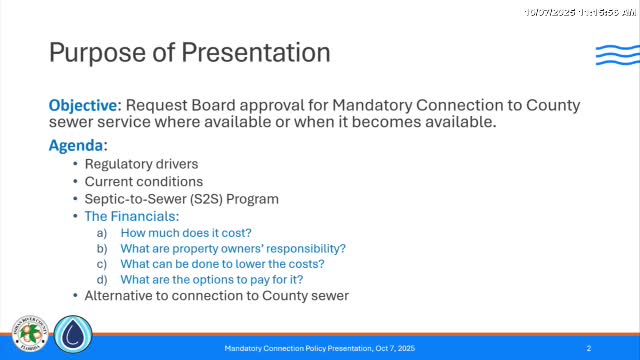
Indian River County commissioners voted Oct. 7 to direct staff to pursue a county policy to require on‑site septic systems to connect to central sewer where county sewer is available, to begin outreach and to adopt several administrative measures intended to lower homeowner costs — while deferring a decision on whether the county will waive assessments for the non‑grant portion of infrastructure costs.
Sean Lieske, director of the Department of Utility Services, and Howard Richards, the department’s capital program manager, presented an extensive briefing on state regulatory drivers, existing sewer‑service conditions, the county’s septic‑to‑sewer program, capacity and a set of proposed policy and financing steps. Lieske told commissioners the state bills at issue—House Bill 1379 and Senate Bill 1632—prohibit continued use of conventional on‑site sewage treatment and disposal systems (OSTDS) in the Indian River Lagoon BMAP without either connection to central sewer or upgrading to an "enhanced nutrient removal" OSTDS.
"By 07/01/2030, any property on an OSTDS must connect to central sewer if it's available, or upgrade to this enhanced nutrient removal system," Lieske said, laying out statutory deadlines and notification requirements in the law. He said the county must notify owners at least a year before sewer becomes available and that owners have 365 days after notification to connect; failing OSTDS would have 90 days to connect after notice.
Richards presented cost estimates and options. He said the county’s GIS and system mapping identify roughly 28,374 parcels in the urban service area that currently lack sewer availability and that, under one full build‑out scenario, bringing sewer to all those parcels would require between about $3.1 billion and $3.69 billion in public and private infrastructure investment. "This is the estimated cost of what it would take to deliver sewer to 28,000 properties," Richards said during the presentation.
The presentation differentiated public infrastructure (mains, laterals, lift stations) from private‑side connections (grinder or STEP systems, electrical, abandonment of septic tanks, property restoration and labor). Richards and Lieske showed modeling that if the county retains its "no sewer without water" policy, some homeowners would face higher connection costs because county sewer generally requires a water account; they also modeled steps the board could take to reduce homeowner costs—waiving certain connection or permit fees, procuring private‑side equipment in bulk, short‑listing contractors and using grant programs.
Staff presented a pro forma that showed per‑property cost ranges from approximately $18,000–$165,000 depending on complexity and whether new main lines, water service or a grinder/pump is required; if the board agrees to a set of staff proposals (suspending the "no‑sewer‑without‑water" policy, waiving certain fees and allowing the utility to procure private‑side equipment) Richards said the estimated per‑property range would fall to roughly $9,000–$19,000 for many homeowners, although the full county build‑out cost would remain in the multi‑billion‑dollar range.
Staff identified potential funding sources including FDEP and other state grants (which typically pay for public infrastructure, not private‑side connections), the Clean Water Coalition (income‑eligible assistance), USDA Section 504 loans/grants, CDBG, SHIP, the state’s small‑loan programs and county financing options. Staff also described alternatives such as STEP/STEP‑like systems and nitrogen‑reducing aerobic OSTDS units that can cost $12,500–$25,000 to install and require annual service contracts.
Board action: After extended public comment and discussion, Commissioner Adams moved (seconded by Commissioner Moss) to approve several of staff’s recommendations—specifically items labeled B, C, D, G and J in the staff report (which include adopting a mandatory connection policy consistent with state law, providing notification and outreach, supporting negotiated costs in hardship cases, waiving specified county utility permit fees and endorsing third‑party financing/assistance pathways)—and to direct staff to return with further analysis on item E (waiving county assessments for the portion not covered by grants). The motion passed 3–2; Vice Chairman Law and Chairman Fletcher registered opposition.
Commissioners voiced concern about costs to homeowners and the timing of state requirements; several urged aggressive pursuit of grant funding and legislative advocacy. Lieske and Richards said staff will begin targeted outreach to neighborhoods where sewer lines abut homes, pursue grant and low‑interest loan programs and return to the board with recommended ordinance language and an implementation plan. Richards said staff will also produce a detailed accounting of the fiscal impact if the board elects to waive assessments.
Why it matters: The move implements (and aims to operationalize) state law that will compel property owners in the Indian River Lagoon BMAP to connect to sewer where available or to install upgraded OSTDS systems by 2030; the county must balance environmental goals, statutory deadlines and significant potential costs to homeowners.