Get Full Government Meeting Transcripts, Videos, & Alerts Forever!
Get email alerts on the Public Safety topic
No spam. Unsubscribe anytime.
Wilson County EMS outlines trauma survivability initiative centered on prehospital whole blood and ultrasound
Summary
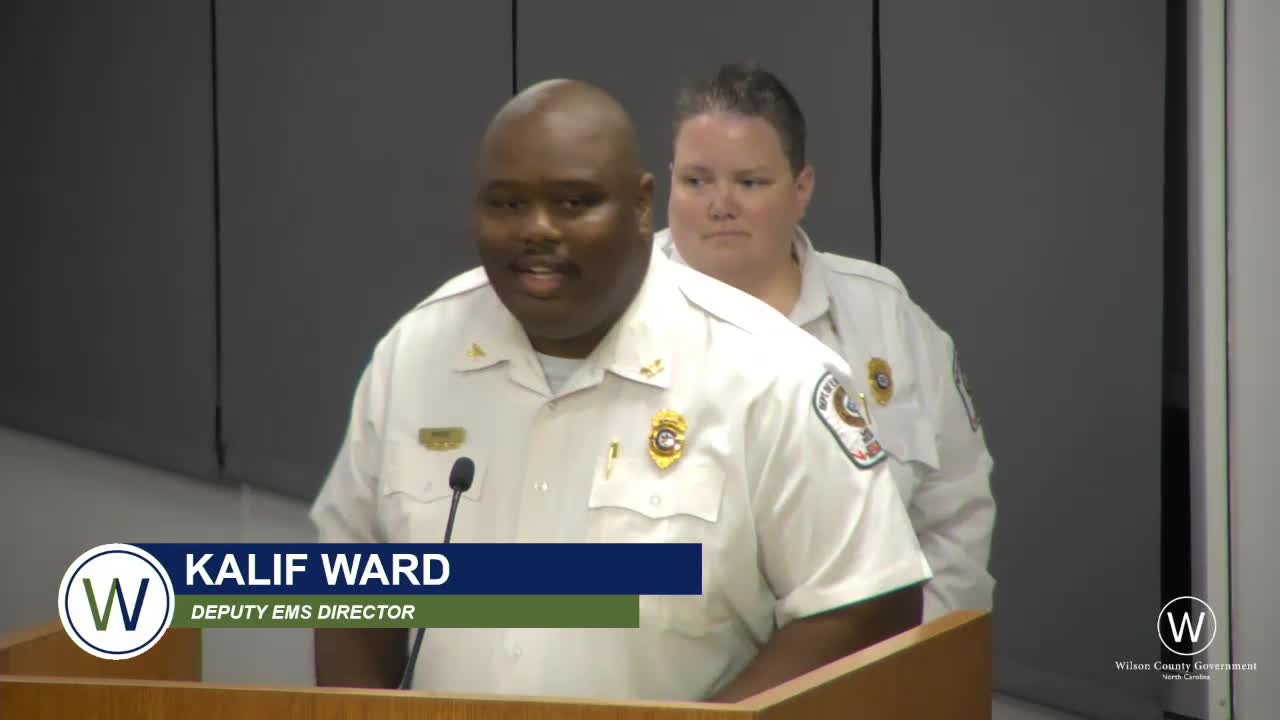
Deputy EMS Director Califf Ward presented a trauma survivability initiative funded by a $100,000 responsive grant from the Health Care Foundation of Wilson to implement prehospital whole blood, point-of-care ultrasound and app-based clinical decision tools across county EMS units.
Wilson County Deputy Emergency Medical Services Director Califf Ward presented the county’s trauma survivability initiative at the Board of Commissioners meeting on Oct. 6, saying the program is designed to bring lifesaving care to critically injured patients earlier in the prehospital setting.
Ward said the county analyzed a 2023 cohort of traumatic-injury patients and found about 20% of those patients would have met criteria for a prehospital whole blood transfusion. He told commissioners, “for every 1 minute delay that a patient has that need blood, there’s about an 11 percent increase in their mortality.” He said those findings drove county efforts to change prehospital practice.
The initiative is funded by a $100,000 responsive grant from the Health Care Foundation of Wilson. Ward said the funds will be used to place whole blood on quick-response vehicles (QRVs), equip ambulances and QRVs with point-of-care ultrasound devices, purchase airway-management equipment to enable advanced airway care in the field, and license an app-based clinical tool to help medics with dose calculations and protocol decision-making.
Ward described the operational rationale: because the nearest level 1 trauma centers are roughly 30 minutes away (WakeMed in Raleigh to the west and ECU Health in Greenville to the east), some seriously injured patients can benefit from earlier diagnostics and interventions in the field. Point-of-care ultrasound, he said, helps crews detect internal bleeding that may not be apparent on external exam and supports destination decisions in consultation with receiving physicians.
When asked whether the equipment would appear on all units, Ward said point-of-care ultrasound and advanced-airway technology will be placed on all in-service ambulances and the two QRVs; whole blood will be staged on QRVs and with supervisors who routinely respond to high-acuity calls.
The board received the briefing; no formal action was required that evening. Commissioners thanked EMS staff and acknowledged prior county work to merge and modernize EMS operations.
Ward’s presentation and the board’s discussion establish immediate follow-up needs including training, protocols for blood storage and use, and integration of the clinical app into standard operating procedures.