Get Full Government Meeting Transcripts, Videos, & Alerts Forever!
Get email alerts on the Disciplinary Actions topic
No spam. Unsubscribe anytime.
Board reviews multiple disciplinary cases; approves fines, cautions and monitoring conditions
Summary
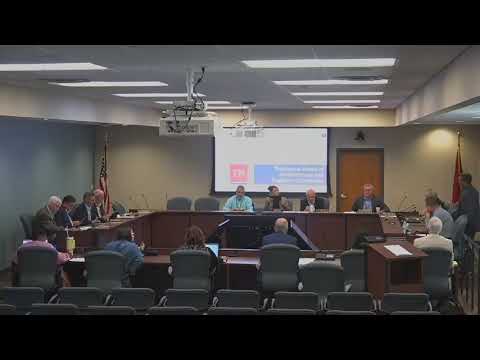
At its Oct. 2 meeting the Tennessee Board of Architecture and Engineering Examiners heard legal reports and voted on several disciplinary matters — issuing letters of caution in some cases, authorizing consent orders with fines in others, and setting monitoring conditions for a licensee with a multi‑state disciplinary history.
The Tennessee Board of Architecture and Engineering Examiners considered a series of disciplinary matters during its Oct. 2 meeting and approved recommendations from board counsel on multiple files, including consent orders, fines and monitoring conditions.
Scott (legal counsel) presented several matters involving out‑of‑state disciplinary actions that registrants failed to report on Tennessee renewal applications, and cases alleging improper stamping and practice outside a registrant’s firm affiliation. In several matters the board authorized consent orders with civil penalties; in others the board issued letters of caution or closed cases after additional review.
Key board actions included: - A motion to approve a committee recommendation allowing an application from Darryl McCann (landscape architect applicant) to proceed conditionally if he satisfies the terms of a Texas agreed citation, including payment of the stated fine; the Landscape Architecture Committee moved and the board approved that approach for processing the application. - Case 2025031711 (professional engineer): the board authorized formal charges and approved a consent order totaling $10,500 in civil penalties for improper stamping/signature practices on a 10‑drawing set (board voted to assign $500 per affected drawing for two separate violations and a $500 filing penalty), and required the registrant to pass the board’s laws and rules exam. The board also directed staff to open a complaint concerning the complainant’s failure to file a firm disclosure form. - Case 2025037371 (professional engineer with multiple out‑of‑state actions): after reviewing the registrant’s disciplinary history across several states the board approved a consent order imposing $3,000 in fines (revised from an earlier recommendation of $1,500) for failure to disclose revocations/surrenders and required submission of a project log for all Tennessee work at mid‑cycle checkpoints; the order will also require the registrant to pass the laws and rules exam and submit selected work for review as part of monitoring conditions. - Case 2025039321 (professional engineer): the board approved a $500 consent order for providing false information on a renewal application; the record shows the registrant later reported the out‑of‑state action when notified. - Case involving a convicted registrant incarcerated in Georgia (case 2025037401): the board approved a $1,000 civil penalty for the conviction and failure to report and resolved to perform a “Fresh Start” review at the time of license renewal to evaluate rehabilitation materials before any reinstatement; staff will withhold renewal until the review is complete.
Several other matters were closed with letters of caution where out‑of‑state discipline had been reported or did not meet Tennessee’s reportability threshold. Board members who spoke during the disciplinary agenda included Frank Wagster, Rick Thompson, Blair Parker, Jason Carter and others who asked clarifying questions about precedent, enforcement mechanics and monitoring logistics.
Board counsel and staff said administrative steps will follow: consent orders will be drafted for signature, compliance checkpoints will be calendared, and associated complaints opened where staff was directed to investigate related firm disclosure failures.