School committee upholds superintendent, keeps Statewide depot busing after parent appeal
Loading...
Summary
After a public appeal from a North Kingstown parent over depot-style routes and a disabled student’s pickup, the school committee voted unanimously to uphold the superintendent’s decision to contract with Statewide Transportation and maintain depot stops; committee members urged the parent to pursue RIDE’s appeal process.
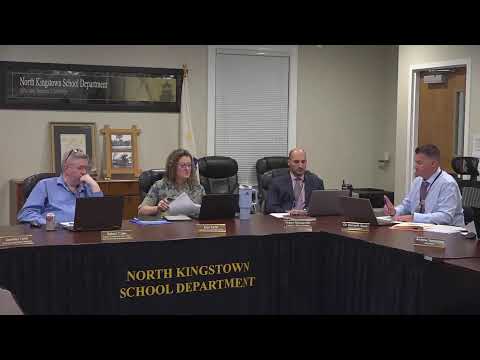
The North Kingstown School Committee on Oct. 7 voted unanimously to uphold Superintendent Duba’s decision to contract with Statewide Transportation and to use depot-style bus stops for students who attend private, parochial and charter schools.
The committee’s decision came after a public appeal from Kent Dressler, a North Kingstown resident and parent, who told the committee that new depot stops require his disabled son and other children to be dropped off as much as 2.5 miles from their home. “You either don't know what's going on in your district or you're just plain lying to me,” Dressler said during his appeal.
The nut of the dispute was the district’s April decision to move from neighborhood drop-offs to depot stops and to contract with the vendor known in committee discussion as Statewide. Superintendent Duba told the committee that the district notified families of the change in April and that families who wanted Statewide-provided transportation were instructed to register through Statewide’s portal. She said the district only learned of some route details — including an apparent stop near Dressler’s neighborhood — when the committee staff received Statewide’s route files the night before the meeting.
Legal counsel for the committee explained the limits of the school committee’s authority. Citing state law (16-21-1.4 and 16-21.15), counsel said that once the district enters a contract with a statewide provider, the operational relationship is between families and the provider and that appeals relating to the provider’s decisions are handled by the Rhode Island Department of Elementary and Secondary Education (RIDE). “If a family feels that the transportation they’re being provided is not suitable, they are directed to go directly to RIDE,” counsel said.
Transportation supervisor Michelle (transportation supervisor) described the notification process. She said district staff asked families to sign up in the spring as in past years and then provided those sign-up lists to Statewide. She told the committee that Statewide generally organizes depot stops as part of its statewide operating procedures and that requests for individual accommodations — for example tied to a student’s IEP — are routed through Statewide and RIDE, not directly handled by the district.
Committee members voiced sympathy for Dressler’s situation while also citing the fiscal and operational reasons for the change. One member said the switch to Statewide kept roughly $100,000 within the town’s budget for public-school transportation. Several members urged Dressler to pursue the RIDE appeal process; one said that if RIDE denied an appeal, the committee could then revisit the matter.
After deliberation the committee moved to “uphold the superintendent’s recommendation to continue contracting with Statewide and refer the family to Statewide/RIDE appeals.” The motion passed on a unanimous voice vote.
The committee did not instruct the administration to terminate the Statewide contract; members noted the district may reconsider the arrangement when the contract comes up for renewal. Superintendent Duba said the district would share with the parent available records and the correspondence from the police chief that addressed the safety of depot stops.
Dressler told the committee he intends to pursue further action. The administration and at least one committee member said they planned to assist by sharing documentation and by clarifying the appeal steps to RIDE.