Minnesota witnesses warn SNAP cuts, program errors could deepen food insecurity
Summary
A testifier at a state subcommittee hearing said Minnesota food shelves are at capacity and warned federal SNAP reductions and state error rates could exacerbate hunger; she cited recent program cuts and urged system modernization.
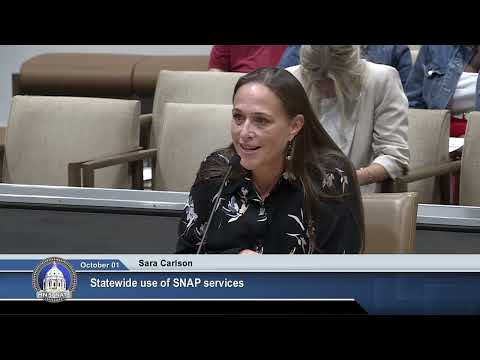
A testifier at a hearing of the Federal Impact on Minnesotans and Economic Stability Subcommittee warned that recent program cuts and lingering administrative errors in Minnesota’s food-assistance programs risk worsening household hunger and straining food shelves statewide.
“I don't understand. Why do we have lines down the block for people to get access to healthy food? ... there’s not enough food,” the testifier said. She told the subcommittee that Minnesota food shelves saw about 9,000,000 visits last year — roughly 2.5 times the visits recorded in 2020 — and that the emergency food system now regularly supports about 18% of Minnesota households.
The testifier said those pressures come as federal and state-level policy changes will reduce SNAP (the Supplemental Nutrition Assistance Program) benefits for some people. She cited a provision she called the Big Beautiful Bill Act and said that when its new requirements “kick in and some people lose access to SNAP, food shelves cannot make up the difference.”
Why this matters: food-shelf operators report record usage, the testifier said, and several state programs that supported local food access were recently cut. She told the panel that the state’s local food purchase assistance program was cut by $4,700,000 on March 7 and that a local food-for-schools and childcare cooperative agreement was cut by $13,000,000 on the same date. She also said SNAP-Ed staffing fell by 60 people.
The testifier discussed Minnesota’s SNAP error rate as part of the conversation. She said the state’s error rate was about 9% in 2024, just under the national average she cited at about 11%, and noted new federal guidance that states above a 6% error rate may face increased federal cost-sharing. She estimated that, based on current caseloads, Minnesota could face a cost shift of about $86,000,000 a year if error rates remain elevated.
“Error rates ... are often based on client errors that we are unaware of. The forms they have to fill out are very complicated, and errors happen,” the testifier said, adding that Minnesota’s eligibility and benefits systems are technologically outdated and lack interoperability. She said counties told the subcommittee they “need better technology, to get these error rates down.”
The testifier also cited a long-range federal spending change, saying roughly $300,000,000,000 will be cut from SNAP between now and 2034 and warning that the gap would have to be covered in other ways. She noted that reduced SNAP benefits would affect not only families on the program but also local grocers, schools, and businesses that face greater instability when employees and students go hungry.
On next steps, the testifier urged subcommittee members to “work together, to speak to each other, to hear the people, and stop pointing fingers,” and to prioritize modernization of the state’s enrollment and eligibility systems so they can communicate and reduce preventable errors.
The hearing record does not include a named sponsor or formal motion related to the measures discussed. No formal votes or committee directives appear in the testimony excerpt.
AI generated
The text on this page is AI generated. Summaries, highlights, analysis, and video transcripts are all produced from the original source material.
AI can make mistakes, so if you spot one, and we will fix it for everyone.
Note: the source content is unaltered by us. Any content source we link to, be it a video, an audio recording, or a document, is presented exactly as its publisher released it. That publisher is usually a government body, sometimes an individual official or another organisation.