Get Full Government Meeting Transcripts, Videos, & Alerts Forever!
Get email alerts on the Public Safety Firearms Regulation topic
No spam. Unsubscribe anytime.
Seaside planning commission backs zoning rules, security standards for firearm and ammunition sales; recommends 300-foot buffer from sensitive uses
Summary
The Seaside Planning Commission voted June 25 to recommend a zoning ordinance amendment that would create a new classification for firearm and ammunition sales, limit locations to a southwest quadrant of the city and require enhanced security and annual licensing overseen by the police chief.
The Seaside Planning Commission voted June 25 to recommend that the City Council adopt a zoning ordinance amendment creating a regulated classification for the sale of firearms and ammunition and establishing location and operating standards for such businesses in most of the city.
Planning staff told commissioners the ordinance, drafted in two parts of the municipal code, would add more specific licensing and security requirements under Title 5 and would set where sales are allowed under Title 17. "On March 20, council directed staff to review appropriate locations for the sales of firearms and ammunition within the city of Seaside," Andrew, planning staff, said during a presentation.
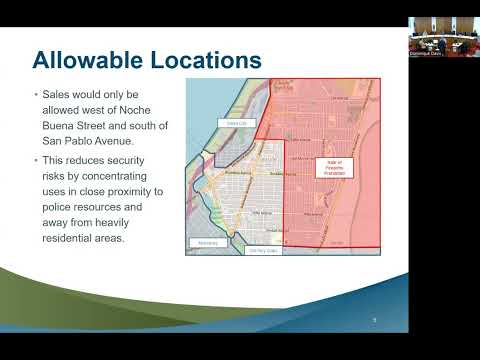
Why it matters: the ordinance would leave the West Broadway Urban Village already restricted by a May 1 council resolution, and would limit sales elsewhere to a southwest quadrant of Seaside "west of Noche Buena and south of San Pablo," in the community commercial (CC), regional commercial (CRG) and heavy commercial (CH) zoning districts only, and only with a use permit. Staff recommended a 300-foot minimum distance from sensitive uses such as parks, schools, recreation facilities and day cares; staff showed maps comparing 200-, 300-, 500- and 1,000-foot radii and said 300 feet aligned with the city’s notification radius while balancing available commercial parcels.
The Title 5 changes would move retail firearm activity from being treated as general retail to a licensed use with annual inspections by the police chief. Security measures described in the draft ordinance include physical hardening of premises in consultation with the police chief and building official (bollards, bars on windows), alarm and video monitoring, secure storage (safes or vaults) for firearms off the sales floor, and on-floor security measures such as quarter-inch trigger‑guard cables with no more than five firearms per cable. The draft also requires annual licensing and inspection by the police chief. "The number one thing we're looking at preventing is that exact scenario" of stolen firearms entering illegal markets, Andrew said.
Commissioners asked staff to confirm technical details in the security language — for example whether cable material should be specified (a commissioner suggested stainless steel) — and whether sales of firearm components (barrels, triggers, parts) should be regulated alongside complete firearms and ammunition. Andrew told the commission he had not yet spoken with the police chief about components and sought the commission's flexibility to include components if the police chief advised it.
Staff also noted Title 17 review is limited to zoning (where sales would be allowed). Title 5 licensing and security would remain within the police chief’s purview. Staff said there were no active business applications at the time of the meeting.
Votes at a glance - Approval of minutes (May 28, 2025): motion to approve passed. Tally: yes 5, abstain 2 (names not specified in transcript). - Use permit UP20025-004 (Meals on Wheels / Taylor & Carey Loewish Revocable Trust, 1020 Auto Center Parkway): continued to July 9, 2025 (no formal hearing or vote on merits at this meeting). - Zoning ordinance amendment ZOA 2025-001 (create regulated use for firearm and ammunition sales; recommended 300-foot buffer; allowed CC, CRG, CH; West Broadway Urban Village already prohibited): commission voted to recommend approval as drafted. Tally recorded in the meeting: yes 7, no 0, abstain 0.
What happens next: the commission’s action is a recommendation to the City Council; the ordinance must move through the council process before changes to the municipal code or licensing rules take effect. Staff said the police chief will play the primary enforcement and licensing role under Title 5, and the planning office will review zoning and use-permit consistency with the general plan when applications arrive.
Details and limits: staff cautioned that some parcels within the mapped quadrant may not meet general plan consistency or coastal zone requirements and therefore could be ineligible even if their zoning is CC, CRG or CH. Staff also emphasized that some security measures (wall or roof hardening) will be determined case by case in coordination with the police chief and building official rather than by precise prescriptive language in the ordinance.
Commissioner remarks stressed public‑safety priorities and deference to the police department’s operational judgement. The commission voted to forward the resolution recommending approval to the City Council.