Get Full Government Meeting Transcripts, Videos, & Alerts Forever!
Get email alerts on the Education Finance topic
No spam. Unsubscribe anytime.
Glendale Elementary board approves revised annual financial report; presenter flags $4 million special-education shortfall
Summary
The Glendale Elementary School District Governing Board on Oct. 2 approved a revised fiscal 2025 Annual Financial Report after a presentation outlining a roughly $4 million shortfall in special-education funding, declines in enrollment that squeeze classroom percentages, and outstanding bond obligations.
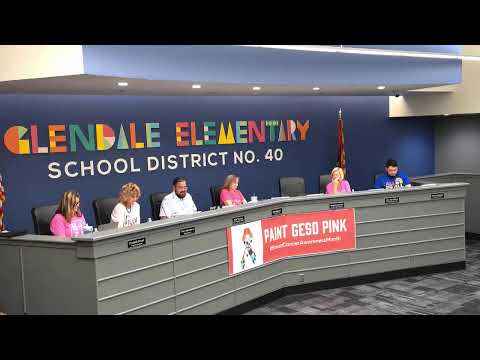
The Glendale Elementary School District Governing Board on Oct. 2 approved a revised annual financial report for fiscal 2025 after a presentation by district finance staff that detailed a shortfall in state special-education funding and pressures from declining student enrollment.
Mike Barragan, who presented the report for district staff, told the board that "the annual financial report ... [is] due to the Department of Education on an annual basis by October 15." He said the district estimates it receives about $11,600,000 from the state's special-education calculation while spending about $15,700,000, leaving roughly a $4,000,000 gap that the district covers from general maintenance and operation funds.
The shortfall matters because, Barragan said, federal and other allocations do not fully close the gap. He said the district receives about $3,200,000 in federal allocations for special education and that if the state's funding formula funded 40 percent rather than the current level, the federal and state shares would add materially to the district's ability to avoid using M&O (maintenance and operation) dollars to cover special-education costs.
Board members asked questions about how enrollment declines affect budget metrics. One board member described the effect as "a mathematical equation" in which falling enrollment reduces state funding and makes classroom-dollar percentages appear less efficient, even when district spending is intentional. Barragan reiterated that enrollment declines make it harder to maintain classroom-dollar percentages and said the district has been "very intentional in saving some of those dollars" as enrollment falls.
The presentation covered other fiscal details presented to the board and the public, including: - Maintenance and operation spending: Barragan said salary and benefits comprised about 72 percent of M&O spending in the last reported year. - Special-education totals: The presenter described a combined special-education spending picture of roughly $21,600,000 when adding M&O expenditures, federal IDEA and other components described in the report. - Bond debt and capital: The district made about a $2.7 million payment, leaving just under $41,200,000 in outstanding bonds, and said about $12,500,000 is held at the treasurer's office for new construction or replacement schools. Barragan also noted roughly $405,000 generated from the School Facilities Oversight Board for multiple sites. - Capital and performance contracting: The report showed $4,900,000 in capital spending in the current year and a mechanism, performance contracting, used to replace aging equipment when capital dollars are insufficient.
Board members also asked about the potential budget impact of ongoing litigation referenced in the presentation (the Roosevelt/Bishop matter and related funding discussions). Barragan said if that litigation "goes through the full legal process, I think it's gonna be several years" before any statewide financial impact is realized.
After the presentation and questions, the board moved to approve the revised annual financial report. The motion passed unanimously: Mr. Jaramillo — Aye; Miss Wilson — Aye; Miss Bartels — Aye; President Martinez — Aye.
The board received the report as a formal informational and approval item. No additional policy actions were taken in connection with the AFR during the meeting; staff signaled follow-up work to break down utility- and efficiency-related variances and to present further detail on capital spending and carryforward balances later in the year.