Get Full Government Meeting Transcripts, Videos, & Alerts Forever!
Get email alerts on the Land Use Traffic And Parks topic
No spam. Unsubscribe anytime.
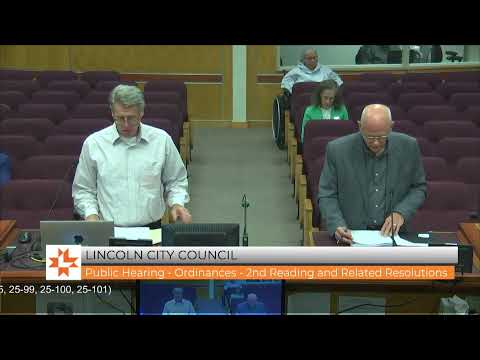
Council hears debate over Highlands Townhomes: turn‑lane length, parkland sale and stormwater detention
Summary
City staff recommended denying a developer’s appeal to shorten required turning lanes on Fletcher Avenue for a proposed 72‑unit multifamily project, citing safety and AASHTO guidance; the developer argued counts and costs justify a shorter lane and that moving detention onto adjacent golf‑course land enables higher density housing.
Lincoln city staff and a developer clashed on Oct. 6 over traffic safety, cost and housing trade‑offs tied to a proposed 72‑unit multifamily project near Northwest Thirteenth Street and West Fletcher Avenue.
Elizabeth Elliott, director of Lincoln Transportation and Utilities (LTU), asked the council to deny a developer request to shorten required turning lanes on Fletcher Avenue. “Ultimately, our reason for denial is grounded in safety first,” Elliott said, explaining LTU’s access‑management standard calls for a 300‑foot turn lane on that arterial and that the city’s standard is supported by AASHTO guidance and federal crash‑reduction goals under the Safe Streets Lincoln initiative. Elliott told the council the developer’s requested reduction — roughly cutting the lane length to 155 feet — “does not meet the safety standards, and that would create an unsafe area where we would likely see many more rear end crashes and potentially serious, if not deadly crashes at a 45 mile an hour arterial zone.”
City planning and parks staff described related land actions that are part of the same package: a use permit to develop 3.45 acres into multifamily housing, comprehensive‑plan conformance for a small area of city‑owned land, a change‑of‑zone and a proposed real‑estate exchange in which Highlands Townhomes LLC would purchase about 0.7 acres of city parkland adjacent to Highlands Golf Course to construct a stormwater detention/water‑quality cell. Maggie Stokke Ross of Lincoln Parks and Recreation said the department supports the sale, calling the surplus area small, not used for active recreation and a maintenance burden. Jocelyn Goldin from the city law department said the city would receive about $30,000 for the parcel and that proceeds would go into the advanced land acquisition fund per city charter; the parks benefit, she said, is reduced maintenance obligations.
Developer representatives said gravity sewer limitations originally kept the parcel from being developed and that a pump‑station solution now makes multifamily feasible. Rick Onond of ENA Consulting and developer Bob Lewis said turning‑lane requirements are excessive for the specific, low‑volume use proposed and that shorter lanes would reduce development costs. Onond said traffic counts the team conducted on July 29 showed peak hour trips associated with the site of 521 eastbound and 99 westbound trips and that national guidance would require considerably higher trip thresholds (844 eastbound and 247 westbound) to justify a full turn lane as a cost‑effective measure. He said the developer’s proposed 155‑foot turn lanes would cost about $451,000; extending to the city’s 300‑foot standard would be about $687,000.
Council members pressed both sides on technical points including sight distance, roadway grade and how the project’s detention location affects unit count. Developer testimony said moving detention onto the golf course allowed the proposal to reach about 72 units; without off‑site detention the developer said unit count would be “probably half.” Council members asked about the sight distance analysis and the developer said a sight‑distance exhibit submitted to LTU “greatly exceeds what is required by national standards.” City staff countered that many federal benchmarks assume turn‑lane entry speeds near 35 mph; in this corridor, speeds commonly exceed the posted 45 mph and the approach includes a curve and a grade that factor into safety calculations.
Elliott said LTU negotiated two of three requested deviations with the developer and offered a compromise to shorten the lane by 50 feet, but that the remaining difference on the critical turning lane was significant enough that staff recommended denial. Council member questions clarified that a 50‑foot reduction would save roughly $46,000 compared with the full city standard; the developer said the reduced lane length and other cost savings support more affordable units.
No final council vote on the deviation or related land actions appears in the Oct. 6 transcript. The matter was presented in public hearing with staff recommendations, applicant rebuttal and public comment opportunities before the council; the record shows active technical exchange and multiple staff and applicant exhibits were referenced.
Why it matters: the decision will affect whether the project proceeds with the developer’s proposed access and detention arrangement, the city’s roadway safety posture on a 45‑mph arterial, and the disposition of a small parcel of parkland and the associated $30,000 advance‑land acquisition funds.