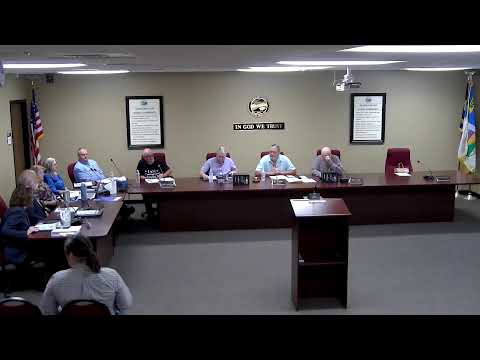
Alleghany County commissioners approve opioid fund carryover, budget amendments and investment of reserves
Loading...
Summary
Alleghany County commissioners voted to carry over opioid settlement funds for jail addiction treatment and approved multiple budget and investment measures, including transferring $1.5 million into a transfer facility budget and placing county reserves in the North Carolina Capital Management Trust.
Alleghany County commissioners voted to carry over opioid settlement money for addiction treatment at the county jail and approved a series of budget and investment measures during their regular meeting, commissioners and staff said.
The actions included a motion to amend a resolution allowing unspent opioid settlement funds appropriated last fiscal year to be carried into the current fiscal year for addiction treatment services at the Alleghany County jail; a general fund budget amendment allocating fund balance for the county—s transfer facility project; a transfer of $1,500,000 into the transfer facility budget; acceptance of two EMS grants totaling $25,000 for training equipment; and authorization to place funds with the North Carolina Capital Management Trust, county staff said.
Why it matters: Commissioners said the measures preserve funding already authorized for local programs, move committed money into the account for the transfer facility and seek higher yield on idle fund balance by using an LGC-approved pooled investment vehicle rather than keeping all funds in low-yield county savings accounts.
The opioid settlement carryover was presented by Kelly Wells of Appalachian Health. "So I'm here on behalf of the opioid settlement committee, and our request is that we consider continuous allocation of funding to the Allegheny jail," Wells said during public business. She told the board the funds had been appropriated last fiscal year but not spent and that the committee requests the money be carried over so the committee can follow up this year. Commissioners approved the amended resolution by voice vote, 4-0.
County manager April Ham presented the budget amendments and the recommendation to invest county funds in the North Carolina Capital Management Trust. Ham described the trust as an investment entity approved by the Local Government Commission and said the county could access its money quickly. "Safety, liquidity, and yield is the priorities with this capital management trust," Ham said. She told commissioners the county could withdraw funds and have them back in its checking account the next morning if needed.
Commissioners voted 4-0 to: adopt general fund budget amendment No. 5, transfer $1,500,000 into the transfer facility budget, and accept two EMS grantsa0($10,000 from the Winston-Salem Foundation and $15,000 from the Roaring Gap Foundation) for training equipment. Following discussion about liquidity and risk, commissioners also approved placing the $1.5 million previously allocated for the transfer facility and an additional $5,000,000 of fund balance into the North Carolina Capital Management Trust, by voice vote, 4-0.
Commissioners and staff discussed risk and oversight. Ham and others noted the trust is not FDIC insured like a bank deposit but is overseen differently and is approved by the state—s Local Government Commission; the presentation also referenced SEC oversight. A commissioner noted the difference from a certificate of deposit and expressed comfort with staff—s research and the number of other local governments participating. Ham told the board the county—s current on-hand savings yield was "below 3% now," and one commissioner asked a staff estimate of potential additional interest; a figure of roughly $200,000 per year was mentioned in the meeting as an illustrative upside, but specific future yields were not guaranteed and are subject to market conditions.
Other business noted in the county manager—s report included that staff submitted materials by a September 30 deadline to apply for an interest-free loan from Blue Ridge Energy (award decisions expected in January), hiring of a veterans services director (Wes Breininger, start date noted as Sept. 30) and a grant writer (Rahel Busuwork, start date Nov. 11), and ongoing coordination with local businesses and community groups. Those items were presented as informational updates rather than formal votes.
The board ended the public portion of the meeting by approving a motion to enter closed session under the North Carolina statute cited by staff for economic development (General Statute 143-318.11(4)).