
Board chair lays out why Bristol schools ran a deficit and flags high-school roof repairs
Get AI-powered insights, summaries, and transcripts
Subscribe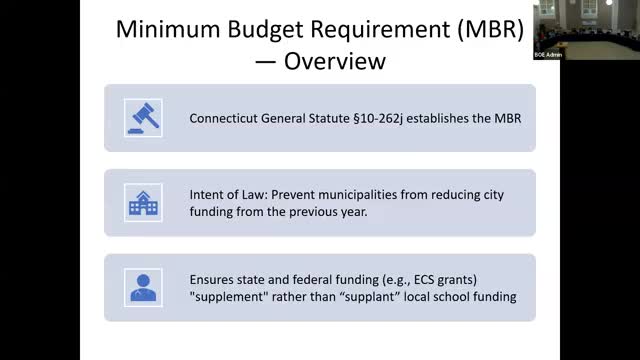
Summary
Shelby Ponds, chair of the Bristol Board of Education, told the board on Oct. 1 that the district ran a deficit after the city reduced its annual appropriation in prior years and used the board—s non-lapsing reserve to cover municipal funding shortfalls.
Shelby Ponds, chair of the Bristol Board of Education, told the board on Oct. 1 that the district ran a deficit after the city reduced its annual appropriation in prior years and used the board—s non-lapsing reserve to cover municipal funding shortfalls.
Ponds said Connecticut General Statutes —S 10-262j (the minimum budget requirement) prevents municipalities from reducing local education funding year over year and that the state notified Bristol on Sept. 23 that the city had not met that requirement in the prior year. The state required the city to provide $1,372,811 to cure the shortfall or face a penalty amounting to double that sum in a subsequent year, she said.
The chair said the district—s apparent funding growth over the past four years masks two facts: about $10.75 million of the increase arrived as late, state-mandated payments to cover shortfalls, and roughly $3.9 million came from the district—s own non-lapsing reserve. Those two items, she said, mean the district was not funded upfront at the levels the Board of Education requested.
"If we were funded appropriately to begin with, then it wouldn't have required intervention or a state mandate," Ponds said, adding that using the reserve to replace city funding is effectively supplanting and leaves the district with no rainy-day balance.
Ponds cited Connecticut General Statutes 10-248a, which allows boards to keep up to 2% of unspent funds in a non-lapsing account for one-time uses. She said the city used roughly $3.9 million from that reserve across several years to reduce its appropriation to the school district; the reserve had been intended for one-time purchases such as Chromebooks.
The chair described a pattern of rising expenses: a 12% increase in overall costs this past year, a roughly $3.4 million insurance increase, a $2.74 million transportation cost rise, and about $2.6 million higher special-education costs. She said special-education tuition and outplacement costs rose faster than planned and helped drive the shortfall.
Ponds also updated the board on building repairs. The Board of Finance approved a roof replacement for Bristol Central High School at roughly $8.8 million; the board previously funded a temporary patch of about $168,670 that will be replaced by the full project. Bristol Eastern High School, she said, has only a patch and no approval for replacement at this time; both high schools serve roughly 1,000 students and would require relocation plans if a major roof failure occurred.
The chair appealed to the city and voters to treat education funding as a priority and warned that piecemeal repairs can raise overall costs when work is done out of sequence.
The board—s discussion did not produce a formal vote on funding beyond reporting the status of Board of Finance decisions. Superintendent Iris White and other administrators said they would continue to brief the board as projects and funding decisions move through the Board of Finance and city processes.
Background: Ponds said the state had required supplemental funding in three recent years because of mandates, totaling about $10,748,513; that, combined with use of the district—s reserve, created the appearance of higher funding even as operational cashflow remained strained.
Next steps: Ponds said Edgewood renovations were recommended as a —3renovate-to-new—2 approach at the special meeting last week and will be on the Board of Finance agenda on Oct. 28; she urged commissioners to support that request so younger learners have a long-term, safe learning environment.