Get Full Government Meeting Transcripts, Videos, & Alerts Forever!
Get email alerts on the Ems Finance topic
No spam. Unsubscribe anytime.
Skagit County hears proposal to update ambulance transport fees; EMS director urges single rate, 3% annual adjustment
Summary
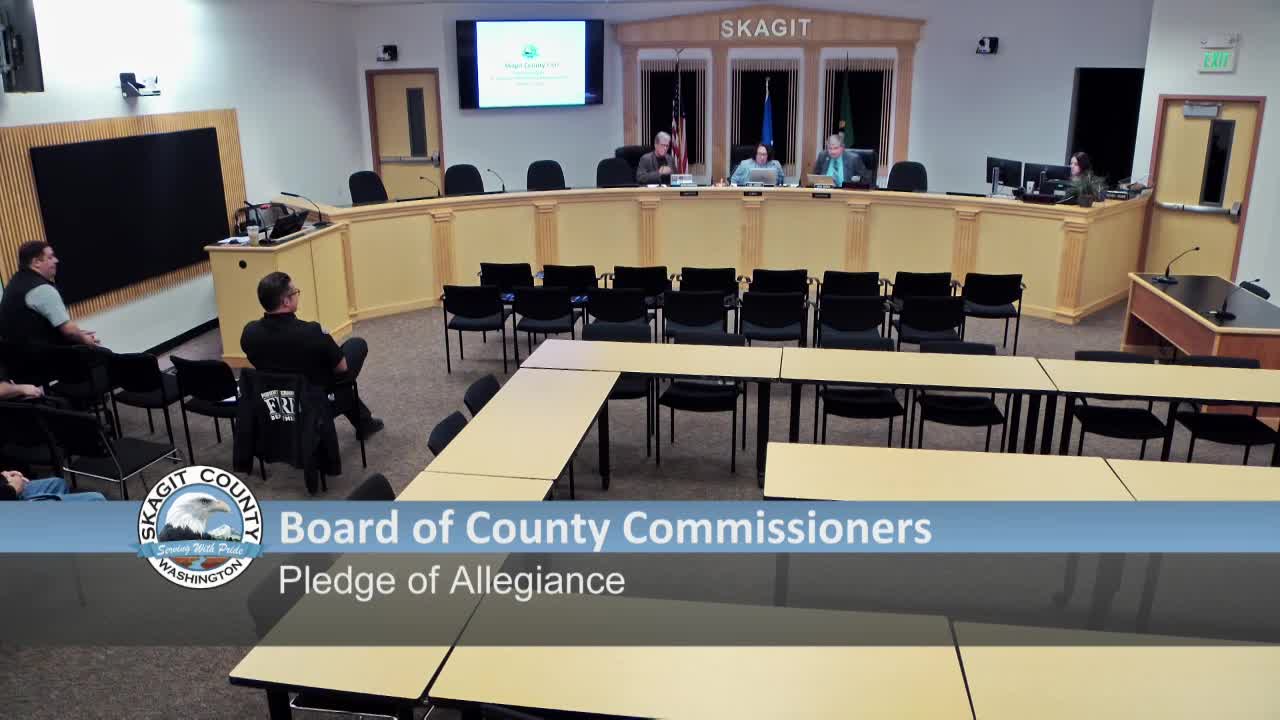
Skagit County commissioners held a public hearing Oct. 6 on proposed revisions to Resolution 20170.124 that would update the county ambulance transport fee schedule.
Skagit County commissioners held a public hearing Oct. 6 on proposed revisions to Resolution 20170.124 that would update the county ambulance transport fee schedule.
Emergency Medical Services Director Josh Polonio told the board the county needs to update local rates to reflect legislative changes and maintain system sustainability. Polonio said the Balance Billing Protection Act now covers ground ambulance services and that county-operated ambulance agencies must submit their locally set rates to the Washington State Office of the Insurance Commissioner (OIC) by Nov. 1 for the following year. "We want to make sure that we're collecting the money that we can collect to help offset the cost," Polonio said, describing the intent behind the proposal.
Polonio presented a breakdown of 2024 transports across the county's contracted providers (9,525 total transports). He said Medicare and Medicaid — the "capitated" payers — accounted for the bulk of trips and were subject to federal fee schedules (average collected per transport: $497 for Medicare, $467 for Medicaid). Non‑capitated payers (commercial insurers and private/self-pay) represented roughly 19% of transports; the county's analysis showed average collections of $960 from commercial insurers and about $104 from self-pay accounts. Polonio said the proposed schedule would eliminate separate resident and nonresident rates and adopt a single rate, partly because the new law requires health plans to reimburse providers based on locally filed rates.
The draft proposal would start from the county's 2024 nonresident schedule and apply a 3% increase for 2025 and another 3% to reach 2026 levels, with an administrative process to apply a 3% inflation factor annually unless revised. Polonio estimated the immediate revenue impact, given current collection rates and payer mix, at "a little over $71,000." He cautioned that federal policy changes identified as "HR 1" (which could affect Medicaid enrollment and hospital reimbursements) create uncertainty about future transport revenue and whether additional allowances will be needed for "treatment on transport" (care provided without hospital transport).
Public testimony was uniformly supportive. Mount Vernon Fire Chief Brian Harris said his department "averaged about $3,750,000 in annual transport revenue" from 2022–24 while incurring roughly $8,380,000 in costs, and urged commissioners to adopt the update. Burlington Fire Chief Rob Toth and Tony Smith, director of Aero Skagit Emergency Services, told the board the local transport providers operate on thin margins and rely on levy and transport revenue. Smith said, "Aero Skagit is a private nonprofit. We don't have any other funding sources other than the EMS levy and transport revenue fees," and noted a recent temporary lapse of a Medicare add-on that effectively reduced reimbursements by 3%.
Commissioners closed the hearing by voice vote; Polonio said the measure will likely appear on a future consent agenda to allow the county to submit updated rates to the OIC before the Nov. 1 deadline. No final rate adoption occurred at the Oct. 6 hearing.
Why it matters: Ambulance transport revenue affects day‑to‑day operations of the county's coordinated EMS system, including staffing, equipment and the capacity for mutual‑aid responses. Recent state and federal billing changes mean local rate setting and timely filings with the OIC can materially affect agency collections and system sustainability.
Next steps: Polonio said the county expects to bring the proposed schedule forward on a consent agenda so staff can submit the locally set rates to the OIC by the statutory deadline.