Get Full Government Meeting Transcripts, Videos, & Alerts Forever!
Get email alerts on the Clean Mobility Carshare topic
No spam. Unsubscribe anytime.
Sac Metro Air District approves extension and larger contract for community car‑share program
Summary
The Sacramento Metropolitan Air Quality Management District board on Sept. 25 authorized the executive director to extend and increase a contract that funds the Our Community Car Share program, citing rising vehicle miles and a mix of public and user revenue that staff say improves sustainability and equity.
The Sacramento Metropolitan Air Quality Management District board on Sept. 25 voted to give the executive director authority to extend and increase a contract that supports the district’s Our Community Car Share (OCCS) program. The motion passed by roll call with all voting directors recorded as “aye.”
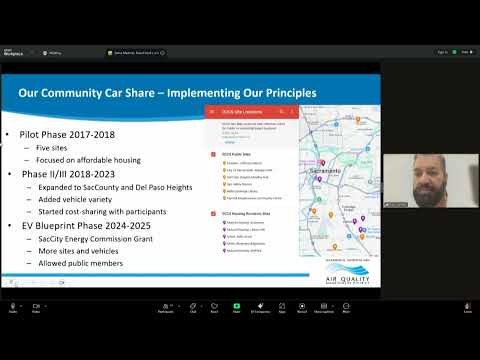
The vote implements staff’s recommendation to continue district support for OCCS, a program the district and partners launched in 2017 to place zero‑emission shared vehicles at affordable housing sites and other community locations. Paul Philly, program manager for Transportation and Climate Change at the Sac Metro Air District, told the board mobile sources are the largest source of emissions in the Sacramento Valley and that the district has a statutory role in motor vehicle use reduction measures.
District staff and partners adjusted the car‑share model after the pandemic to improve fiscal sustainability and access, Philly said. Key program changes include a cost‑share model (hourly fees for some users), waived membership fees for low‑income participants, an initial eight free hours to encourage trial use, and a community representative program that provides rides for residents without licenses. Philly said the program expanded into Del Paso Heights and the unincorporated county with state funding and local partners.
"The program takes care of insurance, fuel, electricity, everything. All you have to do is come with your license and application and then everything else is handled," Paul Philly said during board Q&A, describing how OCCS simplifies participation for users.
Staff presented usage metrics to the board: the system previously reached roughly 60,000 electric vehicle miles traveled (EVMT) in a single quarter pre‑pandemic, usage fell during the pandemic and has since rebounded, and staff expected about 45,000 EVMT for the quarter during the meeting. Philly said the program is approaching 1,000,000 zero‑emission miles and that public (non‑subsidized) revenue from casual users is roughly twice the revenue generated by subsidized members, which staff said improves the program’s financial sustainability while keeping access for low‑income users.
Board members asked about funding sources and program impacts. Philly said the program currently blends multiple funding streams, including state funds from the California Air Resources Board (CARB), federal funds routed through SACOG, and funding tied to the EV Blueprint (California Energy Commission) for infrastructure. Director Hume and others raised broader questions about how declines in gas tax revenue and measures tied to gasoline use could affect transportation funding allocations.
A public commenter, Cameron Belton, who identified himself as working with Green Tech Mobility in Del Paso Heights, described OCCS and the adjacent mobility hub as a training and workforce pipeline. "We've been able to train 16 to 24 year olds on just the importance of not just the lifestyle shifts, but the workforce development, and the workforce opportunities that could and will be available," Belton said, and told the board the hub had helped create local service‑technician jobs to maintain EV chargers.
Board action and next steps
The board approved the staff recommendation to authorize the executive director to extend the OCCS service contracts and increase the contract amount as needed. The motion’s mover and seconder were not recorded on the roll; the clerk conducted a roll‑call vote in which Chair Cherry Aquino, Directors Desmond, Hume, Lopez Taft, Maple, Robles, Rodriguez, Sander, Sandhu, Serna and Vang were recorded as voting yes. Staff said current delivery of OCCS operations is supported by a state grant and that the district seeks authority to keep the program operating through July 2027, subject to available funding.
Staff told the board they will continue to coordinate with the city of Sacramento and other partners on siting vehicle stalls, charger infrastructure and opportunities to leverage other clean mobility programs. The board did not adopt additional conditions or amendments to the recommended authority at the meeting.