Get Full Government Meeting Transcripts, Videos, & Alerts Forever!
Get email alerts on the Land Use Solar topic
No spam. Unsubscribe anytime.
Commissioners amend draft fund to require developers to pay 100% compensation for solar project areas containing any prime soils
Summary
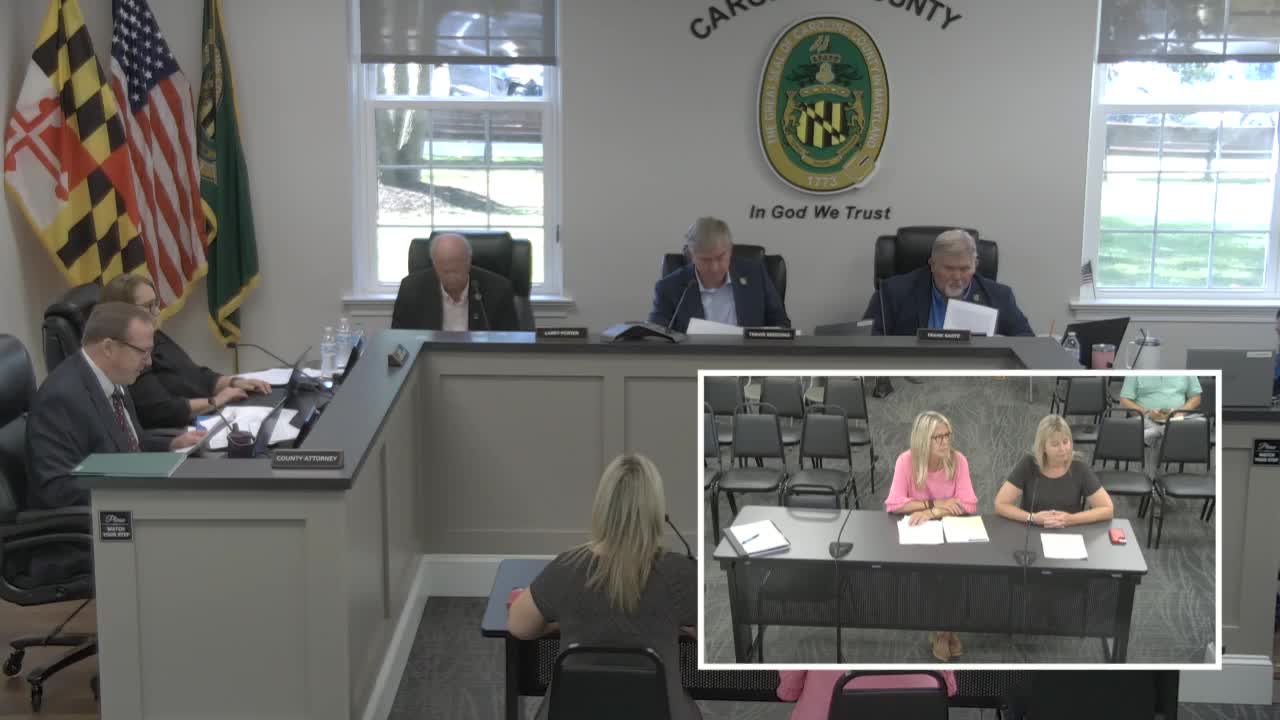
Caroline County commissioners amended a draft ordinance Oct. 7 to require solar developers to pay compensatory preservation contributions equal to 100% of project-area fair-market value when any portion of the project area contains prime or statewide-important soils; the board opened and closed a public hearing with no public comment.
Caroline County commissioners voted Oct. 7 to amend a proposed new county chapter creating an agricultural land preservation fund tied to solar-energy development on farmland. The amendment sets the compensatory-preservation contribution at 100% of the appraised value of the project area when any part of that project area contains soils designated as prime farmland or farmland of statewide importance.
The proposed legislation (legislative bill 2025-011) creates a county-administered fund to receive payments when solar energy generating stations and energy storage are developed on agricultural soils classified by the U.S. Department of Agriculture as "prime farmland" or "farmland of statewide importance." The fund’s money, the draft says, may be used to buy agricultural land preservation easements, including purchases through the Maryland Agricultural Land Preservation Foundation (MALPF) and other approved programs.
Why it matters: Commissioners and staff described the change as a way to ensure that developers who place solar infrastructure on high-value agricultural soils compensate the county for preservation efforts. The amendment also clarifies appraisal procedures to value project areas and removes reliance on a single state-determined average number.
What the board changed and why: - Staff initially drafted a calculation tied to an annual MALPF average (the MALPF "fair market value" measure) and a 75% multiplier; commissioners voted to remove the MALPF-only calculation and increase the multiplier to 100%. A county attorney and staff said the county could instead require independent appraisals paid for by the developer if MALPF data were unavailable. - Commissioners debated whether compensation should apply only to prime soils or to the full project area. After discussion they adopted an amendment that applies the contribution to the entire project area if any portion contains vital (prime or statewide-important) soils, reasoning that infrastructure and transmission affect the whole parcel. - The board opened a public hearing on the amended bill, received no public testimony and closed the hearing.
Next steps: The amended version will be available for further consideration and a final vote at a later meeting. Staff said the amendment clarifies appraisal methodology and gives the county the ability to require two independent appraisals paid by the developer if needed.