Get Full Government Meeting Transcripts, Videos, & Alerts Forever!
Get email alerts on the Employee Health Insurance topic
No spam. Unsubscribe anytime.
Jacksonville committee hears plan to curb rising city health‑care costs; Bailey Group to analyze pharmacy, stop‑loss and contribution options
Summary
Council auditors’ Doge committee heard a presentation from the Bailey Group on options to reduce the city’s employee health‑insurance deficit, including a pharmacy carve‑out, stop‑loss market checks, contribution strategy changes and on‑site clinic pilots. The firm will gather city claims data and return with detailed recommendations.
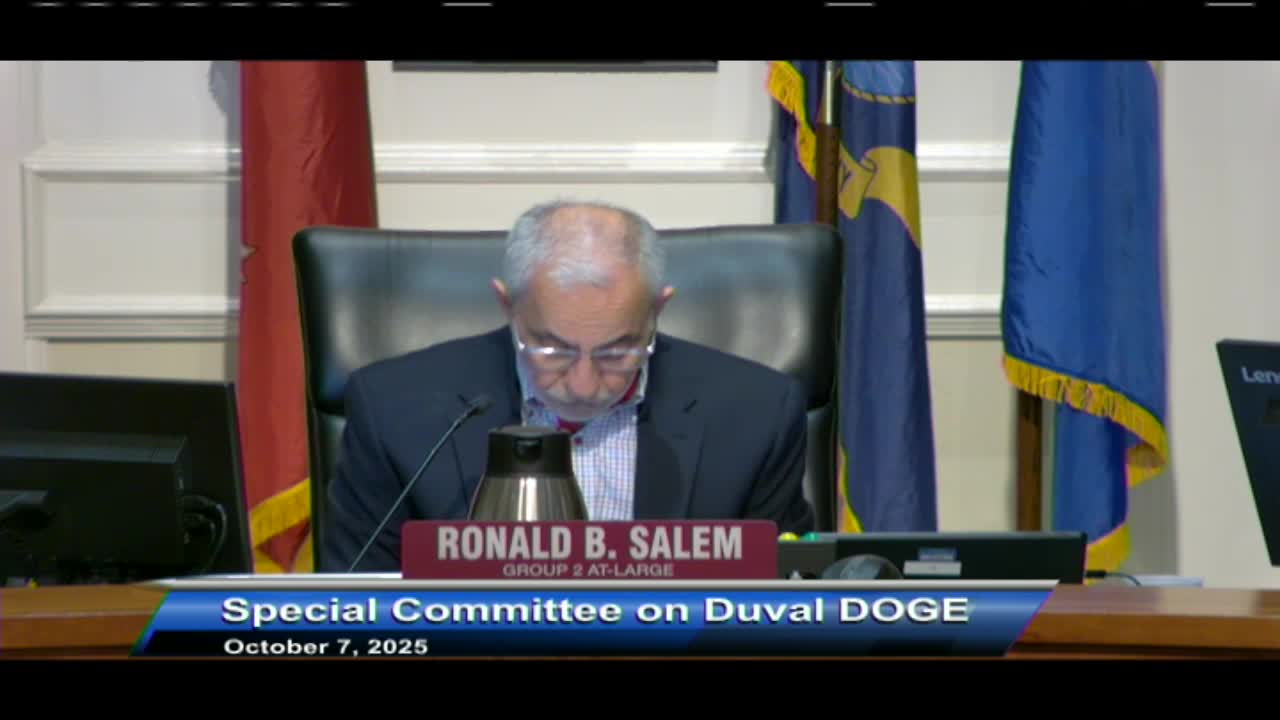
The Jacksonville Doge Committee on Oct. 7 heard a presentation from the Bailey Group on steps to reduce a multi‑million‑dollar shortfall in the city’s self‑insured employee health plan and on how the city might limit future increases in health‑care costs.
The Bailey Group, a benefits consulting team affiliated with NFP and Aon, told the committee it will gather two years of claims data to analyze pharmacy management options, stop‑loss coverage, medical repricing and contribution strategies. "I view this as a as a 3 year plan," Councilman Ron Salem said, adding the goal is to identify both short‑term changes and longer‑term actions the administration could adopt.
Why it matters: City officials told the committee the health plan has faced a structural gap between premiums and claims. Committee chair Ron Salem said prior budget actions had covered more than $28 million in recent years to shore up the health care trust; the Bailey Group presentation emphasized that pharmacy spending and large individual claims are major drivers of rising costs.
Key points from the presentation
- Pharmacy strategy: The Bailey Group explained the difference between a "carved‑in" pharmacy arrangement (managed by the same carrier that handles medical claims) and a "carve‑out" to a dedicated pharmacy benefits manager (PBM). The firm presented de‑identified case studies in which a formal carve‑out or contract renegotiation produced pharmacy savings; one example showed roughly a 15% reduction in pharmacy spend after an intervention. The consultants said whether a carve‑out is advisable depends on the city’s contract terms and the detailed claims data.
- Stop‑loss coverage: Sherry Beignet of the Bailey Group said the city’s stop‑loss policy has a specific deductible of $1,000,000 and recommended an annual market check of stop‑loss carriers and a review of whether the $1,000,000 level remains appropriate. The firm noted the city had two members who had reached roughly half that deductible within six months of the plan year.
- Medical repricing and carrier discount review: The consultants said they will attempt to reprice recent claims under alternative carriers (for example, Aetna, Cigna or UnitedHealthcare) to quantify potential savings or added costs. They cautioned that, for some samples, Florida Blue was competitive in certain categories, particularly outpatient and inpatient discounts.
- Contribution strategy and plan design: The Bailey Group said it will benchmark Jacksonville’s employee and employer contributions, plan designs and eligibility rules against national and local peers. Council members asked the firm to analyze whether contribution tiers or salary‑based pricing could reduce the shortfall without unduly shifting costs to lower‑paid staff.
- On‑site clinic pilot: Consultants described clinic models used by other Florida local governments that include no‑copay visits, an on‑site dispensary for selected generic drugs, and, in some cases, embedded mental‑health staff. The firm said clinics can shift primary‑care visits and lower‑cost prescriptions out of the claims system, reducing claims expense if enrollment and utilization support fixed clinic costs.
Case studies and special programs
Bailey Group highlighted work with the Jacksonville Police and Fire Health Insurance Trust, which separated from the city plan about five years earlier. The consultants said carving police and fire pharmacy benefits out and introducing targeted programs (for example, a $0 copay for generics, specialty drug riders and a gene‑therapy rider) helped the trust manage high‑cost claims in specific instances; they cited a case where a gene‑therapy drug costing about $2.3 million was covered through a specialty rider.
Questions and direction from council members
Councilman Rory Diamond (District 13) and others pressed the consultants on implementation mechanics, including whether changes require executive‑branch action and the timing relative to open enrollment. Travis Cummings of the Bailey Group said an RFP and vendor transition could be executed within months if contracts and termination provisions allow, with results typically incorporated into the next open‑enrollment cycle.
Deputy Chief Administrative Officer Kelly O'Leary told the committee the administration has already pursed some plan changes and is willing to review outside recommendations. "Yes. We have actually gone through a lot of these processes as well," O'Leary said, adding the benefits team had implemented pharmacy management steps and introduced a high‑deductible health plan option.
Next steps and committee direction
The Bailey Group will continue data collection and return to the Doge Committee with more detailed findings, including repricing results and benchmarking. The firm and committee discussed meeting every four to six weeks while the analysis proceeds. Committee staff and the auditors will supply forms and administrative liaisons: the auditors are preparing a form for departments to request release of a 2% budget lapse the council imposed during the budget process.
No formal votes were taken at the Oct. 7 meeting on the Bailey Group recommendations. Committee Chair Ron Salem said the council can only make recommendations and that any plan changes require action by the administration.
Ending
The committee scheduled follow‑up briefings and asked the Bailey Group to return with claim‑level repricing, stop‑loss market checks and modeling of contribution alternatives. The firm will present recommended options for pharmacy management, stop‑loss adjustments and potential pilot programs such as an on‑site clinic for employees, spouses and dependents enrolled in the city plan.