Get Full Government Meeting Transcripts, Videos, & Alerts Forever!
Get email alerts on the Public Health Ssp topic
No spam. Unsubscribe anytime.
Lewiston council pauses syringe-service ordinance after hours of debate; public split
Summary
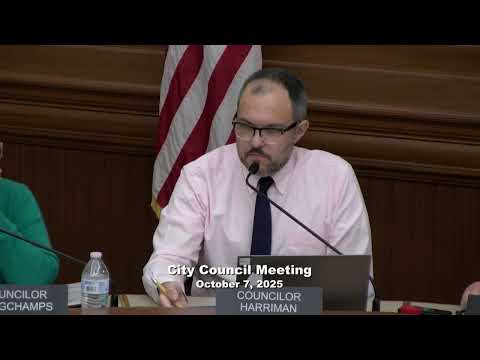
After nearly three hours of debate and extensive public comment both for and against syringe service programs, the Lewiston City Council voted 4–3 to table further action on proposed amendments to the city's syringe service program (SSP) licensing rules until a later meeting.
The Lewiston City Council voted 4–3 on a motion to table further action on proposed amendments to chapter 22 (business licenses), article 18 (syringe service programs), effectively pausing first-passage consideration of the draft ordinance.
The ordinance under discussion would set local licensing and operating requirements for SSPs (syringe service programs) in Lewiston, including zoning limits, application and reporting requirements and an earlier proposal language dealing with whether programs must operate on a strict 1-for-1 syringe exchange model. The draft before the council also included limits on the number of city licenses; staff briefed the council that the current draft permits two licenses within the city.
Supporters of looser distribution policies and more than one licensed operator argued a less restrictive approach helps public health and lets providers respond to changing needs. State and public-health speakers told councilors that limiting the number of providers and imposing strict exchange ratios could reduce the ability to meet demand and hinder harm-reduction goals. As the Maine CDC representative put it during public comment, “limiting the number of service providers would likely limit the ability of providers to nimbly respond to needs of the community.”
Opponents and some council members said the city’s recent experience with a failed provider had eroded trust and that more restrictive local provisions or fewer licenses would give the council and residents more control. Councilors who favored a restrictive approach repeatedly cited business and neighborhood impacts and urged stronger local oversight, pointing to the need for a trusted, accountable operator.
Council discussion focused on two recurring choices: how many local licenses to allow (the draft permits two) and whether to restore or require a strict 1-for-1 exchange requirement (the prior council action had removed the 1-for-1 language; an attempt to restore it was briefly reconsidered during the meeting). Several councilors proposed compromise positions — including time-limited moratoria on additional licenses or language allowing a single licensed provider to operate additional locations or mobile services — but those measures were not resolved before the motion to table passed. Councilors who supported tabling said more time and a focused workshop would help craft enforceable local rules and address concerns about zoning, mobile units and funding.
Public comment was extensive and sharply divided. Business owners, downtown residents and others described concerns about discarded needles and neighborhood safety; other speakers representing health and harm-reduction organizations urged the council to avoid restrictions that would limit access to sterile syringes and services for people who inject drugs. Spurwink, the current local provider, and its senior director, Catherine Bridal, said the organization had inherited the earlier program and could expand services if local rules permitted, noting that state certification can allow additional sites or modifications with notice to the state.
The council instructed staff and agreed to pursue additional information and follow-up. Members also scheduled a special workshop slot to continue work on the ordinance and related concerns; staff will return with refined language and details on how mobile services and multiple locations would be treated under state certification and local licensing rules.
Why it matters: The city’s ordinance will set the local process to license and oversee SSP operations, balancing public-health aims with business and neighborhood impacts. The tabled decision delays the city’s formal local rules, but the program that currently operates in the community remains legally certified at the state level while councilors refine the local ordinance.
What’s next: Councilors agreed to a special workshop to continue the discussion and asked staff to prepare a draft moratorium ordinance and to detail how mobile units and secondary locations would be handled under state and municipal requirements. The ordinance will return to the council for further action once that work is complete.