Get Full Government Meeting Transcripts, Videos, & Alerts Forever!
Get email alerts on the Sign Variance topic
No spam. Unsubscribe anytime.
Commissioners deny variance for freestanding sign at Highway 92 property, 3–2
Summary
The Cherokee County Board of Commissioners denied a request by ALC Veterinary Properties to allow a non‑monument freestanding sign at 7946 Highway 92, citing current sign‑ordinance requirements. The board discussed a targeted ordinance revision to address masonry enclosure requirements for monument signs.
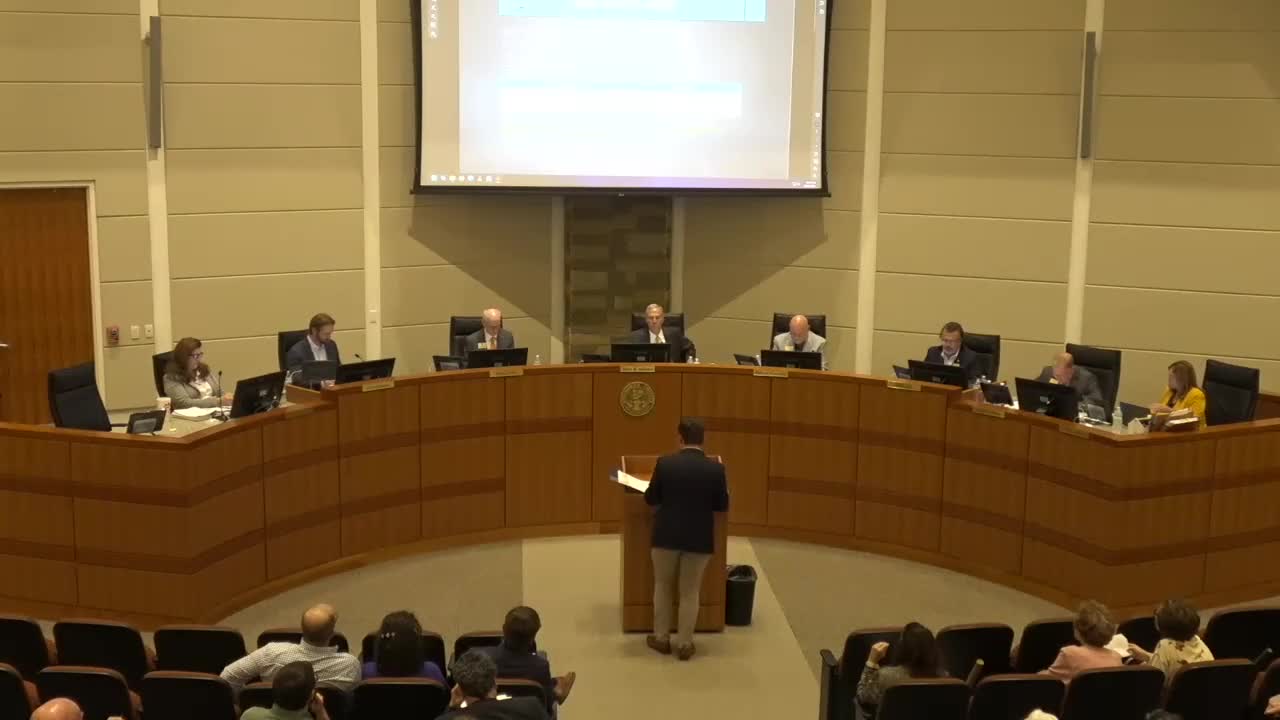
The Cherokee County Board of Commissioners voted 3–2 on Oct. 7 to deny a variance request that would have allowed a freestanding sign that does not meet the Highway 92 Overlay District’s monument‑sign masonry enclosure requirement.
The sign variance application was filed by ALC Veterinary Properties, represented to the board by Adam Rosen on behalf of Dr. Amy Crowder for property at 7946 Highway 92. Planning staff said the request sought relief from Article 16 of the county overlay district that requires the copy area of freestanding signs to be fully enclosed by masonry.
Commissioner Ragsdale moved to deny the variance, saying the application did not meet the ordinance as written: "I’m still of the opinion that this should be denied simply based on the fact that it doesn't meet the ordinance," he said. Chairman Harry Johnston, who dissented, praised the applicant’s design: "I think the sign is beautiful. It actually looks better than what it would look otherwise," he said during the debate.
Board action and next steps
- Vote: Motion to deny variance carried 3–2 (yes: Commissioners Ragsdale, Wetherbee, Cagle; no: Chairman Harry Johnston, Commissioner Carter). The denial was based on noncompliance with the current sign ordinance. - Commissioners discussed a two‑track approach to the problem: a targeted sign‑ordinance amendment to address monument‑sign masonry requirements that could be prepared in as little as one to two months, and a full sign‑ordinance rewrite that could take up to a year.
Why it matters: The decision enforces the county’s existing design standards while flagging the ordinance as a recurring source of variance requests. Planning staff was directed to prepare a short, narrowly focused ordinance amendment for board consideration to allow limited flexibility for monument signs while a comprehensive rewrite is developed.
Ending: The denial closes this variance application in its present form; staff will return with recommended ordinance language if the board requests it for fast‑track consideration.