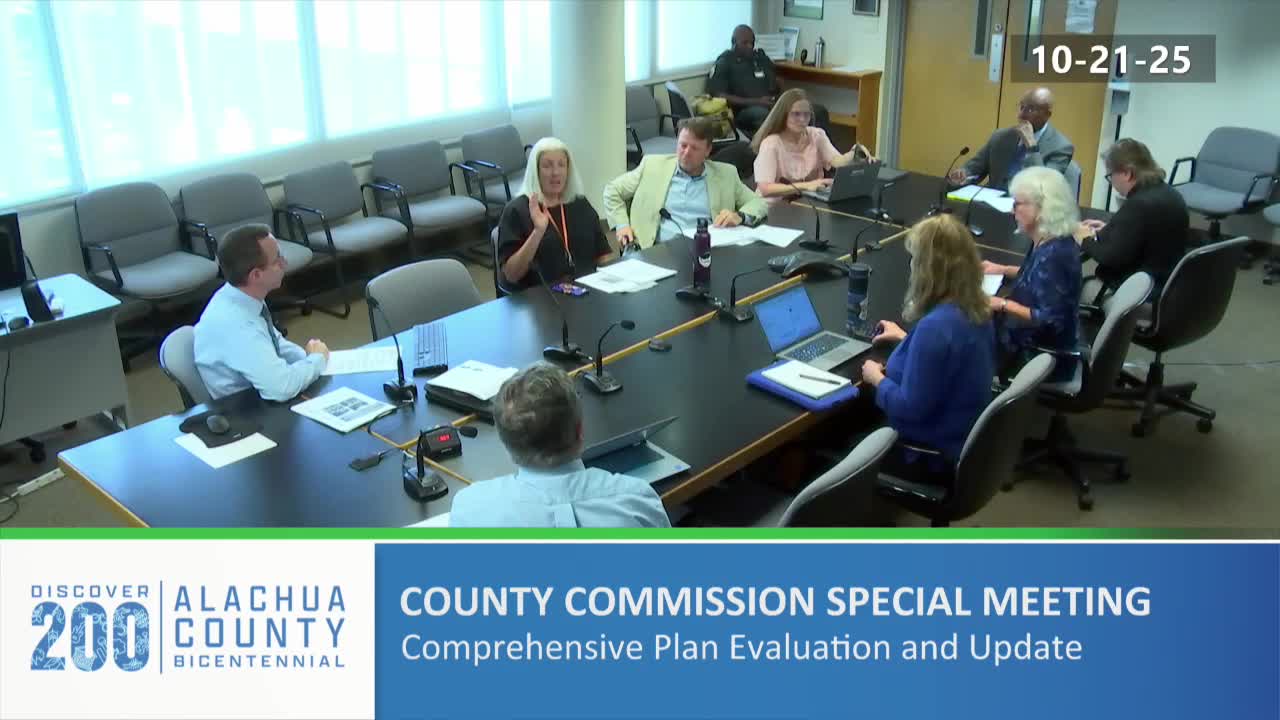
Alachua County reviews proposed comprehensive-plan updates for transportation, parks, waste and public health
Loading...
Summary
Alachua County officials on a special meeting reviewed proposed updates to the comprehensive plan’s community facilities and services elements — transportation, recreation, solid waste and community health — and directed staff to draft amendments for later review and transmittal to state reviewers ahead of the April 1, 2026 statutory deadline.
Alachua County officials on a special meeting reviewed proposed updates to the comprehensive plan’s community facilities and services elements — transportation, recreation, solid waste and community health — and directed staff to draft amendments for later review and transmittal to state reviewers ahead of the April 1, 2026 statutory deadline.
Ben Chumley of Growth Management opened the presentation, saying, “This is your fourth policy workshop on the comprehensive plan evaluation and update,” and asked the board for direction on staff’s recommendations so staff can prepare plan amendments and return with proposed text.
Why it matters: The county must transmit amendments required to maintain state statutory consistency by April 1, 2026. Staff told commissioners they will prioritize changes that must comply with state law and hold optional or potentially more restrictive items pending the outcome of a proposed state ‘‘glitch’’ bill (Senate Bill 180). The board’s direction will shape which updates the county forwards now and which it postpones until after the Legislature acts.
Transportation: staff proposed tightening multimodal goals and incorporating a bicycle-pedestrian master plan by reference. Allison Moss, Transportation Planning Manager, said the existing transportation element is “very strong in terms of aspirational…goals” but urged making the policies “more rigorous, to put them into action.” Staff described a draft countywide bike-ped network now under consultant review for feasibility and a planned approach to set mode-share goals for walking and bicycling that differ inside and outside the urban cluster. The presentation noted the county adopted a transportation capital improvements program (CIP) update earlier this year.
Board members pressed for specifics on safety near schools and community centers; one commissioner asked whether the plan would address the Santa Fe High School intersection and safe routes to school. Moss said the bike-ped plan includes safe-routes-to-school priorities and that consultants will be able to “take a closer look” at goals and feasible targets. Staff also recommended incorporating the Safe Streets and Roads for All action plan and noted the board has previously adopted a Vision Zero resolution committing to zero serious injuries and fatalities on county roadways.
Transit and paratransit: commissioners asked staff to strengthen the transit section. Chumley and staff said the draft transportation maps must be updated to reflect current service and that the county is tracking regional discussions about a possible regional transit authority and paratransit changes; staff advised that those developments could require further updates once they are advanced.
Recreation and parks: staff recommended incorporating the county’s 2023 Parks and Open Space Master Plan into the comp plan and revising level-of-service (LOS) standards to account for geographic distribution and park types rather than rely solely on acreage-per-1,000-population. Chumley noted current LOS measures do not address equity of park access across the county.
Commissioners emphasized maintenance and operations: several asked the plan to include clearer expectations and funding for ongoing upkeep of parks and suggested policies to encourage ‘‘friends of’’ groups or neighborhood stewardship to support maintenance and community ownership. Ed Williams of Alachua County Parks described existing signage and phone numbers at parks and confirmed some larger pavilions already have electrical outlets and timer-controlled lighting; he said the department engages communities for park renovations and would support exploring formal volunteer or friends-of structures.
School partnerships and park access: commissioners discussed existing projects that opened school grounds for public park use and asked staff to evaluate opportunities to partner with school districts on shared facilities or creating public parks adjacent to, rather than inside, school campuses to avoid conflicts with after-school programming.
Solid waste and circular economy: staff recommended strengthening the solid-waste element to prioritize waste reduction and to reflect the county’s draft climate action plan goals on waste management and resource recovery. Chumley noted the comp plan currently references a generalized LOS for solid waste of “0.8 inbound tons per person per year” at the LaVita Brown Environmental Park (up from 0.73 in a prior update) and said staff will reevaluate that figure.
Commissioners urged a shift toward circular-economy policies, investment in material-recovery infrastructure (for example, modern MRFs and optical sorting), and stronger public education on recycling. Staff noted limitations in regional glass processing and the cost and market challenges that have reduced recycling participation in some places; commissioners and staff discussed outreach channels, including social media and county communications, to re-engage residents and businesses.
Community health element: staff recommended removing outdated references and aligning the comp plan health policies with current initiatives. Chumley recommended deleting the 2009 hunger abatement plan reference (now outdated) while retaining policy concepts that address food insecurity, and removing a local tobacco-licensing policy that is preempted by state law.
Commissioners proposed additions and clarifications: several asked for stronger language on social determinants of health (beyond poverty alone), more explicit references to mental-health, reentry and gun-violence prevention work, mentioning jail health efforts where appropriate, and proactive programs to help older residents age safely in place (including home modifications and stronger ties to senior centers and community partners). Commissioners also discussed Narcan availability and whether a lobby dispenser had been installed; staff said they would follow up.
Process, timing and next steps: staff said the board’s input from the workshops will be converted into specific plan amendments; those amendments will go to the planning commission before returning to the board. Staff noted one additional calendar date (Dec. 2) is reserved but said it is unlikely they will need another workshop. Chumley said staff will prioritize items that must be transmitted for statutory compliance and hold non-mandatory items if the state bill narrows what the county can adopt now. The board can wait up to 180 days after receiving state comments to adopt changes, staff said.
Public comments: at the meeting’s public comment period, a resident urged a specific reevaluation date for inclusionary housing policies, stronger exclusion of unhealthy processed foods from county-supported food programs, and noted traffic-safety policy options recommended by national safety coalitions. Several commissioners and staff discussed food-hub work and state funding opportunities tied to fresh produce distribution and infrastructure.
What’s next: Staff will draft plan amendments based on the board’s direction, reconcile the comp plan text with the county’s climate action plan where applicable, and return proposed amendments for formal consideration and the statutorily required transmittal process. Items that may be affected by state action on Senate Bill 180 will be tracked and either transmitted (if required by statute) or held pending the bill’s outcome.
Ending: Commissioners signaled broad support for incorporating recent master plans and for strengthening language on safety, equity and waste reduction; staff will return with draft amendments and the planning commission review before any formal adoption or transmittal to state reviewers.