Get Full Government Meeting Transcripts, Videos, & Alerts Forever!
Get email alerts on the Comprehensive Plan Environmental topic
No spam. Unsubscribe anytime.
Alachua County holds workshop on comprehensive-plan environmental updates, including septic, cave protections and land-conservation questions
Summary
County staff briefed commissioners on proposed updates to the conservation, stormwater, potable water/sanitary sewer and energy elements of the comprehensive plan and sought direction on topics including expanded protections for cave/karst systems, enhanced septic requirements tied to Basin Management Action Plans, low‑impact development measures,
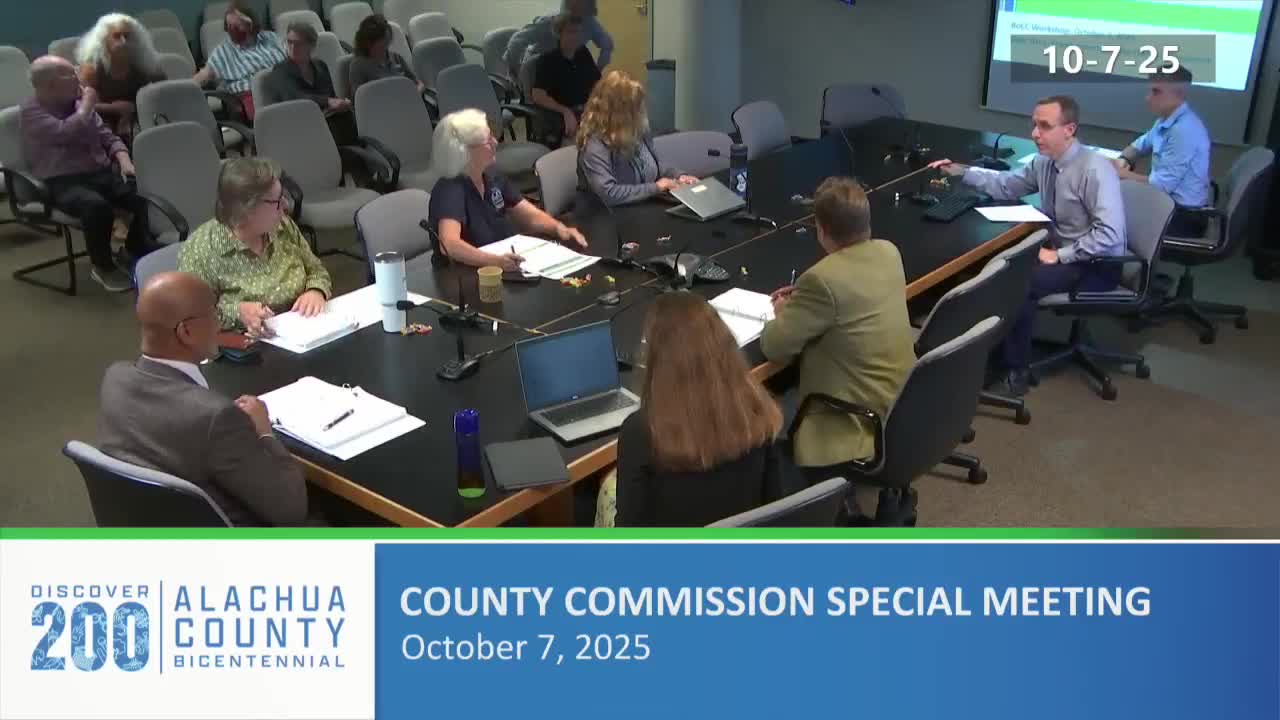
Alachua County growth-management staff on Oct. 7 presented a third workshop on the county’s comprehensive plan update focused on environmental protection and resilience, asking the county commission for direction on possible policy and code changes.
The briefing by Ben Chumley of Growth Management and Steve Hostetter (staff) covered the conservation and open-space element, stormwater management, potable water and sanitary sewer policy, and the energy element. Chumley said staff will translate the board’s direction into draft amendments and bring proposed language back to the planning commission and board next year.
Why it matters: the conservation and related elements set local standards for protecting wetlands, strategic ecosystems, listed-species habitat and karst features that underpin groundwater quality and ecological connectivity. Changes could affect permitted development, septic requirements in nutrient-impaired watersheds and how the county implements low-impact development (LID) and land‑conservation priorities.
Discussion highlights
- Cave/karst protections: Commissioner Alfred raised concerns about cave systems and species that live in karst habitat, saying a simple buffer around cave entrances may not protect subsurface hydrology or species. Steve Hostetter agreed there is “opportunity to do that, to look at what protection opportunities could be included,” and staff said they will develop options but cautioned some will take longer than the April 1 statutory deadline for state-required compliance amendments.
- Enhanced septic systems and BMAPs: Staff reviewed 2023 state legislation requiring enhanced nitrogen‑reducing septic systems on new lots under one acre inside designated Basin Management Action Plan (BMAP) areas. Stacy Greco of Environmental Water Resources said some BMAPs (for example, Silver Springs) may include language requiring upgrades for modified or replaced systems if the plan survives legal challenges; other basins (Santa Fe/Orange Creek) currently do not. Commissioners asked staff to draft a policy approach that could range from strictly following state standards to proposing county‑level requirements or incentive programs; staff said it would return with several options.
- Low‑impact development (LID) and soils: Staff noted multiple comprehensive-plan policies already encourage LID and highlighted recent landscaping-code changes that limit permanently irrigated turf and encourage native plantings and soil amendments. Commissioners asked for stronger direction to avoid wholesale topsoil removal on forested or native sites and for incentives or requirements that retain native topsoil where feasible.
- Wetland and small-impact approvals: Staff reported the county currently brings wetland impacts of any size to the board for review. Because that process can be burdensome for small residential applicants, staff proposed an administrative threshold for very small impacts (for example, below a quarter‑acre), with a caveat that exceptions would apply when avoidance is not feasible; the board asked staff to draft clear language that limits administrative approvals to cases where no reasonable alternative exists.
- Land conservation vs. future land use (East Side Activity Center): Staff raised a case where Alachua County Forever (ACF) may have an opportunity to acquire four parcels within the East Side Activity Center, a place designated for mixed‑use development since 1994. Commissioners and public speakers discussed the 300‑foot ecological corridor requirement on the western side of the activity center and whether acquiring parcels for conservation would conflict with the activity‑center future land use. Staff said such acquisitions are consistent with other comprehensive‑plan policies that protect strategic ecosystems and recommended the board provide direction before moving forward with acquisitions.
- Potable water, sewer and biosolids: Staff recommended adding groundwater and surface‑water protection language to the potable‑water/sanitary‑sewer goal, working with Gainesville Regional Utilities (GRU) to revisit the potable‑water level‑of‑service standard, and adding composting or similar processes as an allowed biosolids disposal option. Staff also recommended adding nitrogen‑reduction identified in a BMAP as a possible basis for requiring conversion from septic to municipal systems where appropriate, and to consider advanced septic treatment where sewer connection is infeasible.
- Energy element: Staff recommended updating outdated energy‑element goals and metrics to align with the county’s climate action plan and current measures for greenhouse‑gas reductions, vehicle‑miles‑traveled and non‑automobile mode share.
Direction and next steps
Staff said it will prepare draft amendment language for the board’s review, including: options for karst and cave protections; a menu of approaches for enhanced septic systems (state‑consistent baseline plus potential county options and incentive programs); potential administrative thresholds for small wetland impacts with strict caveats; LID/soil retention implementation measures (code and programmatic options); updated special‑area maps for Idlewild/Idyllwild and Cross Creek; and wording changes to the potable‑water and energy elements to reflect water‑quality and climate goals. The board scheduled a fourth workshop on Oct. 21 to address community facilities and services and was reminded of the April 1 statutory deadline for transmitting any amendments necessary for state compliance.
Ending
Staff will return with draft amendment language and options, coordinate with GRU and water‑management partners where appropriate, and present the package to the planning commission and the board in 2026. Commissioners asked staff to include clear tradeoffs and cost implications when drafting options, particularly where requirements could affect the economics of septic‑to‑sewer conversions or developer obligations.