Get Full Government Meeting Transcripts, Videos, & Alerts Forever!
Get email alerts on the Data Centers topic
No spam. Unsubscribe anytime.
Leesburg planners review tighter data center standards; staff to research generator testing practice
Summary
The Planning Commission reviewed draft data center use standards including landscaping, screening, fenestration, and noise limits. Commissioners asked staff to research generator testing frequency and decibel levels and to compare county standards before returning with revised language.
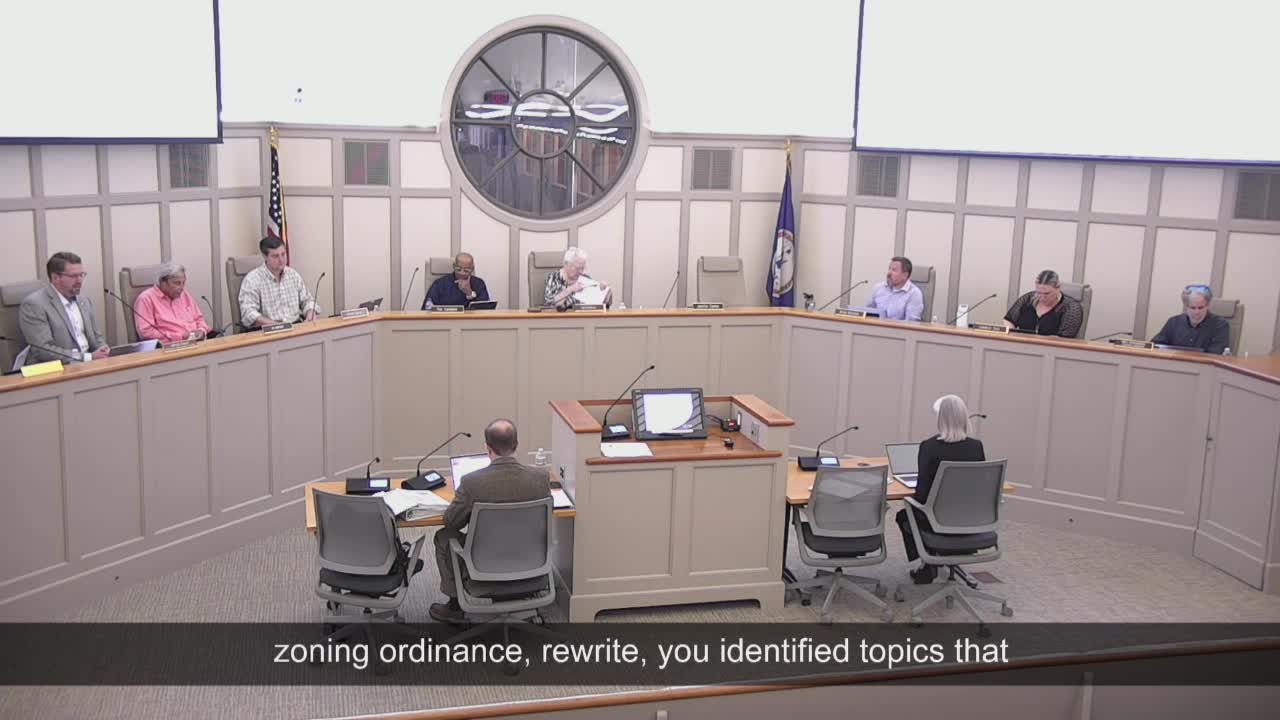
The Leesburg Planning Commission on Oct. 2 reviewed a revised draft of data center use standards in the town’s zoning rewrite and directed staff to gather additional technical information on generator testing and noise before returning to the commission.
Staff described edits to the draft standards intended to tighten design and environmental protections for proposed data center projects, including changes to facade glazing, screening of ground- and rooftop equipment, and a new approach to green-building technique requirements. Staff said they would research industry norms for backup-generator testing — how many units are tested at once, how long tests run and typical noise levels — and report back.
Why it matters: commissioners said data centers’ continuous operation and occasional generator use can produce sustained noise impacts on nearby residents. Commissioners pressed staff to ensure any new rules are defensible, not inconsistent with existing noise rules, and practicable for essential operations during testing and emergencies.
Staff presentation and proposed changes James David, Department of Community Development staff, reviewed draft edits that staff captured from prior commission direction. He said the document (section 12-3 under the industrial heading) now reads: where possible, avoid “all or most established forested areas,” requires that 30% of a primary façade include windows or simulated windows instead of using the technical term “fenestration,” and expands screening requirements so screening “will include year-round landscaping or a screen wall.” He also added rooftop-screening language for sites that are lower in topography than adjacent residential neighborhoods: “Rooftop equipment should be screened from the top-down view to the extent practicable,” he said, adding the qualifier to avoid interference with HVAC operation.
Staff also revised the green-building list so that applicants must select one technique from each category (site design, energy/resource efficiency, etc.) rather than just a single, easy-to-meet item. He said lighting standards in the zoning ordinance will continue to apply in addition to the new data-center-specific lighting language.
Noise and generators Commissioners discussed whether to adopt a blanket 55-decibel limit at the property boundary for all data centers. James David noted the town’s existing noise standard already applies the “more restrictive” limit where two zoning districts meet (55 dB adjacent to residential, 65 dB adjacent to commercial, 70 dB adjacent to industrial). He said staff is comfortable relying on that existing receiver-based standard but had drafted a proposed flat 55 dB limit for commission discussion.
Commissioner McAfee raised generator testing as a key open question: “Do we have any verbiage in regards to the temporary utilization of the diesel generators for testing?” he asked. Commissioners debated whether tests should be exempted from a noise limit, limited by a maximum run time (staff suggested testing limits such as a span “no more than 24 hours” as an example, and commissioners said that seemed excessive), or constrained by hours of day. Several commissioners urged staff to research industry testing cycles and typical decibel levels. James David said he would contact the Data Center Coalition and Benjamin “Mister Levy” (identified as an industry contact) to ask how many units are tested simultaneously and how long tests typically run.
Commissioners also asked about emergency use (brownouts or blackout). The town attorney told the commission the town has no authority over emergency declarations that are driven by the power supplier; staff and commissioners agreed that backup generator operation for true emergencies must be allowed, and that the ordinance should clarify an emergency exemption (for “event of power loss” or similar) while preventing indefinite continuous operation that would unduly impact neighbors.
Other technical directions The commission also directed staff to: - Revisit the green-building list to make required techniques more meaningful (staff already revised it to require one technique from each category). - Keep the existing noise standard as the baseline and bring comparisons with Loudoun County’s noise and generator testing language. - Return with industry-standard testing cycles, typical decibel levels during testing, and whether testing typically cascades generators on a rolling basis.
Quotations “Rooftop equipment should be screened from the top-down view to the extent practicable,” James David said, adding the qualifier that screening should not interfere with necessary HVAC exhaust. Commissioner McAfee asked: “Do we have any verbiage in regards to the temporary utilization of the diesel generators for testing?”
Ending Staff said it would gather the requested information and return with revised language in a future draft. Commissioners signaled general comfort keeping the town’s existing receiver-based noise limits (55/65/70 dB by adjacent district) while clarifying testing duration, allowable hours, and an emergency exemption.