Get Full Government Meeting Transcripts, Videos, & Alerts Forever!
Get email alerts on the Poly Permitting System topic
No spam. Unsubscribe anytime.
St. Paul’s new ‘Poly’ permitting system launched; city officials cite faster workflows but historic data conversion and staffing remain challenges
Summary
Director Angie Weasey told the Finance and Budget Committee that the city accelerated rollout of a modern permitting platform called Poly, processing thousands of backlog records in its first week and enabling new inspector mobile tools and cross-department reviews. Council members pressed for measurable service targets and flagged remaining work:
Angie Weasey, director of the Department of Safety and Inspections (DSI), told the St. Paul City Council Finance and Budget Committee on Oct. 24, 2025, that the city accelerated the rollout this year of a modern permitting and licensing system known as Poly to recover from a cyber incident and modernize decades‑old systems.
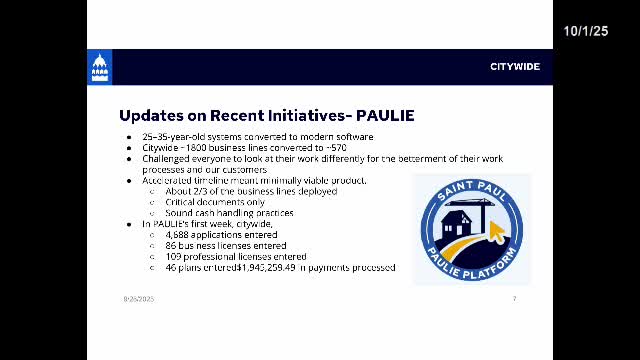
Weasey said the first week after the September 15 rollout handled “over 4,600 applications entered into Poly,” including 86 business licenses, 109 professional licenses, 46 plan submissions, and “almost $2,000,000 in payments” processed. “We replaced 25‑ and 35‑year‑old systems with a modern system,” she said.
That initial surge was part of an accelerated “minimally viable product” (MVP) deployment, in which about two‑thirds of the city’s roughly 570 business lines moved forward with critical documents and basic workflows. Weasey said Poly adds features the legacy platforms lacked: an inspector mobile app, real‑time cross‑department notifications for shared reviews, customer self‑service for historic records once data is migrated, address verification to reduce manual entry, and integrated email and workload dashboards for managers.
Why it matters: permitting and licensing backlogs affect business openings, construction timelines and public safety inspections. Council members said they need measurable performance goals so the public can see improvements. Council President Naker asked for specific responsiveness targets and for the department to report how Poly will change service‑level measurement.
Weasey acknowledged remaining work. The historic records are not fully converted; the team is mapping older records to new business‑line definitions and converting data that is not an “apples to apples” migration. She said the city is phasing in additional automations, online inspection scheduling tied to Outlook, and email confirmations as those components are tested.
On performance measurement, Weasey said Poly will provide managers with dashboards and service‑level agreement views and will allow load balancing among reviewers. She told the committee the department proposed an “attrition adjustment” in the 2026 budget to preserve staffing flexibility so DSI can collect operational data in 2026 and propose personnel adjustments in 2027 based on measured pinch points.
Council members pressed for concrete metrics. One member asked for targets such as response within 48 hours for inquiries and defined turnarounds for a completed plan application; another asked that the department make public the percentage of requests meeting those targets once the dashboards are live.
Weasey also said Poly includes a new electronic plan review product (Bluebeam) that many private‑sector customers use, replacing a less familiar system and aiming to speed collaboration with applicants.
The department said a mix of short‑term staffing (about 80 people assisted during the Poly backlog week) and ongoing conversion work remain, and the committee asked DSI to return with metrics and an update on historic data migration. For now, DSI described the rollout as functional with significant follow‑up work required to restore full historic functionality and to measure the system’s impact on turnaround times.
Looking ahead, Weasey asked the council to treat 2026 as an assessment period: collect data, identify recurring pinch points and then request targeted personnel or process changes in the 2027 budget.