Get Full Government Meeting Transcripts, Videos, & Alerts Forever!
Get email alerts on the Permitting It topic
No spam. Unsubscribe anytime.
St. Paul DSI says accelerated Poly rollout reduced backlog but historic data migration and service metrics remain work in progress
Summary
DSI described benefits from the recently accelerated rollout of Poly, a modern permitting and licensing system, and outlined remaining work: historic data migration, automations, online inspection scheduling and performance metrics. Council members pressed for measurable service targets and staffing data.
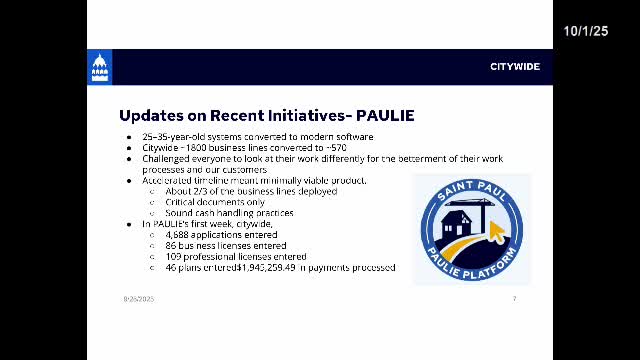
Angie Weasey, director of the Department of Safety and Inspections, told the committee the city accelerated launch of a modern permitting platform called Poly to recover from a recent cyber incident and to replace two legacy systems.
“We went from about 1,800 business lines in those 2 systems to a 170,” Weasey said, describing a consolidation of workflows. She reported that in the first Poly rollout week (September 15) city staff entered more than 4,600 applications into Poly, processed 86 business licenses, 109 professional licenses and 46 plans, and recorded almost $2,000,000 in payments.
Weasey said roughly two‑thirds of the department’s approximately 570 business lines went forward with a minimally viable product in the accelerated launch. The rollout included mobile inspection capability, improved cross‑departmental record sharing, real‑time application updates, online inspection requests and 24‑hour access to critical documents. Weasey said Poly also provides address verification and the ability to email directly from records — features the legacy systems lacked.
Council members sought details on performance management and staffing. Council president Naker (vice president in the meeting sequence) asked for concrete service metrics and whether review timelines and responsiveness will be baked into staff performance evaluations. Weasey replied that Poly will provide manager dashboards, service‑level dashboards and load‑balancing tools to target pinch points and that the department is carrying an attrition adjustment into 2027 to collect post‑Poly data before committing to permanent hires.
On electronic plan review, Weasey said the city is replacing Project Docs with Bluebeam, a plan‑review product widely used by private‑sector reviewers, and that Bluebeam integrates better with Poly. Council members who work with development projects said the change will help customer experience because Bluebeam is commonly used by applicants.
Weasey cautioned that historic records still need to be converted to Poly and that not all application automations are enabled yet. She said some items are simple edits, while others require building new reports and automation carefully to avoid turning on incomplete automations. DSI staff also reported ongoing work to stabilize the addressing system (called STAMP) and to connect enterprise service‑request intake to Poly so “report a concern” submissions feed into inspections workflows.
Council members asked for future updates that include: metrics for responsiveness (examples proposed included 48‑hour response targets for inquiries and a 7‑day standard for completed plan application intake), data on annual construction permit review volumes, and a breakout of staff assigned to plan review versus front‑counter intake. Weasey and other staff said they will provide those figures and performance targets as Poly usage stabilizes.
The committee did not take any formal votes on operational changes during the session; members asked DSI to return with performance metrics, staffing counts by activity and progress reports on historic data migration and electronic plan‑review deployment.