Get Full Government Meeting Transcripts, Videos, & Alerts Forever!
Get email alerts on the Procurement Compliance topic
No spam. Unsubscribe anytime.
State trainers outline federal and North Carolina procurement rules for recipients of state fiscal recovery funds
Summary
Presenters from the Budget and Management, Office of State reviewed how 2 CFR 200, North Carolina statutes and administrative code interact, explained procurement thresholds for goods, services and construction, and emphasized documentation, debarment checks and competitive processes.
Joe, a presenter with the Budget and Management, Office of State, opened a training session on procurement by defining the term and explaining why it matters for projects funded with state fiscal recovery and other federal dollars. “Procurement is the process of acquiring the goods and services that you need to implement your projects,” he said.
The session, led by Joe and a co-presenter identified as Chris, laid out how federal procurement requirements in 2 CFR part 200 (the Uniform Guidance) and North Carolina law interact, and how organizations — state agencies, local governments and nonprofits — should determine which rules to follow. The presenters used an extended “road trip” analogy to stress that who is buying, what is being purchased and which funding category applies determine the applicable rules and documentation required.
The guidance matters because improper procurement can trigger audit findings and potential clawback of grant funds. Chris said federal procurement rules generally apply to subrecipients and local governments but that states may follow their own procurement rules under 2 CFR 200 while still complying with certain federal overlays, such as vendor eligibility checks and minority/women/veteran business contracting goals.
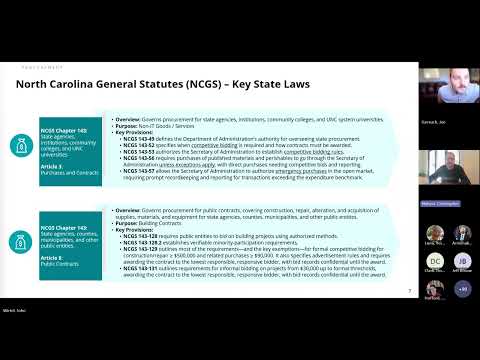
Presenters summarized the principal North Carolina authorities that govern state and local procurement: Article 3 of Chapter 143 (procurement of most non‑IT goods and services), Article 8 of Chapter 143 (public construction contracts), and the North Carolina Administrative Code provisions that implement Article 3 (1 NCAC 05, including Subchapter 05B). Chris noted that Subchapter 05B contains contract provisions, performance‑monitoring requirements and rules for contract renewals and competition waivers.
Several concrete thresholds and examples were described. Under federal 2 CFR 200, micropurchases are allowed up to $10,000; small purchases requiring informal quotes generally fall between $10,000 and $250,000; and formal competition is required for procurements above $250,000. For state construction rules under Article 8, formal bidding typically begins at $500,000, so entities must apply the more restrictive threshold that governs their situation. Joe illustrated procurement decision‑making with a hypothetical $600,000 technology procurement that would trigger a formal RFP process.
The presenters emphasized common compliance pitfalls and leading practices: document the procurement rationale and thresholds used; apply the most restrictive applicable rule (organizational, local, state or federal); maintain a central file for procurement records; check sam.gov and the state suspension/debarment list before awarding funds; and retain procurement records for five years (with one additional year possible for audit resolution).
Chris and Joe discussed permissible noncompetitive procurement under 2 CFR 200. Section 200.320(c) allows sole‑source awards only when justified in writing at the time of procurement and only if one of the limited conditions is met (for example, only one source is available or competition would cause unacceptable delay). They gave monitoring examples where failure to document a sole‑source justification resulted in a required repayment after oversight found other qualified vendors.
Contract terms and conditions highlighted for inclusion in agreements were: availability of funds and “not to exceed” amounts tied to the award; debarment and suspension clauses; payment terms that avoid unnecessary advanced payments; federal compliance provisions (for non‑revenue‑replacement projects); and protections for state data and personally identifiable information. Joe advised adding required federal terms into an appendix when a vendor contract lacks them.
The presenters closed by recommending concrete practices: maintain an up‑to‑date written procurement policy, establish clear procurement roles and contract oversight, track vendor performance, use state term contracts where appropriate, and train staff on procurement rules and thresholds. The session ended with a knowledge check and a question‑and‑answer period.
The presenters repeatedly urged attendees to consult procurement officers when in doubt and to document threshold decisions to improve audit readiness.