Get Full Government Meeting Transcripts, Videos, & Alerts Forever!
Get email alerts on the Office To Residential Conversions topic
No spam. Unsubscribe anytime.
PHED committee advances CB‑43 to allow residential conversions in CGO zones with grandfathering language to be finalized
Summary
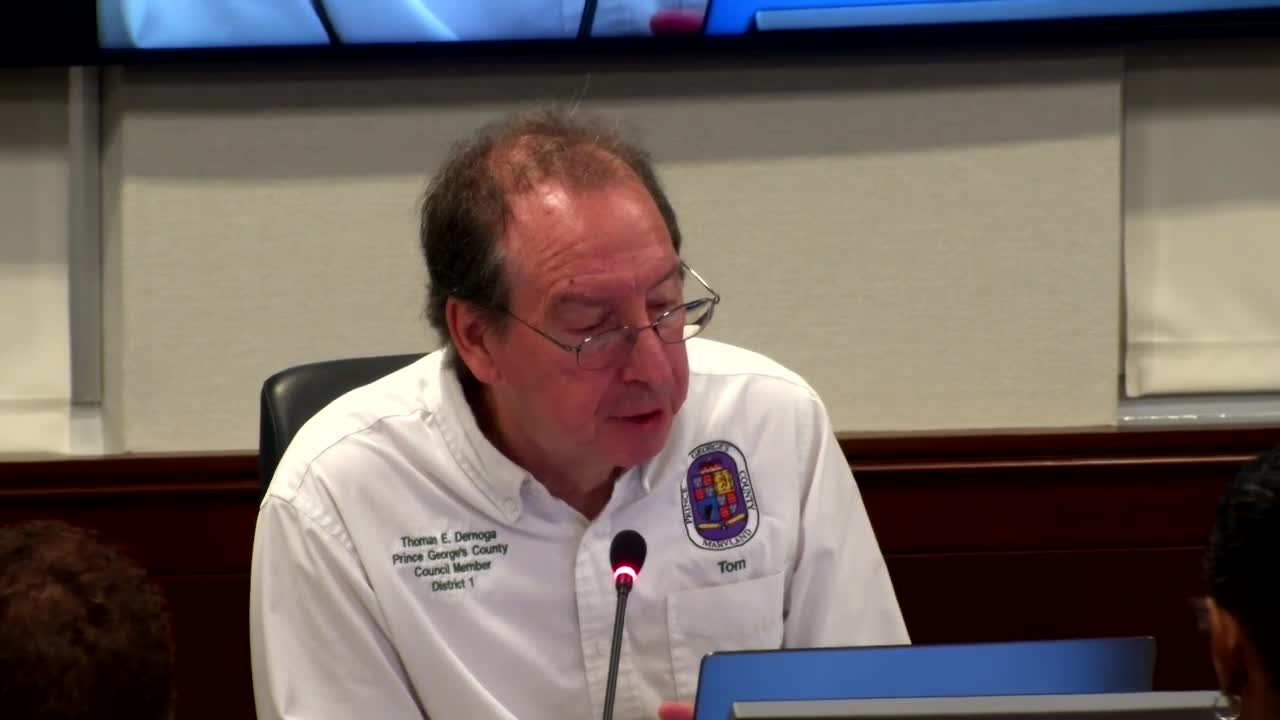
The PHED Committee voted 5–0 to advance CB 43 (2025), an ordinance addressing residential uses and conversions in the county's Commercial General Office (CGO) zone, and adopted amendments to protect applicants already far along in the approval process.
The Prince George’s County PHED Committee voted 5–0 to forward CB 43 (2025) to the full council with amendments intended to protect applicants who already submitted or were far along in approvals when last year’s zoning amendments were litigated.
Sponsor remarks and multiple public commenters framed CB 43 as a corrective measure to allow residential conversion of underused or obsolete office properties and to provide flexibility for redevelopment in CGO zones. The sponsor said the draft was amended to soften the earlier limits on residential development and to “provide relief for developers who want to convert an existing office building to a residential building.”
County legislative staff and the county executive’s legislative director discussed the need for careful drafting; the executive’s office suggested separating programmatic initiatives such as incentives or tax abatements from the ordinance. Planning staff also flagged concerns and urged attention to master‑plan consistency. The planning director’s office reiterated that CGO zones were intended to encourage mixed use and noted that technical issues in prior drafts required correction.
The committee adopted an amendment (Amendment 1) to the uncodified effective date that exempts projects proposing in a CGO zone that received detailed site plan approval under the current zoning ordinance prior to Nov. 30, 2025; members said they would continue to negotiate final effective‑date language to ensure projects that had started the approval process before litigation were not unfairly disadvantaged. Committee members also signaled interest in requiring minimum retail or mixed‑use components for certain office‑to‑residential conversions.
Several developers and property owners testified in support, saying conversions are necessary to rescue dead or dying office parks and to generate housing in areas where office vacancy has led to blight. Opponents and community speakers raised concerns about traffic, school impacts and the loss of commercial uses; one public commenter called the approach “red tape dressed up as democracy.”
Office of law advised that the committee’s grandfathering amendment mitigated certain legal risks. The committee’s favorable recommendation preserves the bill’s general direction while asking sponsor and staff to refine the effective‑date and mixed‑use language before introduction to the council.