Get Full Government Meeting Transcripts, Videos, & Alerts Forever!
Get email alerts on the Criminal Justice topic
No spam. Unsubscribe anytime.
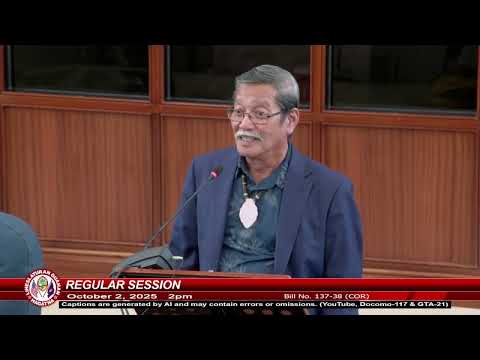
Guam Legislature advances bill to criminalize interference with reporting sexual assaults
Summary
The Legislature moved Bill 1-37(38COR) to third reading after legislators debated adding definitions for assisting or abetting. An amendment to define assisting or abetting failed; the main bill was advanced without that change.
Vice Speaker Tony Atta moved to place Bill 1‑37(38COR) on the third‑reading file, proposing to add subsections to Title 9 of the Guam Code Annotated to make it a crime to interfere with reporting criminal sexual‑conduct offenses. The measure models its language on existing family‑violence reporting laws and would create parallel offenses in the criminal sexual‑conduct and assault statutes.
The bill’s author, Vice Speaker Tony Atta, said the proposal “is constructed identically … to the laws that make interfering with reporting a family violence a criminal offense,” and cited national and local estimates that many sexual assaults go unreported. “We can’t have justice for victims of [sexual] crimes unless these … are reported,” he said.
Why it matters: proponents said the measure aims to reduce coercion and stigma that keep victims from reporting and to hold third parties who prevent reporting accountable. Senator Gumitata cited criminal‑justice data presented during debate, noting the Guam Police Department received hundreds of criminal sexual‑conduct reports in 2023–24 and arguing the bill would strengthen protections for vulnerable victims.
Amendment debate: Senator Sabina Perez proposed an amendment to add a statutory definition of “assisting or abetting” to the new provisions, requiring both intent and an act that facilitates the offense. Perez argued the definition would bring clarity and align the section with Supreme Court definitions and existing Guam Criminal Code provisions. Opponents, including the Vice Speaker and legal counsel during a short recess, said elements of complicity and aiding already exist in Title 9 (guilt by complicity, criminal facilitation) and objected to duplicative statutory definitions. After discussion and a brief recess for legal review, the body voted by raised hands and the Perez amendment failed.
Outcome and next steps: After closing remarks urging support, Vice Speaker Atta’s motion to place Bill 1‑37 into the third‑reading file carried without recorded objection. No final adoption or enactment vote was recorded in the transcript; the bill advances to the full reading/vote stage.
What remained unresolved: the body debated whether an express statutory definition would be useful for courts and law enforcement. The transcript records proponents saying the definition would add clarity at trial, while others said existing Title 9 provisions already cover complicity and facilitation.
Credits and context: Witnesses referenced national research (RAINN) and local reporting (KUAM) on underreporting of sexual assaults; the Judiciary and the Guam Criminal Law Review Commission were mentioned as stakeholders whose ongoing code modernization work overlaps with this proposal.