
Commission reaffirms Palo Alto's carbon‑neutral accounting and renewable‑credit exchange program, votes 4‑0
Get AI-powered insights, summaries, and transcripts
Sign Up Free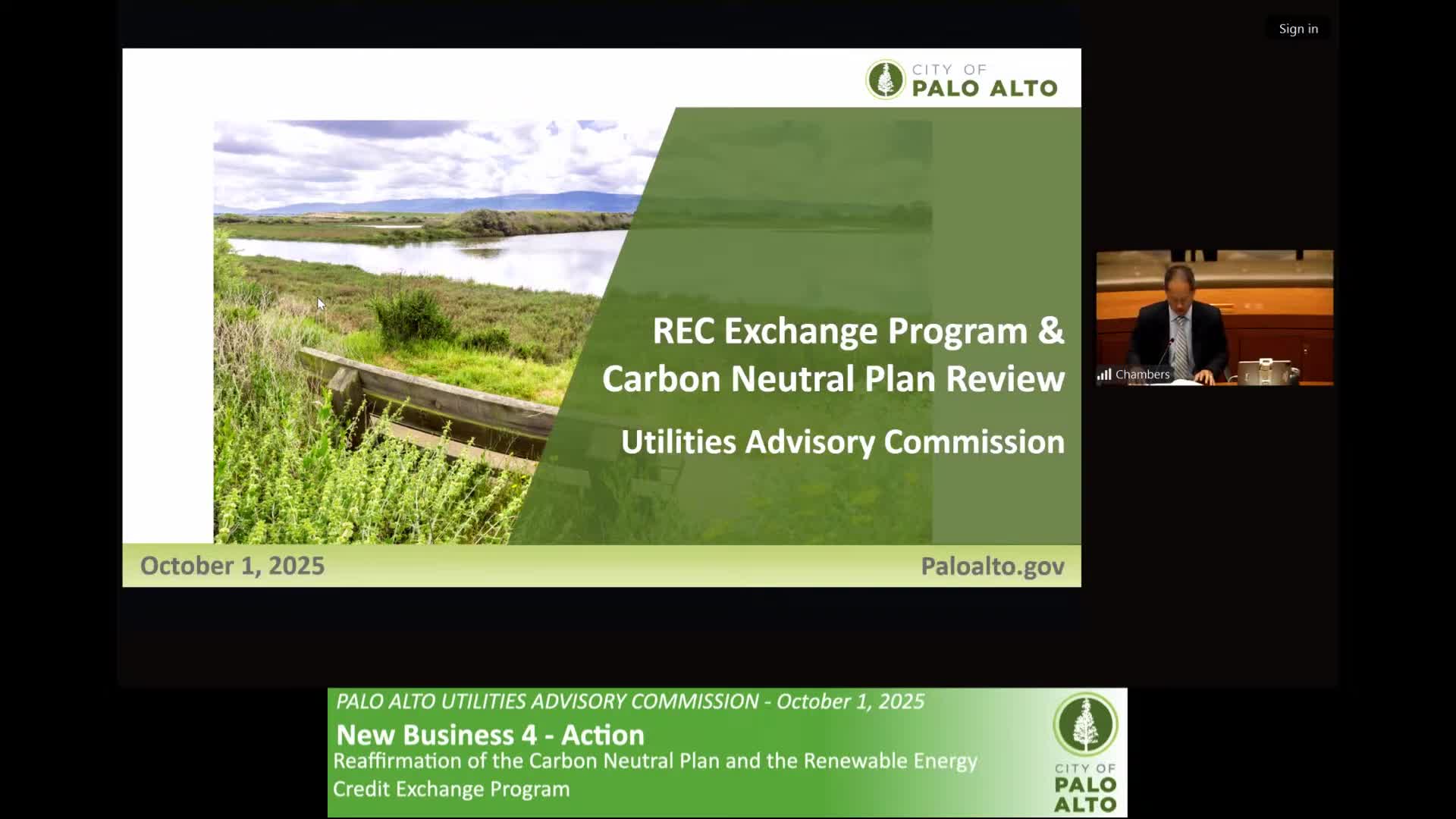
Summary
The Utilities Advisory Commission voted unanimously to continue the city's hourly carbon neutral accounting and the Renewable Energy Credit (REC) Exchange program; staff reported $28.5 million in net exchange revenue since 2019 and projected declining future revenue.
The Utilities Advisory Commission voted 4‑0 to reaffirm Palo Alto's carbon‑neutral plan and the Renewable Energy Credit (REC) Exchange program after staff reviewed six years of results and longer‑term projections.
Jim Stack, senior resource planner, told commissioners that the city shifted in 2020 from annual to hourly accounting for its carbon‑neutral plan to reflect the changing grid mix across the day. At the same time the council authorized a REC Exchange program that sells surplus in‑state renewables and replaces them 1‑for‑1 with out‑of‑state renewable energy credits (RECs) to meet the city's portfolio needs; the exchange produces net revenue when in‑state REC prices exceed out‑of‑state REC prices.
Stack said REC exchange net revenue totaled about $28.5 million over the six years reviewed, with large spikes in 2023–2024 driven by unusually high in‑state REC prices. Staff noted those large receipts exceeded expectations and the city's other carbon allowance revenues, and said they will return with recommendations for handling the atypically large balance. Stack projected roughly $2 million per year in exchange revenue over the next several years under current assumptions, declining as the city meets higher Renewable Portfolio Standard levels and as the utility portfolio changes.
Stack also explained a secondary impact: because California rules treat out‑of‑state RECs as ‘‘unspecified’’ power for the annual power content label, exchanges make the city's label look dirtier even when the underlying hourly accounting remains carbon neutral. For 2025 staff presented a comparison showing the portfolio's hourly carbon intensity without exchanges (about 45 lb CO2/MWh) and with the exchanges performed to date (about 159 lb CO2/MWh), noting the label impact is a function of state reporting rules.
No public speakers addressed the item. Commissioner remarks were supportive. A motion to continue the current carbon neutral plan and the REC Exchange program was made, seconded and approved in a roll call: Commissioner Tooker — yes; Vice Chair Mater — yes; Chair Scharf — yes; Commissioner Phillips — yes. The motion passed 4‑0.
Staff said they will return with follow‑up recommendations on how to manage and allocate unusually large REC exchange revenues and with continued reporting on REC prices, projected exchange revenue and any proposed allocations to local decarbonization funds.