Get Full Government Meeting Transcripts, Videos, & Alerts Forever!
Get email alerts on the Fire Service Funding topic
No spam. Unsubscribe anytime.
Lancaster County discussion centers on millage versus fee to fund fire services
Summary
County staff and commissioners discussed whether to fund fire services through a property millage or a per‑structure fee, noting legal limits, potential impacts on churches and homeowners, and gaps in developer‑escrowed funds for new stations.
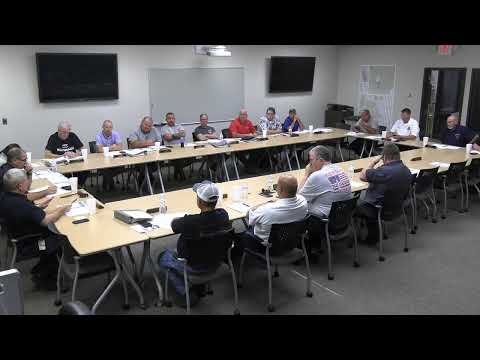
Staff member briefed the Lancaster County Fire Commission on funding options for the county's fire service, describing two main approaches under consideration: a property millage and a per‑structure fee. The discussion covered account rules for existing fire districts, how fees would be calculated for churches and large properties, legal constraints tied to state law and local ordinances, and shortfalls in developer‑escrow funds for planned stations.
The matter matters because it affects how much residents, businesses and nonprofits would pay for fire protection and whether the county can fund new stations and equipment. Staff said the county must choose between a millage, which grows automatically with property valuation, and a fee model, which would require ordinance changes each time the fee level or commercial multiplier is adjusted.
Staff member explained that the county's current budgets for fire operations are run from what they called “county ordinary” accounts and cited two specific budget lines (141 and 144) that roll back to the county fund balance at year end if unused. By contrast, money in Indian Land's account (referred to as a 940 account in the discussion) does not roll back into the county savings account if unspent: “If Indian Land does not spend the money that was allocated for their particular budget that year ... it stays in that account because that's what it was taken from the taxpayer to do,” the staff member said.
Commissioners and chiefs raised practical effects of the two funding approaches. Under the fee model staff outlined a formula using a 750‑square‑foot commercial multiplier and a base fee of $240; using that approach, large churches would face a significant annual charge. Staff observed that many local churches have large facilities but small memberships and could face “between $5 and $15 or $20,000” annually under the fee scenario, a level that could prompt organized opposition during any public outreach.
Supporters of a millage argued it is more equitable. A commissioner said, “the people that are poor pay the poor man's portion and the people that are rich pay the rich man's portion, and it's just so much more equitable to me.” Staff noted the millage approach includes an automatic growth mechanism tied to property valuations: as the tax base rises, a fixed millage yields more revenue without an explicit rate increase.
Participants also discussed capital funding and developer contributions. Staff said the county currently budgets roughly $6 million for local fire operations in accounts 141 and 144 and discussed an example—Riverchase—where developer escrow has accumulated about $2 million. Staff warned that $2 million is unlikely to cover the full cost of a new station and that some development agreements have timing requirements (for example, triggering an obligation to build within 12 months) that are difficult to meet in practice.
Legal and process constraints were flagged repeatedly. Staff referenced county ordinances, state law, “Act 3 88” and a possible link to “Title 4” as factors that could limit or delay options; the speaker emphasized uncertainty about precise legal impacts and said attorneys would need to clarify those points. Staff also warned that impact fees cannot be applied retroactively to developments covered by existing development agreements or a planned development district (PDD), and that the county's assessor has limited capacity to run large scenario models unless the commission firm‑up its preferred approach.
Chiefs at a prior meeting expressed a consensus favoring millage, though staff said that consensus was not unanimous. Staff advised that the fire commission should reach a unified recommendation before asking county council to act: “If service is not united, the council is not going to forward it there,” the staff member said. The county administrator, staff noted, has said he will not recommend a funding option himself but will take a commission recommendation to county council and advocate for it if the fire service presents a united front.
No formal motion or vote was recorded in the transcript. Staff said next steps would include identifying the budget target the commission wants to fund and asking the assessor to run tax‑impact scenarios once the commission provides a specific direction. The county council could choose to adopt rate changes directly or hold an advisory referendum, staff said, and staff cautioned that some legal mechanisms could shield past development from new fees.
For now, the discussion remains at the recommendation and data‑gathering stage; no ordinance or millage has been proposed in the transcript and no formal action was taken during the reported remarks.