Get Full Government Meeting Transcripts, Videos, & Alerts Forever!
Get email alerts on the Charter Review topic
No spam. Unsubscribe anytime.
Santa Clara charter review committee sworn in, elects Pat Nikolai chair and Joe Susinski vice chair
Summary
At its first meeting, the City of Santa Clara’s Charter Review Committee received legal and procedural orientation, was sworn in, and voted to appoint Pat Nikolai as chair and Joe Susinski as vice chair; staff outlined a work plan aiming for a draft charter amendment for council and possible voter consideration by November 2026.
The City of Santa Clara Charter Review Committee held its first meeting at City Hall on Sept. 16, 2025, where members were sworn in, briefed on legal and procedural rules, and elected Pat Nikolai as chair and Joe Susinski as vice chair.
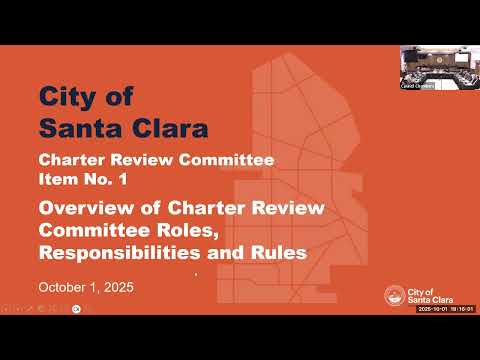
City Attorney Glenn Guggins led the orientation, explaining the committee’s charge: to work with city staff and the public to conduct a comprehensive review of the municipal charter and produce a draft comprehensive charter amendment for presentation to the City Council — and, if the council directs, to voters. "The charter is the equivalent of the city's constitution," Guggins told the committee during the presentation.
The 13-member committee — seven council-appointed representatives and six chosen by lottery — was created after the City Council directed formation of the body to correct, clarify and update charter provisions so they align with state law and current municipal practices. The city received 71 applications and certified 60 as qualifying for the selection process, Guggins said. Members’ terms run until the committee’s work is complete, projected for early July 2026 to allow any council action needed before the November 2026 ballot deadline.
The meeting included an in-depth review of Brown Act public‑meeting rules and the Public Records Act. Staff emphasized that committee deliberations must occur only at properly noticed public meetings and warned members to avoid serial communications — including certain social‑media interactions and cross‑communications that, when aggregated, could amount to a prohibited majority meeting. Guggins noted the Brown Act is codified at Government Code sections 54950–54963 and advised members to contact the city attorney’s office with questions.
The Public Records Act and record retention were also covered. Staff explained that communications about committee business on private devices can be public records and may need to be searched and produced in response to a records request; members were advised to consult staff promptly if a records request is received. Staff recommended simple organization steps such as creating a dedicated email folder to ease retention and search obligations.
Members reviewed the committee bylaws and meeting protocols adopted by the council as Policy 055, which define duties including appointing a chair and vice chair, scheduling meetings and forming ad hoc subcommittees. The bylaws set a quorum at seven members and require seven affirmative votes to forward significant recommendations to the City Council. Staff described the intended use of ad hoc subcommittees — limited, topic‑specific working groups of fewer than a quorum to dig into charter subsections with department staff — and warned that subcommittees must avoid communications that would create a serial‑meeting risk.
During nominations and a roll‑call vote, the committee appointed former Police Chief Pat Nikolai as chair (8 votes) and Joseph "Joe" Susinski as vice chair (9 votes). Nikolai accepted the chairmanship, saying, "I'm happy to accept." The committee also reached consensus to hold its next meeting on Wednesday, Oct. 22, 2025, and staff will return with a proposed regular meeting schedule (staff had initially proposed third Thursdays monthly but members noted recurring conflicts).
Guggins and staff previewed the planned work plan: divide the charter into subject sections, assign subcommittees to review sections with relevant departments (for example, elections and the city clerk on Article VI), and consolidate subcommittee recommendations into a single draft for committee review. Staff framed changes in levels — technical corrections/reorganization (Level 1), alignment with current best practices or state law (Level 2), and more politically sensitive items (Level 3) that might be held out for separate consideration or removed to avoid jeopardizing broader reforms. Staff cautioned the committee that packaging multiple changes into a single ballot measure can raise costs (staff estimated a comprehensive measure could cost on the order of several hundred thousand dollars to place on the ballot) and that the City Council will decide final packaging and whether anything goes to voters.
Other substantive examples discussed included possible charter updates to procurement thresholds and budget language to reflect the city’s current two‑year budget practice and the use of design‑build contracting, areas staff identified as likely candidates for Level 2 changes aimed at operational clarity and cost efficiencies.
The committee was told it will receive a binder of materials, draft work plan and an online project page with meeting materials; staff will coordinate subcommittee assignments and department presentations. With orientation complete and officers selected, the committee will begin substantive review and assignment of ad hoc subcommittees at upcoming meetings.
The meeting adjourned at approximately 8:37 p.m.