Get Full Government Meeting Transcripts, Videos, & Alerts Forever!
Get email alerts on the Grantmaking topic
No spam. Unsubscribe anytime.
Richmond to pilot competitive grantmaking partners, aims to shorten contract cycle and add oversight
Summary
City staff presented a plan to hire up to four external grantmaking partners to run competitive grant programs in four focus areas, aiming to reduce the current application-to-contract timeline and add technical capacity and audit safeguards.
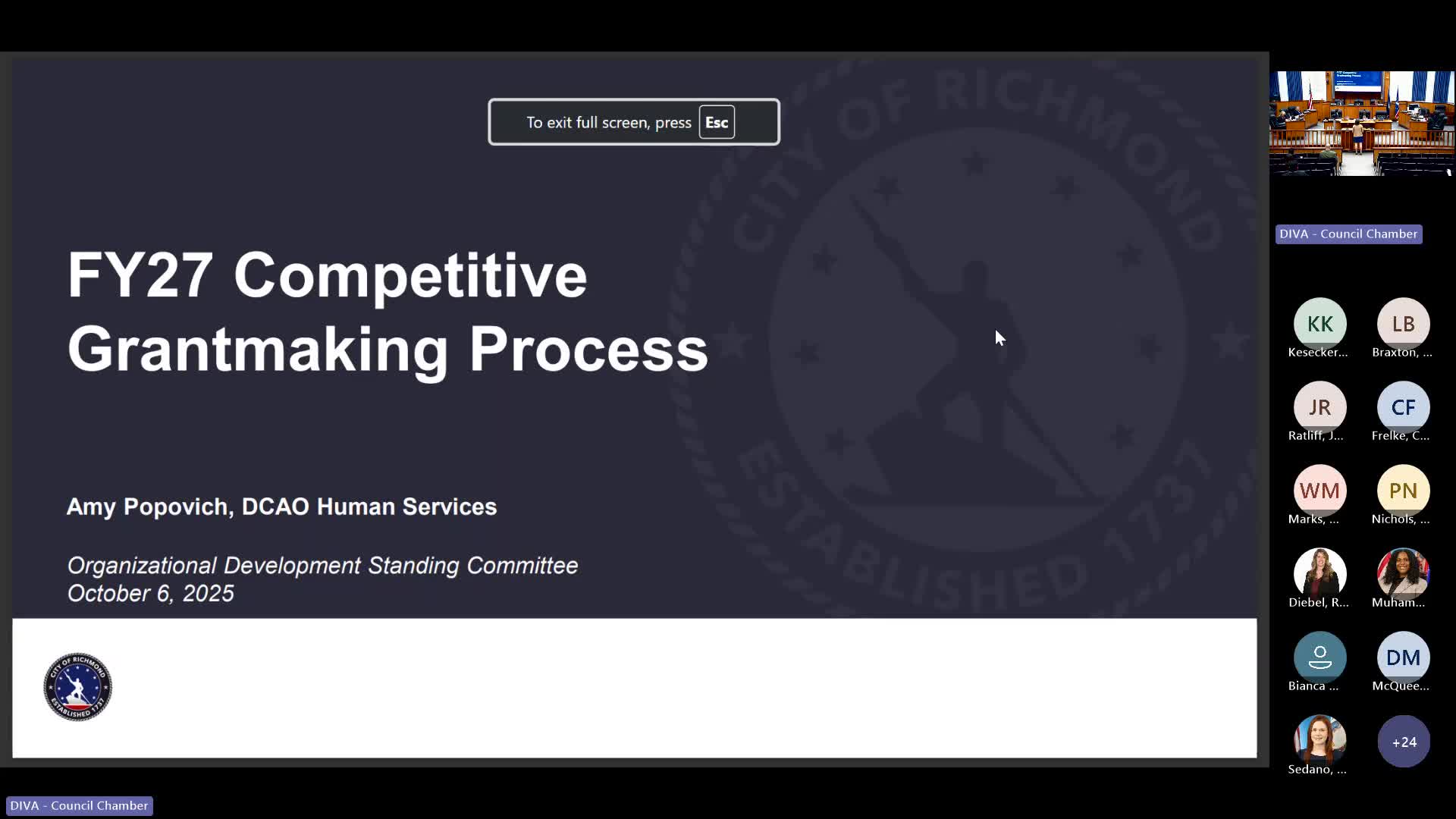
The Richmond City Council Organizational Development Standing Committee heard on Oct. 6 from Amy Popovich, deputy chief innovation officer for human services, about a proposed shift to a competitive grantmaking model that would engage external grantmaking partners to administer city-funded nonprofit contracts.
Popovich said the current internal process manages about 70 contracts across multiple departments and can take “a nearly eleventh month process from the time of the initial application to executing the contract and receiving those funds.” She said the city lacks a single full-time staff person dedicated to the grants function and that an external partner model would be more cost-effective than hiring the staff needed in-house.
The proposed framework would competitively select up to four subject-matter grantmaking organizations to administer awards in four focus areas — children and families, health, economic mobility, and arts and culture — while the mayor and Council would retain final budget authority. Popovich said the model would embed equity frameworks and technical assistance and would shorten the application-to-contract timeline from about 11 months to roughly three months (July–September) for the fiscal cycle.
Why it matters: Council members framed the proposal as a response to a February 2025 audit by the city auditor that identified weaknesses in the existing decentralized process, including uncertainty about the total charitable funds available early in the cycle and insufficient professional grantmaking capacity. Popovich told the committee the change is intended to deliver clearer expectations to grantees, stronger performance indicators, and audit-ready contracts.
Council questions and clarifications focused on conflicts of interest, consultant costs, administrative fees, and whether organizations that receive city grants could also be selected as grantmaking partners. Popovich said the city has hired a short-term consultant, Kelly Chopas, under a shared Council/administration contract for two months at $25,000 to help design the process. She said the city will run a competitive procurement (RFP) for grantmaking partners and plans to cap administrative fees for partners at about 10 percent.
Councilwoman Gibson asked how the new model would address audit findings that some past grantees did not meet funding criteria. Popovich said contracts with grantmaking partners will include the same subject-to-audit clauses used today, and she emphasized using subject-matter experts to apply consistent scoring criteria and reduce duplication of funding. Popovich said the city evaluated other models, including giving all funds to a single entity or creating a new city-run nonprofit, and chose the multi-partner option to maintain city strategic direction.
On conflicts of interest, Popovich told the committee that the procurement and contract language will include specific conflict-of-interest provisions and that any selected partner would not be eligible to award itself direct grants from the funds it administers. She described standard RFP safeguards and said the city will include clearer conflict language in the contracts to address overlap between philanthropic and political giving that Council members raised.
Council members asked about how budget allocations to the four focus areas will be determined. Popovich said the mayor will propose allocations in the annual budget and Council will have final approval through the normal budget process; staff will also consider prior-year spending and strategic priorities when setting initial allocations. She also said certain strategic programs and quasi‑governmental contracts (for example, Richmond Behavioral Health Authority, GRTC, Richmond Ambulance Authority) would remain city-managed and not included in the external partner process.
Popovich said the city’s grantmaking consultant estimated it would cost roughly $1,000,000 to fully staff the function internally and that a previous non-departmental audit recommended five additional FTEs to manage grants. The committee heard that the intent of external partners is to expand professional capacity at lower cost and to provide technical assistance and annual reporting on key indicators and outcomes.
The presentation closed with Popovich asking Council members for feedback to shape the final procurement and priority frameworks; she said the administration plans stakeholder meetings with current and past grantees and with community partners before issuing the RFP.
Ending: Council members expressed general support while pressing for specific conflict-of-interest language, clarity on allocation methodology and evaluation metrics, and assurance that historically underfunded organizations will not face new barriers. Popovich said the administration will continue outreach and return with additional details as the RFP and indicators are finalized.